

Photo adjustments
Proportionally resized and converted to WebP without cropping, retouching or changing the photographed subject.
Explore the region
About Famen Temple
Excavation below the pagoda in 1987 revealed a Tang-period underground chamber containing offerings and a relic venerated as a finger bone of the Buddha. The finds make the museum especially rewarding: metal tea utensils, glass and celadon show the materials used in elite Tang ritual life. Distinguishing the historic temple and excavated objects from the modern Namaste Dagoba makes the site’s different layers easier to understand.
One theory holds that the temple was founded in the late Eastern Han dynasty, during the reigns of Emperor Huan and Emperor Ling; the Buddha's relics are said to have been distributed worldwide by King Ashoka, and Famen Temple was built around a pagoda enshrining one such relic. It took its present name in the first year of the Tang Wude era (618). Emperor Zhongzong and Empress Wei buried their hair beneath the pagoda, unearthed in 1978. Tang emperors obtained Buddha relics here seven times, each donating generously toward the temple's expansion, and it grew to twenty-four courtyards.
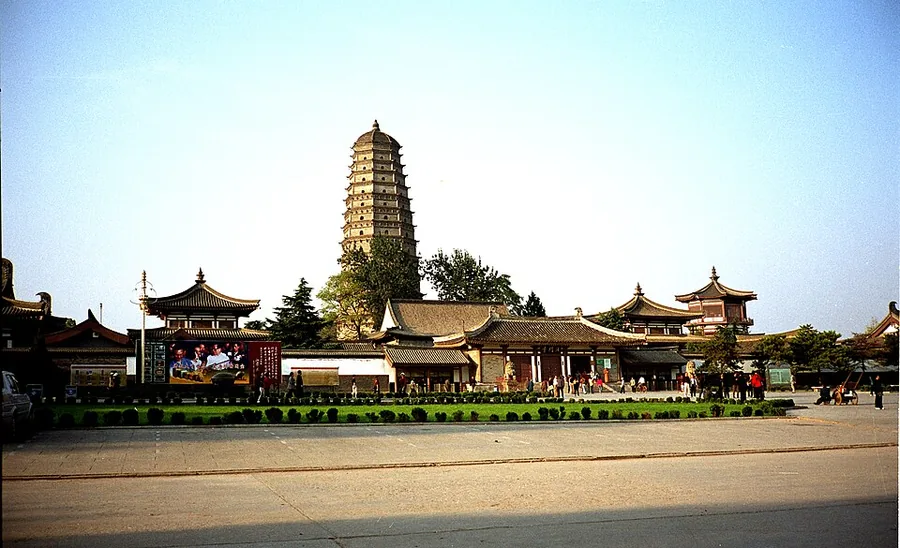
The temple keeps a layout of pagoda in front and hall behind, with the True Body Pagoda (真身宝塔) on its central axis, the mountain gate and front hall before it and the Great Hall (大雄宝殿) behind. The pagoda has been rebuilt several times, from a four-story pavilion-style tower in the Tang dynasty to a thirteen-story brick pagoda in the Ming; the present structure, on a reinforced-concrete frame faced with blue brick, follows survey drawings made of the Ming pagoda before its collapse. The underground chamber has been restored to its Tang-period state, built of white marble and limestone slabs with carved walls and doors.
What to look for
- The reconstructed thirteen-storey True Relic Pagoda and the historic temple axis.
- Tang offerings, including gilt-silver tea utensils and secret-colour celadon, in the museum displays.
- The modern Namaste Dagoba, whose scale contrasts with the older monastery.
Location & getting there
Getting to Famen Temple
Travel to Famen Town in Fufeng County, west of Xi’an, and use the Famen Temple visitor entrance.
- The older monastery, museum and modern complex occupy different parts of the site; check the current access arrangement before choosing the sequence.
Combine your visit
Suggested order within this visit:
-
Historic pagoda and monastery
Start with the site where the underground chamber was discovered.
-
Famen Temple Museum
Study the excavated Tang offerings.
-
Namaste Dagoba
Finish with the modern extension if included in your visit.
This sequence is an editorial suggestion based on the features described in the sources. Access to individual buildings or areas should be checked locally; no travel time or shared admission is implied.
Find Famen Temple
法门寺 · 宝鸡
The pin marks the area, not the entrance.
More places nearby
Approximate straight-line distances between map pins, not travel distances.
Zhouyuan 周原遗址
8 km awayZhouyuan preserves the archaeological landscape of the early Zhou homeland around Fufeng and Qishan. For a practical introduction, start at Baoji Zhouyuan Museum in Zhaochen Village. Its excavated bronzes show the ritual and…
View guide →Yangling Agricultural Museum 杨凌农林博览园
23 km awayThe agricultural museum complex at Northwest A&F University in Yangling combines natural-history collections with the history of farming. Its specialist museums cover insects, animals, soil, plants and agriculture, with further…
View guide →Qianling Mausoleum 乾陵
32 km awayQianling uses the natural mass of Mount Liang as the burial setting for Tang emperor Gaozong and Wu Zetian. Its main underground tomb remains sealed, while the above-ground approach preserves an exceptional sequence of stone…
View guide →Sources & visit information
The sources below support the place-specific description and arrival information. Suggested combinations are editorial planning ideas; confirm current opening, entry arrangements and transport services for your date.
- Wikipedia: Famen Temple ↗
- Wikivoyage: Baoji ↗
- Chinese Wikipedia: 法门寺 (revision 92682247, 2026-05-16) ↗
Visitor information adapted and edited from Wikipedia contributors · CC BY-SA 4.0. Source revision 1372551807.
Visitor information adapted and edited from Wikivoyage contributors · CC BY-SA 4.0. Source revision 5205128.
Background paragraphs translated and condensed from Wikipedia contributors, "法门寺", Chinese Wikipedia · CC BY-SA 4.0. Source revision 92682247.
Background paragraphs condensed from Wikipedia contributors, "Famen Temple", English Wikipedia · CC BY-SA 4.0. Source revision 1372551807.