

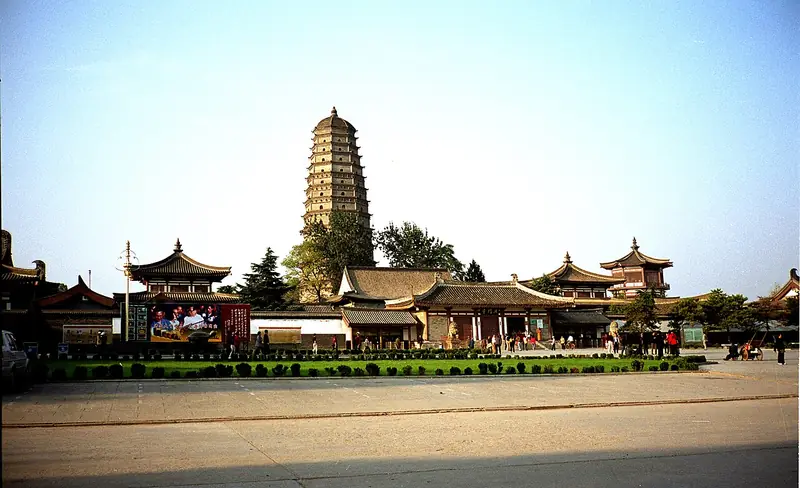
Explore the region
About Famen Temple Cultural Scenic Area
The crypt came to light after the brick pagoda fell on 24 August 1981, brought down by centuries of earthquakes and heavy rain, and the provincial government decided in 1986 to rebuild it; clearing the pagoda base, a provincial, municipal and county team found a Ming ring foundation, a Tang square rammed-earth base edged with bluestone, and at the centre the crypt's caisson cover of 873. The crypt is 21.12 m long and 31.48 sq m in area, in seven parts – stepped ramp, platform, tunnel, front chamber, middle chamber, rear chamber and a hidden niche behind the rear chamber – and Han Wei, who was deputy leader of the excavation, calls it the largest Tang dynasty crypt yet found in China. It was sealed on the fourth day of the first month of 874 and never opened again, so everything in it is of Tang date. The page's own partial count of the finds, other than the bone relics, is 121 gold and silver objects, 20 glass vessels, nearly 400 pearls and gems, 17 porcelain pieces, 12 stone objects, 19 lacquer, wood and miscellaneous objects, some iron objects, several tens of thousands of coins, and large quantities of silk and clothing. Two inscribed stelae came from the tunnel: the record of the Xiantong-era transfer of the true body, and the escorting commissioner's list of offerings, which the article calls the longest, most multi-owner and most varied surviving list of clothing in China.
Four finger-bone relics were found. The first lay in the rear chamber in an eight-fold casket presented by Emperor Yizong, wrapped in a red brocade bag, the outermost layer a pierced sandalwood case with gold and silver hinges carved with scenes of the Buddha preaching, the Amitabha paradise and veneration of the Buddha; inside it were seven more caskets, running from a gilt silver casket with the four heavenly kings to a four-door pure gold pagoda with a single eave and a jewelled finial, and the relic itself is white like jade, tube-shaped with a square cavity, 40.3 mm high and 16.2 g in weight. The second lay in the middle chamber in a white marble double-eaved spirit canopy 16 cm high, carved on its inner faces with eight bodhisattvas and, on its cover, with a vow inscription of the second year of Jinglong recording that the monk Fazang and others made the canopy so that the relic could enter the pagoda. The third lay hidden in the rear chamber's secret niche, inside nested iron, silver, sandalwood, crystal and jade containers. The fourth lay in the front chamber in a four-bodhisattva Ashoka pagoda containing a bronze pagoda. Zhao Puchu of the Buddhist Association of China and Zhou Shaoliang held that the third was the true relic and the other three shadow relics. The Famen Temple Museum, which the Baoji cultural relics bureau calls China's first specialised museum of Tang court treasures and Buddhist art, opened in 1988 and holds 9,439 objects, 138 of them first-class; the provincial public-institution registry gives its address as Famen town, Fufeng County, its founding unit as the Baoji Municipal Cultural Relics Bureau, and its staff as 63.
The city's culture and tourism bureau grades 法门文化景区 as 5A in its 2026 table and gives its address as Famen town, Fufeng County. Xinhua's county profile calls Fufeng the birthplace of Western Zhou culture and the seat of the Famen Temple, counts 453 protected heritage sites in the county, five of them national key units and thirteen provincial, and says the county's twelve attractions are organised around the Famen Culture Scenic Area as their core. Two discrepancies are worth recording rather than resolving. The museum's own honours list includes the phrase 5A级旅游景区, while the city table attaches that grade to the scenic area; and the museum's permanent display is named 宁静的辉煌——法门寺历史文化陈列 where the bureau describes it but 宁静的辉煌——法门寺文化文物陈列 in the museum's honours list on the same page.
What to look for
- The crypt, 21.12 m long and 31.48 sq m in area, in seven parts from the stepped ramp and platform through the tunnel to the front, middle and rear chambers and the hidden niche behind the rear chamber
- The eight-fold casket that held the first relic, from its carved sandalwood outer case through seven silver and gold caskets to a four-door gold pagoda with a jewelled finial
- The white marble double-eaved spirit canopy in the middle chamber, carved with eight bodhisattvas and bearing a vow inscription of the second year of Jinglong
- The four finger-bone relics the crypt held, which Zhao Puchu and Zhou Shaoliang held to be one true relic and three shadow relics
- The two inscribed stelae found in the tunnel, including the record of the 873-874 transfer of the true body
- The Famen Temple Museum at Famen town, which opened in 1988 and holds 9,439 objects, and its permanent display 宁静的辉煌——法门寺历史文化陈列
Location & getting there
Getting to Famen Temple Cultural Scenic Area
Check which interiors and courtyards are accessible. Active places of worship and protected monuments may have different visitor rules.
- Search for 法门文化景区 with 宝鸡市 and 扶风县.
Find Famen Temple Cultural Scenic Area
法门文化景区 · 扶风县
No reliable map pin yet: search by the Chinese name.
Sources & visit information
The linked sources support the identity and background described in this introduction. Opening hours, admission, activity availability and exact arrival arrangements have not been comprehensively checked. Confirm current visitor information with the venue; the original catalogue locality and editorial review flag are retained.
