

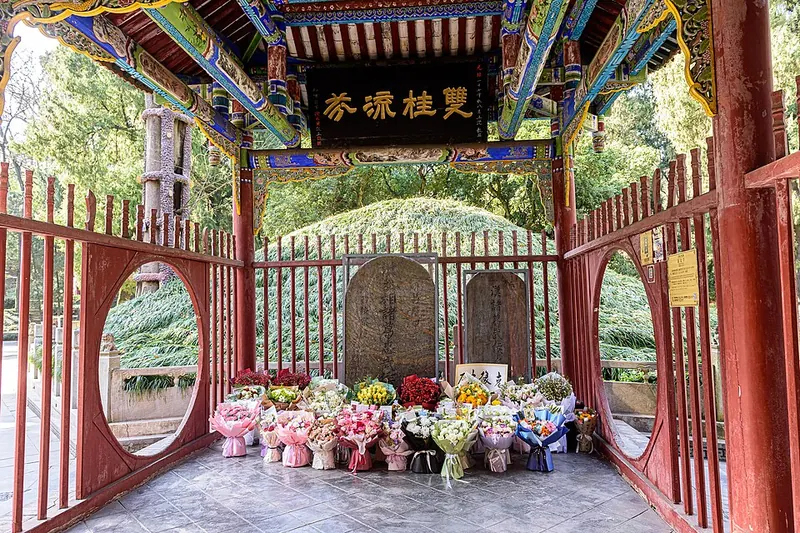
Photo adjustments
Full frame retained; proportionally resized and converted to WebP. No retouching or changes to the photographed subject. Card displays may crop the view.
Explore the region
About Wuhou Tomb
The visit follows a temple-like sequence of halls, inscriptions and the grave behind them. The main hall contains figures of Zhuge Liang with Guan Xing and Zhang Bao, while paintings and carved scenes retell Three Kingdoms episodes. Old trees and successive generations of memorial writing give the enclosure a quieter character than a reconstructed battlefield attraction.
Zhuge Liang (诸葛亮) died in 234 during his fifth northern campaign, falling ill from exhaustion at his military camp on the Wuzhang Plain (五丈原); the Shu Han court buried him below Dingjun Mountain according to his will. The tomb's name derives from his posthumous title, Marquis Zhongwu (忠武侯), by which he became known as Marquis Wuhou. Over the following centuries the complex was significantly repaired and expanded during the Yuan, Ming and Qing dynasties.
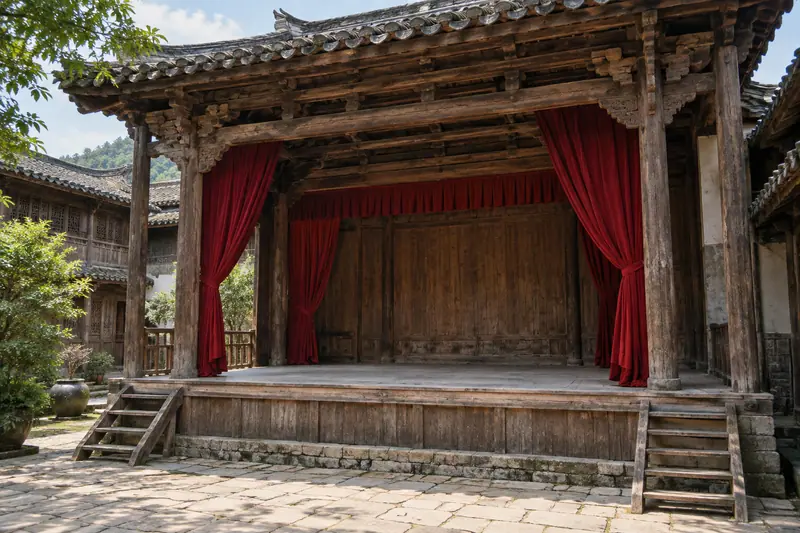
Among its buildings, the opera stage (乐楼) was built during the Ming Wanli era for performances held during Qingming festival rites for Zhuge Liang, and the mountain gate (山门) was rebuilt in the eighth year of the Qing Jiaqing era. The grave mound, behind the main hall, stands 6 meters high with a circumference of 60 meters and is enclosed by a white marble balustrade carved with 35 scenes depicting episodes from Zhuge Liang's life.
The site preserves 32 inscribed plaques and 15 couplets, along with steles erected over the centuries by visitors paying tribute. Each year during the Qingming festival, Wuhou Tomb holds a cultural tourism event that continues the traditional customs of grave-sweeping and mourning alongside other seasonal activities.
What to look for
- The main hall’s statues of Zhuge Liang, Guan Xing and Zhang Bao, with Three Kingdoms wall paintings.
- The grave behind the main hall and its carved stone enclosure.
- Memorial steles, plaques and mature trees throughout the tomb precinct.
The surrounding area
South of the Qinling, with rice-sheet breakfasts, Han history and plank-road interpretation.
Location & getting there
Getting to Wuhou Tomb
Go to Wuhou Tomb at the foot of Dingjun Mountain in Mian County, near Hanzhong.
- Specify 武侯墓 for transport: Wuhou Temple elsewhere in Mian County is a separate memorial site.
Combine your visit
Suggested order within this visit:
-
Entrance and main hall
Start with the statues and historical scenes.
-
Grave enclosure
Continue to the burial memorial behind the hall.
-
Inscription and tree-lined precinct
Read the later commemorative layers around the site.
This sequence is an editorial suggestion based on the features described in the sources. Access to individual buildings or areas should be checked locally; no travel time or shared admission is implied.
Find Wuhou Tomb
武侯墓 · 汉中
The pin marks the area, not the entrance.
Sources & visit information
The linked encyclopedia sources support background and place descriptions. Current opening hours, ticket prices, booking rules and transport schedules have not been independently verified for this guide. Confirm them with the venue or operator before travelling.
Visitor information adapted and edited from Wikipedia contributors · CC BY-SA 4.0. Source revision 92622231.
Background paragraphs translated and condensed from Wikipedia contributors, "武侯墓", Chinese Wikipedia · CC BY-SA 4.0. Source revision 92622231.