

Explore the region
About Yaotou Kiln Site
Pottery has been fired here for a long time, but the record is uneven. A China Daily report says the site's history is traced back to the Tang on the authority of a Ming county gazetteer's line that Chengcheng's porcelain clay began in the Tang, yet no confirmed Tang product has been found in the kiln area – only a small number of Yuan celadon and black-glazed pieces collected by villagers – leaving a gap between the Tang and the Ming. The same report records that the kilns flourished under the Ming and Qing, when local tradition held that the kiln yards at Yaotou numbered more than a hundred at their most numerous and that annual output reached more than 2.2 million pieces, sold through the counties north of the Wei and as far as Shanxi, Gansu, Inner Mongolia, northern Shaanxi and beyond, with black-glazed ware the most famous product.
What survives is a large complex of kilns, workshops and dwellings. The China Daily report counts 129 kiln sites of the Ming, Qing and Republican periods, 78 pottery workshops and 75 old dwellings. The People's Daily Shaanxi channel counts the same 129 kilns, 78 workshops and 75 dwellings, and adds 17 temples and ancestral halls and three layers of potsherd deposits, noting that the village entered the Chinese traditional villages list in 2013. The China Daily report describes the old kiln system as four traditional lines – bowl kilns, jar kilns, black-glazed kilns and sand kilns – producing mainly black-glazed ware alongside white, celadon, white-slip brown-patterned and blue-and-white pieces, among others, and mostly everyday vessels such as vats, basins, bowls, stoves and jars.
The firing technique is carried as a listed skill. The CRI Online report records that the Yaotou kiln firing technique entered the national intangible cultural heritage protection list in 2006. The China Daily and People's Daily Shaanxi reports both name Liu Zhongyang as an inheritor of the Chengcheng Yaotou ceramic firing technique and give the process 72 steps, from clay selection and kneading through throwing and glazing.
One CRI Online report, published earlier, counts only 'more than 30 relatively well-preserved old kilns' where the two more recent reports count 129 kilns in total; the pages do not reconcile the difference and the lower figure is not used here.
What to look for
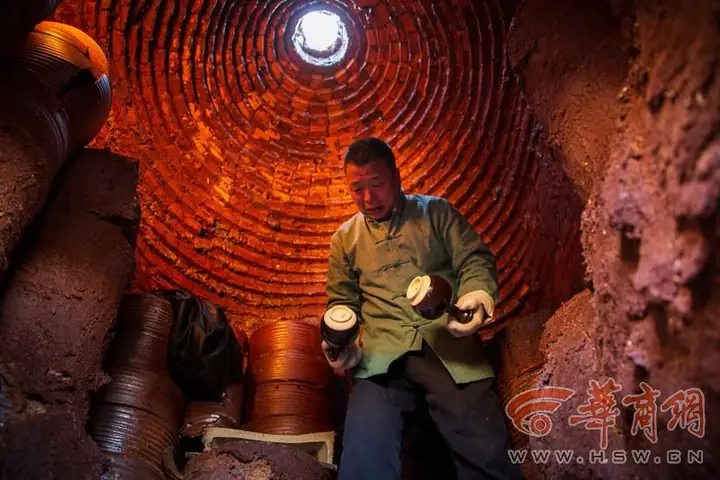
- The kiln interiors: the China Daily report describes firing marks on the kiln walls that a guide reads as landscape paintings and as a dragon-and-phoenix pattern.
- The 129 surviving kiln sites of the Ming, Qing and Republican periods that the China Daily and People's Daily Shaanxi reports both count.
- The 78 pottery workshops, including the well-preserved working workshop the China Daily report describes.
- The 17 temples and ancestral halls and the three potsherd-deposit layers counted by the People's Daily Shaanxi channel.
- The village fabric the People's Daily Shaanxi channel describes – brick-vaulted cave dwellings built against the cliff and stacked saggar walls.
Location & getting there
Getting to Yaotou Kiln Site
Check which interiors and courtyards are accessible. Active places of worship and protected monuments may have different visitor rules.
- Search for 尧头窑 with 渭南市 and 澄城县.
Find Yaotou Kiln Site
尧头窑 · 澄城县
No reliable map pin yet: search by the Chinese name.
Sources & visit information
The linked sources support the identity and background described in this introduction. Opening hours, admission, activity availability and exact arrival arrangements have not been comprehensively checked. Confirm current visitor information with the venue; the original catalogue locality and editorial review flag are retained.
Image credits & notes (1)
- Yaotou Kiln Site · 尧头窑Photo: news.hsw.cnResized for the web; the photo itself has not been edited.