

Explore the region
Tap any red Chinese text to hear it in Mandarin.
Qufu is Confucius’s birthplace in Shandong. The temple was first built in 478 BC and rebuilt over many centuries; UNESCO describes the surviving complex as 104 buildings with more than 1,000 stelae. The property shows how imperial patronage turned a local memorial into a national ritual centre, while retaining the physical setting associated with the Kong family.
Read the three places as different kinds of evidence. The temple is an ordered ceremonial axis; the mansion connects official status with a hereditary household; the cemetery extends north into a large, wooded burial ground. Together they make Confucian history visible as architecture, archives, ritual memory and a living landscape rather than as a single monument.
What to see
Confucius Temple
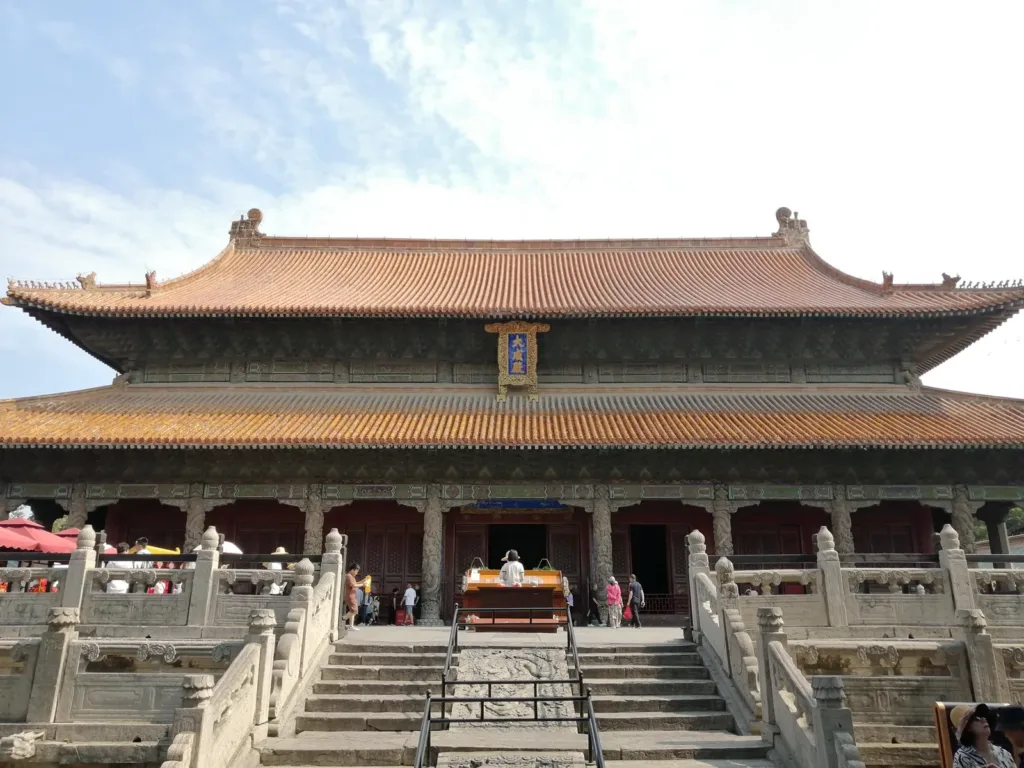
Begin with the temple’s south-side visitor destination, 孔庙南门 (Confucius Temple South Gate), and follow the north–south sequence rather than rushing straight to the main hall. The central route passes gateways, Kuiwen Pavilion, the Thirteen Stele Pavilions, Apricot Platform and Dacheng Hall. The sequence is part of the subject: courtyards, thresholds and axial order express the hierarchy of a state temple.
Look closely at Dacheng Hall’s stone columns and roof silhouette, then slow down at the stele courts. The temple holds inscriptions from different periods, and its buildings range from the Jin to Qing dynasties. UNESCO identifies Dacheng Hall, Kuiwen Pavilion and Xing Altar as key buildings; the National Cultural Heritage Administration also highlights Dacheng Hall and the temple’s architectural craft.
The temple is not simply an old hall dedicated to one teacher. Its layout became a model for Confucius temples across East and Southeast Asia, while the continued repair and imperial additions explain why the complex feels both local and state-scale.
Kong Family Mansion
The Kong Family Mansion adjoins the temple on its east side, but it is a separate place with a different story. It was the residence and office of Confucius’s direct descendants, whose hereditary title tied family life to official rank. The Ministry of Culture and Tourism describes it as both an official residence and a private household; that change of register is useful when reading its courtyards.
Notice the contrast between formal reception and administration near the front and the more domestic spaces farther in. The mansion’s collections and Ming–Qing archives preserve a long record of how a hereditary family managed status, ritual and everyday life. UNESCO notes that more than 60,000 Ming- and Qing-period files and archives are held there.
Cemetery of Confucius
The Cemetery of Confucius is a separate venue north of the town, not another courtyard of the temple. UNESCO places it about 1,100 metres north of Qufu and describes a 183-hectare burial ground containing Confucius’s tomb and more than 100,000 descendants’ graves.
Here the main experience is the long approach through trees and the scale of the cemetery, not a dense sequence of halls. Look for the spirit way, the old trees, the tomb precinct and the stele associated with Confucius. The National Cultural Heritage Administration specifically identifies Confucius’s tomb and the Shendao “Eternal Spring” memorial arch among the heritage features.
Planning the visit
Treat the Three Kong as one heritage property with three distinct visits. The temple and mansion are adjoining components in the old city; the cemetery is farther north and has its own visitor arrival. A single “Three Kong” label therefore does not mean one entrance, one building or one continuous interior route.
Current opening hours, admission products, timed entry and passport-holder arrangements can change by date or event. Confirm the current venue notice before setting out; the official heritage and transport pages consulted for this guide do not provide one complete, current visitor rule set. Do not assume that a domestic-ID booking notice establishes passport eligibility.
Getting there and getting back
The two railway names to keep separate are 曲阜东站 Qūfù Dōng Zhàn (Qufu East Railway Station, the high-speed gateway) and 曲阜站 (Qufu Railway Station). A 2026 operating table published by the Qufu transport authority lists the urban-rural K01 between the high-speed station and Qufu Station, with stops including 游客中心 (Visitor Centre) and 孔庙南门 Kǒngmiào Nánmén; it lists service at roughly 15–25-minute intervals. Use the Chinese destination 孔庙南门 Kǒngmiào Nánmén when travelling to the temple-and-mansion area, and check the direction on the day.
The same official table lists D09 between the high-speed station and the Qufu urban/railway corridor. Both K01 and D09 are shown as two-way services, so the practical return plan is to use the reverse service from the relevant stop after checking the day’s board or station information. Do not substitute the similarly named Qufu East and Qufu stations when reading a train ticket.
The newer B11 and J961 announcement is not a direct Three Kong shuttle: B11 links the Jining Visitor Distribution Centre with Qufu East, while J961 links Jining Daan Airport with the visitor-distribution hub near Taibai Lake. If you use either service to reach the Qufu area, you still need a separate onward connection to 孔庙南门 Kǒngmiào Nánmén.
The official transport table read here does not establish a dedicated cemetery shuttle or a current return timetable from 孔林 Kǒnglín. For the cemetery, show the Chinese destination 孔林 Kǒnglín to a taxi or ride-hailing driver and agree the return pickup point with the venue or driver before entering; do not describe K01 as a direct cemetery bus.
Find Temple and Cemetery of Confucius and Kong Family Mansion
孔庙孔府孔林 · 曲阜市
The pin marks the area, not the entrance.
Sources & visit information
Sources checked on 25 October 2026. Hours, tickets, reservations and transport can change; confirm with the operator before you go.
Image credits & notes (1)
- Dacheng Hall at Qufu Confucian Temple, Qufu. Photo: Yumeto (Wikimedia Commons user Yumeto)Photo: CC BY-SA 4.0