


Get to know Qufu
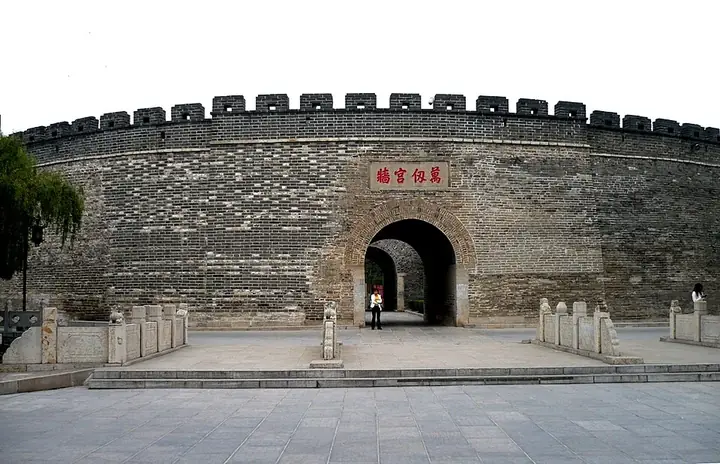
Photo adjustments
Full frame retained; resized proportionally to a maximum dimension of 960 pixels and converted to WebP quality 88. No crop, retouch, generated elements, or subject alteration. Final website rendition: full frame retained, proportionally resized to at most 720 pixels and converted to WebP. No additional retouching or subject alteration. Card displays may crop the view.
- Administrative area
- County-level city · 县级市
- Part of
- Jining
- Chinese name
- 曲阜市
- Local areas
- County-level city guide
Area & population
- Area in the source
- 815.00 km²
- Population · 2017
- 653,000
Source: cited geographic source, as of the dates shown.
Setting and landscape
More than a hundred hills line the eastern, northern and southern borders, with farmland in the centre and west; the highest point is Fenghuang Mountain (凤凰山) in the north at 548.1 m. The Si (泗河) and Yi (沂河) rivers cross the city from east to west, and the area belongs to the Nansi Lake (南四湖) system of the Huai basin.
History
From the start of the Zhou dynasty Qufu was the Lu capital for 873 years. The Sui made Qufu the county name. In 1511 rebels took the county town and stabled horses in the Temple of Confucius, so the court ordered a new town built around the temple and the Kong mansion; finished in 1522, it is the Qufu of today. Its walls were pulled down in 1977 apart from the main south gate, the north gate and some stretches. Qufu became a national historical and cultural city in 1982 and a county-level city in 1986.
The ruins of the Lu state capital (鲁国故城) lie under and around the north and east of the present town; they are a national protected site, and in 2021 they were named one of China's hundred major archaeological discoveries of the past century.
What to see
The Temple of Confucius (孔庙), the Kong Family Mansion (孔府) and, north of them, the Cemetery of Confucius (孔林), with about 100,000 Kong family graves, form the Three Confucian Sites (三孔), on UNESCO's World Heritage List since 1994. The Yan Temple (颜庙) honours Confucius's disciple Yan Hui (颜回).
The Confucius Museum (孔子博物馆), 4 km south of the Temple of Confucius, opened on 6 September 2019 with about 700,000 objects, including 300,000 Kong mansion archives and more than 8,000 Ming and Qing garments. Mount Ni (尼山), about 30 km south-east of the city, is given as Confucius's birthplace; its Temple of Confucius and Nishan Academy (尼山书院) became national protected sites in 2006.
The Shandong civil affairs department groups Nishan Shengjing (尼山圣境), the Confucius Museum and the Confucius Research Institute (孔子研究院) as Qufu's "new Three Confucian Sites".
Food and local products
Kong mansion cuisine (孔府菜), the cooking of the Confucius family household, is known for a wide range of ingredients, fine knife work, careful seasoning and attention to serving vessels. Its cooking techniques were added to the national intangible-heritage list in 2011, and the Shandong civil affairs department credits it with shaping Shandong cuisine (鲁菜).
Highlights
- Temple of Confucius, Kong Family Mansion and Cemetery of Confucius 孔庙孔府孔林: The Three Confucian Sites, on the World Heritage List since 1994.
- Confucius Museum 孔子博物馆: Opened in 2019 with about 700,000 objects, including the Kong mansion archives.
- Mount Ni 尼山: Birthplace of Confucius about 30 km south-east of the city, with a temple and academy.
- Yan Temple 颜庙: Temple to Confucius's disciple Yan Hui.
- Kong Mansion Cuisine 孔府菜: Cooking of the Confucius household; national intangible heritage since 2011.
Sources for this guide
曲阜市 - 维基百科,自由的百科全书 · Wikipedia (Chinese) · CC BY-SA 4.0
孔子博物馆 - 维基百科,自由的百科全书 · Wikipedia (Chinese) · CC BY-SA 4.0
尼山 - 维基百科,自由的百科全书 · Wikipedia (Chinese) · CC BY-SA 4.0
山东省民政厅 地名论坛 曲阜:文脉千年 斯文在兹 · Shandong Provincial Department of Civil Affairs
Original English written from the listed sources and checked sentence by sentence against quoted extracts by a separate reviewer. Updated 2026-09-25.
Explore Qufu
Core places to explore, with English and Chinese names.
Places to explore around Qufu
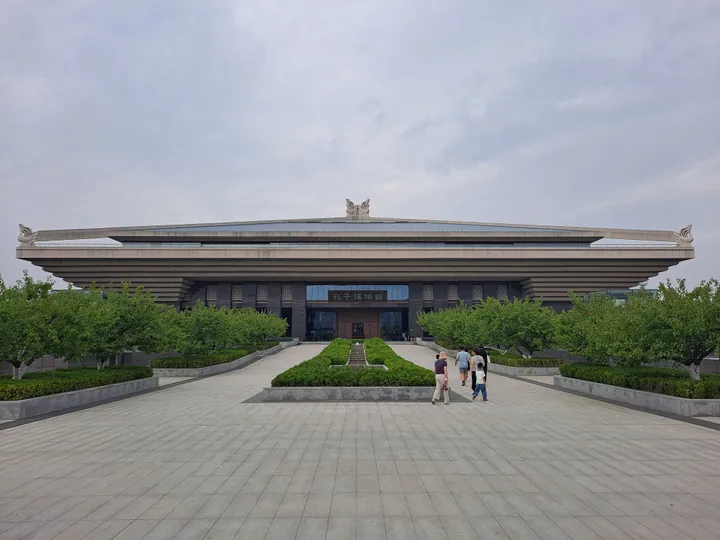 The exterior of the Kong Zi Bo Wu Guan (Confucius Museum) in Qufu, Jining · 济宁市曲阜市孔子博物馆外景 Source-recorded photograph date: 2026-06-21 08:45:52.
Confucius Museum孔子博物馆
Qufu museum opened in 2019, holding some 700,000 objects drawn mainly from the Kong family mansion, with a permanent exhibition on Confucius.
Read the place guide →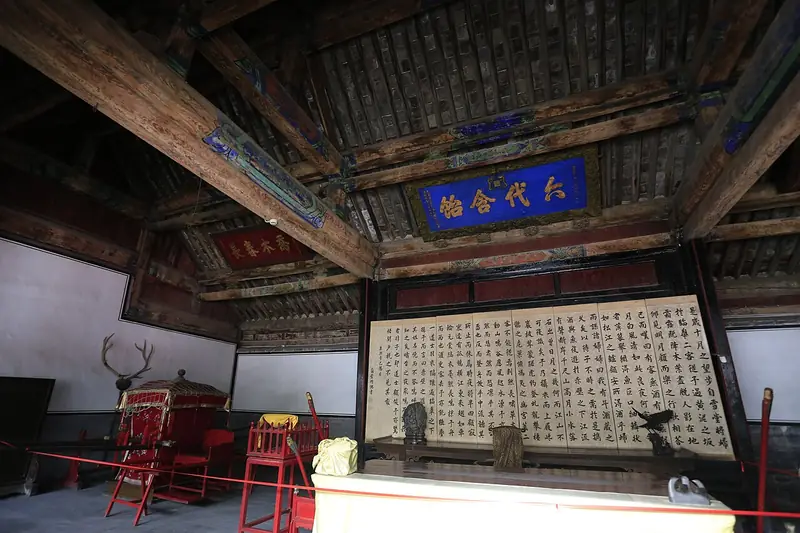 Temple and Cemetery of Confucius and Kong Family Mansion (孔庙孔府孔林), Qufu. Photograph: "Qufu Kong Fu 2015.08.15 15-31-07".
Temple and Cemetery of Confucius and Kong Family Mansion孔庙孔府孔林
The Temple, Mansion and Cemetery of Confucius (孔庙孔府孔林), known in Chinese as the 'Three Kong', stand in Qufu, Shandong, the philosopher's home town. They are a single World Heritage property: a state temple to Confucius, the hereditary residence of his senior descendants, and the family burial ground.
Read the place guide →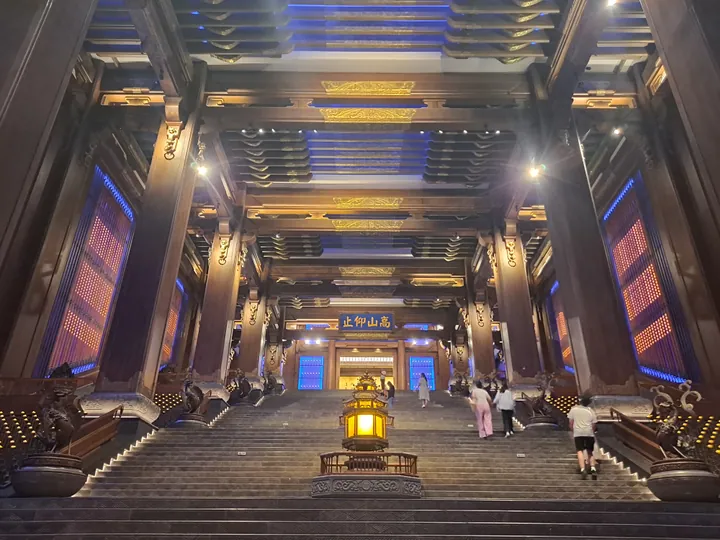 The grand staircase and hall interior of Daxue Hall at Nishan Shengjing, Qufu · 曲阜尼山圣境大学堂大殿内部及台阶 Source-recorded photograph date: 2026-06-21 13:24:47.
Nishan Sacred Land尼山圣境
Nishan Shengjing (尼山圣境) is a purpose-built Confucian cultural resort about 25 kilometres southeast of Qufu, Shandong, inside the provincial-level Nishan cultural tourism resort area. Nishan is the hill traditionally associated with Confucius's birth; the complex here was constructed between 2012 and 2018 and is not one of the historic Three Kong monuments.
Read the place guide →Plan your visit
Getting there
Qufu is about 40 km in a straight line from central Jining. Search for 曲阜市 in a map app to find stations and your accommodation.
Where to stay →Build your route
Confucius Museum and Temple and Cemetery of Confucius and Kong Family Mansion are both listed here. The linked place guides have entrance and visit details.
Continue with Jining →More in Jining
Sources & geographic information
Administrative names and parent areas: Official geographic directory · Reference date 2026-09-06.
Some facts checked against 曲阜市 — Wikipedia contributors, CC BY-SA 4.0.
Some facts checked against 孔子博物馆 — Wikipedia contributors, CC BY-SA 4.0.
Some facts checked against 尼山 — Wikipedia contributors, CC BY-SA 4.0.
Photo: Confucius Museum · 호고호 · CC0. Full frame retained; proportionally resized and converted to WebP. No retouching or changes to the photographed subject. Card displays may crop the view.

Photo: Temple and Cemetery of Confucius and Kong Family Mansion · Zhangzhugang · CC BY-SA 4.0. Full frame retained; EXIF orientation normalized, proportionally resized to at most 800 pixels and converted to WebP. No generated pixels or subject changes. Cards may crop the display.

Photo: Nishan Sacred Land · 호고호 · CC0. Full frame retained; proportionally resized and converted to WebP. No retouching or changes to the photographed subject. Card displays may crop the view.

Map data © OpenStreetMap contributors. Pins mark approximate centres, not entrances or boundaries.