

Photo adjustments
Full frame retained; proportionally resized and converted to WebP. No retouching or changes to the photographed subject. Card displays may crop the view.
Explore the region
About Guangyue Tower
Founded in the early Ming period, it originally served watch and defence functions.
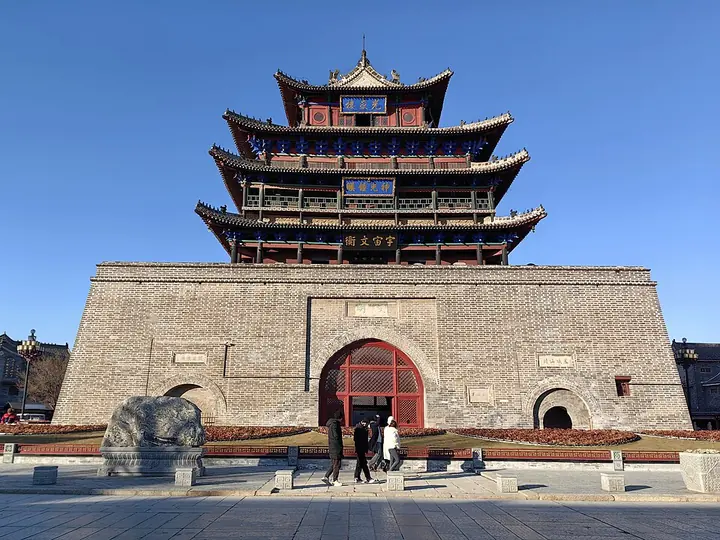
The timber pavilion has four tiers of eaves over a substantial base. Inscriptions and imperial visits add another historical layer to its architectural importance.
The tower is also known as Yumu Lou (余木楼), the Drum Tower (鼓楼) and Dongchang Lou (东昌楼). It rose from timber left over when Chen Yong (陈镛) rebuilt Dongchang's earthen city wall in brick in 1372; the earliest record, the 1777 Dongchang Prefecture Gazetteer, dated its construction to 1374. In 1496 it was renamed Guangyue Lou, the name still used today. It was repaired repeatedly through the Ming and Qing periods and six more times between 1956 and 1985, and was listed as a Major Historical and Cultural Site Protected at the National Level (全国重点文物保护单位) in 1988.
The tower stands 33.38 meters tall, on a tapered platform 9.38 meters high measuring 34.43 meters along the bottom edge and 31.93 meters at the top, covering 1236 square meters. Arched gates on its four sides are named Taiping (太平) on the east, Wenming (文明) on the south, Xingli (兴礼) on the west and Wuding (武定) on the north; the west gate is false, and only the eastern Taiping gate leads upstairs. The all-timber main tower rises 24 meters over four storeys, with 122 steps, 192 support pillars (金柱) and more than 200 sets of brackets. A statue of Lu Ban (鲁班) stands on the first floor, and a two-meter colored statue of the Qianlong Emperor on the second.
What to look for
- Four tiers of eaves define the timber pavilion.
- The building’s watchtower origins and later inscriptions show its changing civic and ceremonial roles.
Location & getting there
Getting to Guangyue Tower
Approach the centre of Liaocheng’s historic Dongchang city, where the tower anchors the old urban plan.
- Confirm the visitor entrance and access to the named areas before departure.
Combine your visit
A suggested sequence through the named features described in the source.
-
Tower base and exterior
Read the substantial base and four tiers of eaves from outside.
-
Inscription and architectural details
Connect the carved details and inscriptions with the tower’s later civic role.
The order is an editorial suggestion. Internal opening arrangements and transfers between sectors need checking; no walking duration or access entitlement is implied.

Find Guangyue Tower
光岳楼 · 聊城市
The pin marks the area, not the entrance.
More places nearby
Approximate straight-line distances between map pins, not travel distances.
Dongchang Lake 东昌湖
2 km awayDongchang Lake surrounds the historic core of Liaocheng. It developed from the moat dug during city construction in the Northern Song period.
View guide →Lingyan Temple 济南灵岩寺
90 km awayLingyan Temple lies in the hills of Changqing, where a major Buddhist complex survives around halls, a pagoda and a burial stupa forest. The Thousand Buddha Hall is especially known for its painted arhat figures, whose varied…
View guide →Baotu Spring 趵突泉
96 km awayBaotu Spring rises through three outlets in a rectangular pool framed by historic halls and pavilions. Guanlan Pavilion stands to the west and Laihe Bridge to the east, giving the water a carefully composed architectural…
View guide →Sources & visit information
The linked encyclopedia sources support background and place descriptions. Current opening hours, ticket prices, booking rules and transport schedules have not been independently verified for this guide. Confirm them with the venue or operator before travelling.
Visitor information adapted and edited from Wikipedia contributors, “光岳楼” · CC BY-SA 4.0. Source revision 84930092.
Background paragraphs translated and condensed from Wikipedia contributors, "光岳楼", Chinese Wikipedia · CC BY-SA 4.0. Source revision 84930092.