

Photo adjustments
Wikimedia thumbnail; fitted to the ranking-card frame.
Explore the region
About Mount Lao
The Taiqing sector is a useful introduction: a coastal boardwalk leads toward Taiqing Palace, whose courtyards contain halls dedicated to different divine figures. Higher routes reach Shangqing Palace and Longtan Waterfall. These are distinct levels of the mountain visit, so a temple-and-coast outing can stand on its own without attempting a summit or crossing between distant scenic sectors.
Formerly written Laoshan (劳山) or Laoshan (牢山), Mount Lao is regarded as one of the birthplaces of Taoism and as the place where the Complete Perfection School (全真教) of Taoism developed. In 412 CE the Buddhist pilgrim Faxian landed near the mountain on his way back from India.
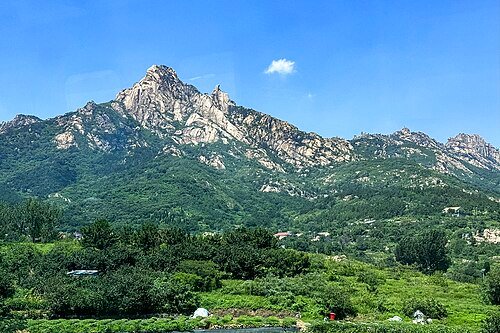
Mount Lao consists of granite, its landforms shaped by glacial action during the Quaternary and by erosion from meltwater released by the ice sheet that covered much of Shandong in the late Pleistocene. Its main peak, Jufeng (巨峰), also known as Laoding (崂顶), rises 1132.7 meters and is the third-highest peak in Shandong province.
Mount Lao was named one of China's scenic areas by the State Council in 1982. Taiqing Palace (太清宫), the mountain's largest temple complex, was first built in the Northern Song dynasty, with its present structures dating to the Wanli era of the Ming dynasty; also known as the Lower Temple (下宫), it was recognized as a National Key Taoist Temple (道教全国重点宫观) in 1983. The mountain hosts both Buddhist and Taoist traditions, with Taoism predominant.
What to look for
- Granite mountain slopes rising directly above the Yellow Sea coast.
- Taiqing Palace’s Sanguan, Sanqing and Sanhuang halls within the Taoist temple complex.
The surrounding area
Coastal city base; Badaguan and the wider Laoshan area are separate outings.
Location & getting there
Getting to Mount Lao
For the Taiqing sector, take Metro Line 4 to Dahedong and continue to the adjacent Laoshan Dahedong Visitor Centre. Transfer there to a Taiqing scenic bus and use Taiqing Square for the coastal boardwalk approach to the palace.
Combine your visit
A suggested sequence linking the specific features of this visit.
-
Taiqing coastal boardwalk
See the mountain and sea together on the approach to the temple.
-
Sanguan and Sanqing halls
Compare two of Taiqing Palace’s principal devotional courtyards.
-
Sanhuang Hall
Complete the palace sequence with the hall dedicated to the Three Sovereigns.
This order is editorial. Confirm access and any transfers between stops; it does not establish a walking route, same-day connection or common admission ticket.

Find Mount Lao
崂山 · 青岛市
The pin marks the area, not the entrance.
More places nearby
Approximate straight-line distances between map pins, not travel distances.
Qingdao International Sailing Centre 青岛奥林匹克帆船中心
24 km awayQingdao’s Olympic Sailing Centre occupies a former shipyard site on Fushan Bay. Built for the 2008 Olympic and Paralympic sailing events, it combines sheltered marina water, quays and long breakwaters. Lovers Dam extends toward…
View guide →May Fourth Square 五四广场
24 km awayMay Fourth Square opens the modern city onto Fushan Bay. Its red May Wind sculpture forms a large spiral near the water, while lawns and paved spaces connect the shoreline with the civic district inland. The name recalls the May…
View guide →Qingdao Beer Museum 青岛啤酒博物馆
26 km awayQingdao Beer Museum stands on Dengzhou Road in Shibei district. It reuses early buildings of the Tsingtao brewery.
View guide →Sources & visit information
The sources below support the place-specific description and arrival information. Suggested combinations are editorial planning ideas; confirm current opening, entry arrangements and transport services for your date.
- Mount Lao ↗
- www.qdlaoshan.cn ↗
- www.qdlaoshan.cn ↗
- Chinese Wikipedia: 崂山 (revision 91264027, 2026-01-26) ↗
- English Wikipedia: Mount Lao (revision 1374055402, 2026-09-09) ↗
Visitor information adapted and edited from Wikipedia contributors, “Mount Lao” · CC BY-SA 4.0. Source revision 1369573774.
Background paragraphs translated and condensed from Wikipedia contributors, "崂山", Chinese Wikipedia · CC BY-SA 4.0. Source revision 91264027.
Background paragraphs condensed from Wikipedia contributors, "Mount Lao", English Wikipedia · CC BY-SA 4.0. Source revision 1374055402.