

Explore the region
Tap any red Chinese text to hear it in Mandarin.
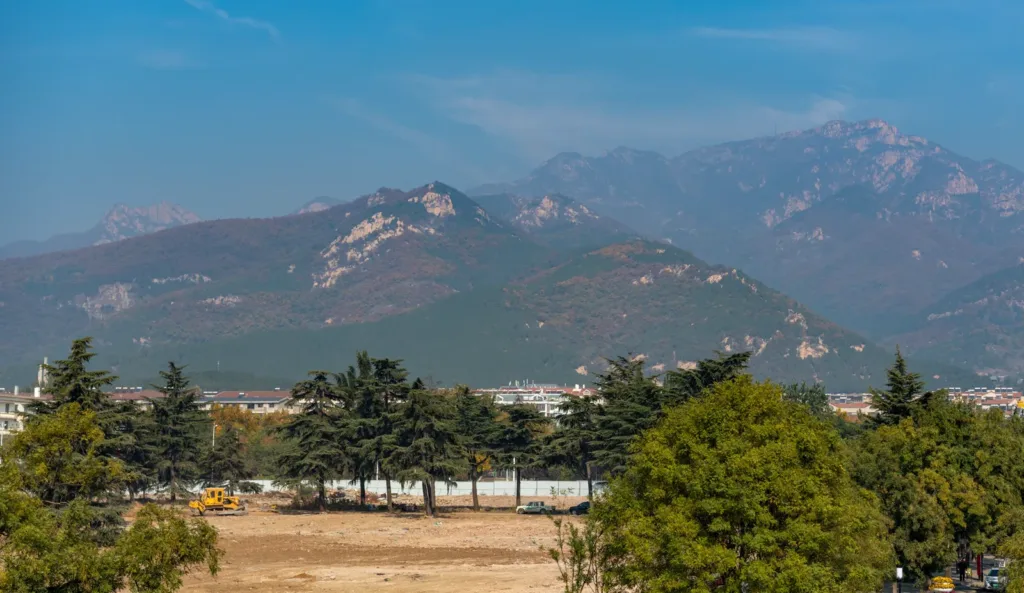
Tai’an is easiest to recognise as a city built against a sacred mountain rather than simply a base for a hike. Mount Tai was an imperial object of worship for nearly 2,000 years, and UNESCO describes its temples, inscriptions and natural setting as a single cultural landscape. The mountain’s main summit is in Tai’an, although the World Heritage property extends across Tai’an and Jinan.
The clearest first encounter is the relationship between Dai Temple (岱庙) and the mountain above it. Dai Temple stands south of Mount Tai in the urban core; its main hall, Tiankuang Palace (天贶殿), belongs to the ritual and architectural world of the mountain. The ascent then changes scale: gateways, stone steps, shrines and cliff inscriptions lead towards Nantian Gate (南天门), Bixia Temple (碧霞祠) and Jade Emperor Peak (玉皇顶). Treat the temple and the mountain as two visits linked by history, not as one compact site.
Local food keeps that mountain-foot identity close to everyday life. Taishan jianbing (泰山煎饼) is made from grains such as millet and corn, with a fermentation step before the batter is spread into a very thin, slightly sour pancake. Fanzhen huoshao (范镇火烧), associated with Fanzhen in Daiyue District, is a layered baked flatbread whose traditional account describes handwork from old dough and flour preparation through shaping and baking. These are regional foods rather than a promise of one particular shop: the local account of Fanzhen huoshao itself notes that not every stall using the name follows the same process.
The wider Tai’an area
The name Tai’an covers more than the streets beneath Mount Tai. The prefecture-level city includes Taishan District and Daiyue District, Ningyang and Dongping counties, and the county-level cities of Xintai and Feicheng. That makes the mountain-and-temple core only one part of the destination.
Beyond the foothills, the Dawen River runs east to west through the Tai’an area and supports farmland, fisheries, irrigation and flood control before reaching Dongping Lake. The lake and western county landscape are not walkable extensions of the old city; plan them as separate rural and waterside outings.
Plan the mountain and city visits
Choose the mountain entrance before arranging the final transfer. The official tourism guide distinguishes several different experiences:
- Hongmen (红门): the traditional walking approach, described as beginning at Dai Temple and continuing through the historic pilgrimage landscape to the summit.
- Tianwaicun Square (天外村广场): a scenic-area bus carries visitors to Zhongtian Gate (中天门), from where the upper mountain can be continued on foot or by cableway.
- Taohuayu Visitor Center (桃花峪游客中心): the western approach uses a scenic-area bus and the Taohuayuan cableway; walking sections include the stream and rock scenery of the western valley.
- Dongyudao entrance at Shangliyuan Village (上梨园村): a separate walking approach to Zhongtian Gate, with fewer services than the two better-known routes.
Entry arrangements are entrance- and date-specific. A 2023 official notice says reservations were tied to the selected entrance and time and that its notice used a resident-identity-card procedure. It does not establish the current passport or foreign-visitor verification process. Visitors travelling on a non-mainland passport should confirm the current ticket, document check, selected entrance and return arrangements with the Mount Tai Scenic Area before purchase.
Arriving and returning
Check the exact station name on the ticket: Tai’an Station (泰安站) and Taishan Station (泰山站) are different railway stations. For the mountain’s southern approach, the Tai’an tourism guide records these practical links:
- From Taishan Station, take bus 3 to Hongmen (红门).
- From Tai’an Station, take bus 37 to Hongmen, or the sightseeing route 61 named “High-speed Tai’an Station–Mount Tai Scenic Area” to the Hongmen mountain entrance.
- From Taishan Station, bus 4 or bus 15 goes to Dai Temple South Gate (岱庙南门); the same guide describes the onward walk north to Hongmen as 1.2 km.
For a return, use the signed reverse-direction stop at the same named destination—Hongmen, Dai Temple South Gate or the relevant station—and confirm the current direction and last service before entering the mountain. The route notice is dated 2023 and does not establish a current timetable, fare or late-night service. For a taxi or ride-hail, show the exact Chinese destination rather than only “Mount Tai”: 岱庙南门 Dài Miào Nánmén, 红门 Hóngmén, 天外村广场 Tiānwài Cūn Guǎngchǎng, 桃花峪游客中心 Táohuā Yù Yóukè Zhōngxīn or 上梨园村 Shàng Lí Yuán Cūn. Do not treat a station as a mountain entrance.
Combine your visit
A suggested sequence linking the specific features of this visit.
-
Dai Temple岱庙
Begin with the rituals and architecture associated with the mountain deity.
-
Mount Tai泰山
Continue with a separately planned ascent through the sacred mountain landscape.
This order is editorial. Confirm access and any transfers between stops; it does not establish a walking route, same-day connection or common admission ticket.
Find Tai'an overview
泰安 · 泰安市
The pin marks the area, not the entrance.
More places nearby
Approximate straight-line distances between map pins, not travel distances.
Dai Temple 岱庙
4 km awayDai Temple stands in Tai’an’s urban foothills as the main architectural counterpart to Mount Tai. The central Tiankuang Hall is roofed in yellow glazed tiles and contains a large mural of the mountain deity’s procession and…
View guide →Mount Tai 泰山
6 km awayMount Tai’s ascent is layered with gateways, inscriptions and shrines reflecting its long role in imperial and popular worship. Near the upper mountain, Nantianmen marks a dramatic transition into the summit precinct. Bixia…
View guide →Lingyan Temple 济南灵岩寺
21 km awayLingyan Temple lies in the hills of Changqing, where a major Buddhist complex survives around halls, a pagoda and a burial stupa forest. The Thousand Buddha Hall is especially known for its painted arhat figures, whose varied…
View guide →Sources & visit information
Sources checked on 25 October 2026. Hours, tickets, reservations and transport can change; confirm with the operator before you go.
Image credits & notes (1)
- Mount Tai seen from the ramparts of Dai Temple, with Tai'an's urban foothills in the foreground. Photo: xiquinhosilvaPhoto: CC BY 2.0