

Explore the region
A museum shaped around Fengxian
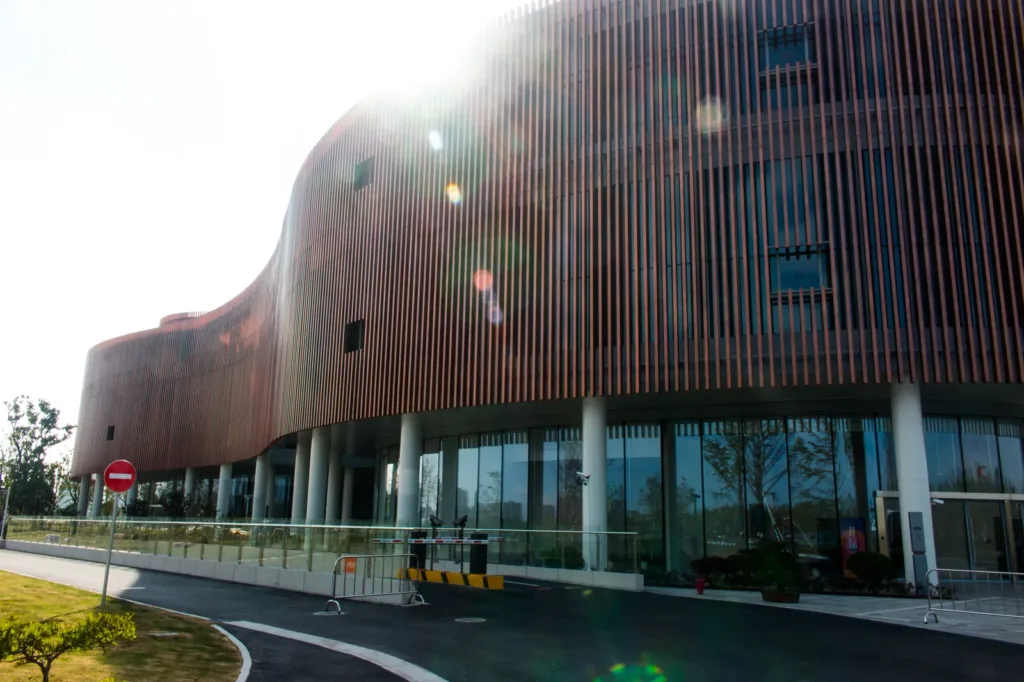
This is the Fengxian Museum at 333 Hupan Road, opened in 2019 beside Jinhai Lake in the Shanghai Fish development. The current complex was designed by Sou Fujimoto as three connected but distinct volumes, with copper-coloured screens and glass. Public routes and planted roof areas link the buildings, so the architecture is part of the visit rather than just a façade to photograph. Building A is the Urban Planning Hall; the museum galleries are in Buildings B and C.
Start with the permanent galleries
The two permanent exhibitions give the visit a clear local focus. In Building C, the Haitang Cultural Hall occupies the ground floor, while the Fengxian History Hall is on the second floor. Haitang refers here to the coastal seawall tradition, not the begonia flower. The hall follows why seawalls were built and how construction methods changed, using Fengxian’s historic East Shitang seawall as a point of reference. Its subject is practical as well as environmental: dikes, salt production and the coastal economy shaped settlement and work along this part of Shanghai.
The History Hall traces the district’s development through themes that include early settlement, salt, cotton and fishing, the growth of market towns, notable local figures and wartime history. Rather than treating Fengxian as an abstract “ancient Jiangnan” backdrop, look for the connections between land, water, work and the communities that grew around them. The museum describes this exhibition as a series of themed sections, not a single chronological room.
Building B has a second-floor temporary-exhibition area. What is showing changes, so check the museum’s notice before making a special trip for a named exhibition. For a compact first visit, allow about 90 minutes to two hours as an editorial estimate. A useful order is to check the current signs and open galleries, see the ground-floor Haitang Hall, continue to the History Hall upstairs in Building C, then add Building B’s temporary show if it is open and interests you. The buildings are connected, but use the museum’s on-site directions rather than assuming every public roof or internal link is part of the visitor route. The museum itself recommends keeping a visit within two hours; queues, special shows and access conditions can change the pace.
Admission and hours
The official visitor guide says no advance reservation is required, and the municipal listing describes admission as free. Visitors enter through security screening, and the museum may manage entry if galleries become crowded. A 2026 district-government notice also reported reservation-free entry. For a planned group tour, the museum offers free guided tours for groups of 10–30: applications open on the 25th for the following month, and the museum asks for an email request at least two working days ahead. A booked tour is not required for an individual visit. The museum also lists paid audio-guide-device rental at Building C; it does not publish a rental price on the guide page.
The latest regular schedule published by the municipal English listing is Tuesday–Sunday, 09:00–16:30, with last entry at 16:00; it says the museum closes on Mondays except public holidays. A special summer 2026 extension ran from 30 June through 30 August and has ended. Because no October 2026 schedule notice was available in the sources checked on 21 October 2026, treat the regular hours as the published baseline, not a guarantee for a particular date. Check the museum’s current notice before setting out, especially around holidays or special exhibitions.
Getting there
Use Jinhai Lake Station on Metro Line 5 as the rail approach, not as a station at the museum entrance. The museum’s visitor guide directs visitors to Exit 1, then south about 100 metres to the bus stop for Fengxian Bus 21 to Hudi Road–Hupan Road (湖堤路湖畔路); from there, it describes an approximately 800-metre walk south to the museum. A September 2026 official traffic notice confirms that route 21 was still operating but temporarily closed this stop during a traffic-control window on 6 September; that event has passed, but the stop’s normal operation and today’s departures were not independently confirmed.
For a taxi or ride-hailing car, enter 奉贤博物馆,上海市奉贤区湖畔路333号 as the destination. Follow on-site signs to the public visitor entrance, where visitors queue for security screening. The sources checked do not identify a dedicated taxi kerb or guarantee vehicle access directly to the entrance. The museum’s underground car park is free during opening hours but capacity is limited. Drivers of vehicles with 11 or more seats are directed by security staff to park across the road in Youth Art Park.
The museum’s 2023 visitor guide also lists a Jinhai Lake sightseeing shuttle to a Museum stop, but a current Amap transit listing flags the weekday and holiday services as suspended. Do not rely on the shuttle unless the museum or operator confirms that it has resumed.
Combine your visit
A suggested sequence linking the specific features of this visit.
-
Lakeside museum exterior
Begin with the building’s relationship to Jinhai Lake.
-
Local-history collections
Look for the textile and domestic-production material associated with Fengxian.
-
Art and temporary galleries
Compare local history with the museum’s broader exhibition programme.
This order is editorial. Confirm access and any transfers between stops; it does not establish a walking route, same-day connection or common admission ticket.
Find Fengxian Museum
奉贤博物馆 · 奉贤区
The pin marks the area, not the entrance.
More places nearby
Approximate straight-line distances between map pins, not travel distances.
Qingxi Old Street 青溪老街
3 km awayQingxi Old Street follows the waterway through Qingcun in Fengxian. Its narrow street pattern and vernacular buildings preserve elements of a Jiangnan market-town setting, alongside later restoration.
View guide →Shanghai Botanical Garden 上海植物园
24 km awayShanghai Botanical Garden lies in the southwestern part of Xuhui. Its collections are divided into specialist planted areas, including penjing, magnolias, peonies, bamboo and other woody and flowering plants.
View guide →Shanghai Wild Animal Park 上海野生动物园
25 km awayShanghai Wild Animal Park separates a vehicle-based safari section from pedestrian animal exhibits. The two arrangements give different ways to observe wildlife: a managed drive through open enclosures and a walking route among…
View guide →Sources & visit information
Sources checked on 21 October 2026. Hours, tickets, reservations and transport can change; confirm with the operator before you go.
- Fengxian Museum official introduction ↗
- Fengxian Museum visitor guide ↗
- Shanghai Government Fengxian Museum listing ↗
- Fengxian District government museum listing ↗
- Meet in Shanghai Fengxian Museum ↗
- Fengxian District government summer-hours notice ↗
- 2026 Fengxian New City cycling race traffic notice ↗
- Amap transit listing for the Museum bus stop ↗
Image credits & notes (1)
- Fengxian Museum's curved copper-toned screen and glazed ground floor, viewed from outside. Photo: StevenliuyiPhoto: CC BY-SA 4.0