


Get to know Fengxian District

- Administrative area
- District · 市辖区
- Part of
- Shanghai
- Chinese name
- 奉贤区
- Local areas
- District guide
Area & population
- Area
- 704.68 km²
- Population · 2020 Census
- 1,140,872
Source: English Wikipedia, as of the dates shown.
Fengxian is a large southern district of Shanghai with a mix of newer urban landscapes, former market-town waterways, farmland and a long Hangzhou Bay coast. It is best understood as several visits rather than a single district-center itinerary. Current administrative listings identify four subdistricts and eight towns.
Jinhai Lake and the new-town landscape
Start at Jinhai Lake (金海湖) if you want Fengxian’s clearest contrast between open water and planned urban space. The “Shanghai Fish” is a large, fish-shaped landscape around the lake; parks, the Fengxian Museum, and other cultural and leisure venues are distributed around the water rather than grouped inside one ticketed attraction.
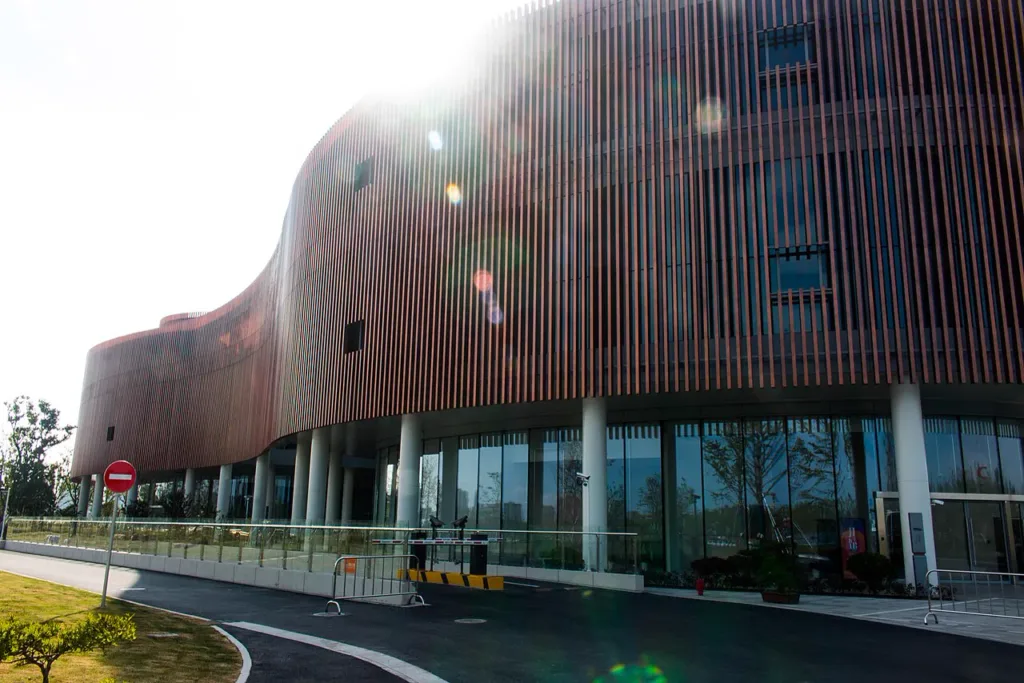
The Fengxian Museum (奉贤博物馆) stands at 333 Hupan Road, within this wider Jinhai Lake area. Its building, designed by Sou Fujimoto, consists of three connected but distinct volumes. Pair an indoor museum visit with time outside by the lake, rather than assuming the museum itself is a lakefront promenade.
Getting there: Jinhai Lake station on Shanghai Metro Line 5 is named as a local arrival point by the district government. The lake area is broad, so enter a particular venue or park as your map destination after leaving the station; do not assume that the station is at every attraction entrance. No specific station exit is confirmed here.
The district museum's venue listing gives Tuesday–Sunday hours of 9:00–16:30, with last admission at 16:00; it notes an exception for public holidays. The listing is dated 2022, and the museum's summer 2026 extended hours ended on August 30, so treat the listed timetable as a starting point rather than a guaranteed schedule for every season. A September 2026 district visitor notice lists free admission and no advance reservation for the museum during the National Day period. Check the museum's own current notice for the date you plan to go, since exhibition schedules and holiday hours can differ.
Qingxi Old Street: follow the canal, not the whole district
At Qingxi Old Street (青溪老街) in Qingcun, the old market-town pattern follows a river channel that runs through the settlement. The conserved streetscape includes vernacular buildings beside the water, small lanes, bridges and courtyards. Later restoration added cultural and commercial spaces while retaining local residents and historic buildings, so this is a lived, adapted streetscape rather than an untouched period set.
Explore by following the river through the old street, crossing between the banks where lanes and bridges invite, then doubling back along the parallel streets to look at the building fronts and courtyards. Allow time for a slow browse, not a long-distance walk. The district's official account describes the street as open to visitors and reported in 2021 that it had begun formal public operation; a separate 2026 holiday visitor notice describes it as free and not requiring a reservation for National Day. Individual shops and seasonal activities can have their own hours or charges.
Getting there: Set Qingxi Old Street or the exact shop or entrance you want as the destination in a map app. It is in Qingcun, away from the Jinhai Lake museum cluster; the government presents them on separate district itineraries, not as one continuous walk. Confirm local bus service and stopping point on the day rather than assuming a metro connection to the street.
Nanqiao: old-town history in a separate cluster
Nanqiao combines an older civic and commercial core with the landscaped setting of Guhua Park (古华公园). A district heritage walk has linked Shenjia Garden, the former civil-defence shelter, Bulode Shrine, the former Eighth Route Army command site, Dingfeng Soy Sauce Factory, Guhuating and Guhua Park. The sequence shows how local history sits within streets and former institutions, rather than in a single enclosed historic attraction.
For a shorter outing, use Guhua Park as the main stop and follow its paths around planted banks, bridges and traditional garden structures. For a history-focused outing, trace selected Nanqiao heritage addresses on foot and finish in the park; check which interiors are open before setting out. The district's 2026 New Year route also grouped Yanzi Academy, Shenjia Garden, Guhua Park and Dingfeng Soy Sauce Factory, but that route and its special holiday activity dates were published for the 2026 New Year period, not as a standing events calendar.
Getting there: Use the specific venue or street address as a map pin. This Nanqiao group is a different outing from Jinhai Lake and the museum. A district-level itinerary is a suggested sequence, not proof that every stop is open every day or connected by an uninterrupted pedestrian route. For the 2026 National Day period, the district listed Guhua Park as an open, free public park without reservation; verify current access outside that dated notice.
Haiwan and the coast: give the south its own day
The far-southern Haiwan (海湾) area offers a different landscape: planted woodland, lakes, meadows, coastal recreation and rural attractions. Shanghai Haiwan National Forest Park (上海海湾国家森林公园) is an extensive man-made forest park with lakes, a plum garden and habitat for wild birds. Its landscape rewards an unhurried visit and a route through the different wooded and water-side zones; the official district itinerary describes a 5.3-kilometre coastline route and mentions bicycles and sightseeing vehicles, but check locally for current rentals and operation.
Getting there: The park is at 1677 Suitanghe Road in Haiwan Town. The district government lists Haiwan Route 3 as public-bus access. This is a separate coastal excursion from Jinhai Lake or Qingcun: use the full park name and address in a map app, and confirm the live bus service before departure.
A September 28, 2026 district visitor guide listed the forest park at RMB 60 per ticket, open 08:30–16:30 with last entry at 15:30. These are the latest date-stamped public visitor details located for this copy, not a guarantee for all seasons or later dates. Check with the park before travel for any operational changes.
Other coastal or rural stops, including Bihai Jinsha and Yusui Village, are in the broader Haiwan area, not adjacent to the museum or Qingxi Old Street. Seasonal swimming, event schedules and admission vary; plan them as separate map pins and confirm current arrangements with the operator.
Planning a Fengxian visit
Choose one geographic cluster as the day’s anchor: Jinhai Lake and the museum for architecture, exhibitions and waterfront parks; Qingxi for a canal-side old-town stroll; Nanqiao for a compact heritage-focused exploration; or Haiwan for a forest and coast day. The district’s own tourism routes separate these landscapes. They are useful for choosing a theme, but the longer village and coastal itineraries are better planned with transport between stops rather than assumed to be walkable.
Before travelling, check current museum, park and event notices. The district's holiday price and opening guide is useful as a dated snapshot, but temporary discounts or holiday arrangements should not be treated as permanent policy.
Guide sources
- Shanghai administrative division codes, July 27, 2026
- Discovering Fengxian: Your adventure guide
- Shanghai Haiwan National Forest Park
- Fengxian visitor opening, reservation and ticket guide, September 28, 2026
- Shanghai Fish and Jinhai Lake
- Introduction to Qingxi Old Street
- Nanqiao heritage walkshow
- Fengxian New Year visitor routes
- Fengxian Museum venue information
- Fengxian Museum's summer 2026 opening schedule
- Shanghai report naming Jinhai Lake station on Metro Line 5
Explore Fengxian District
Core places to explore, with English and Chinese names.
Places to explore around Fengxian District
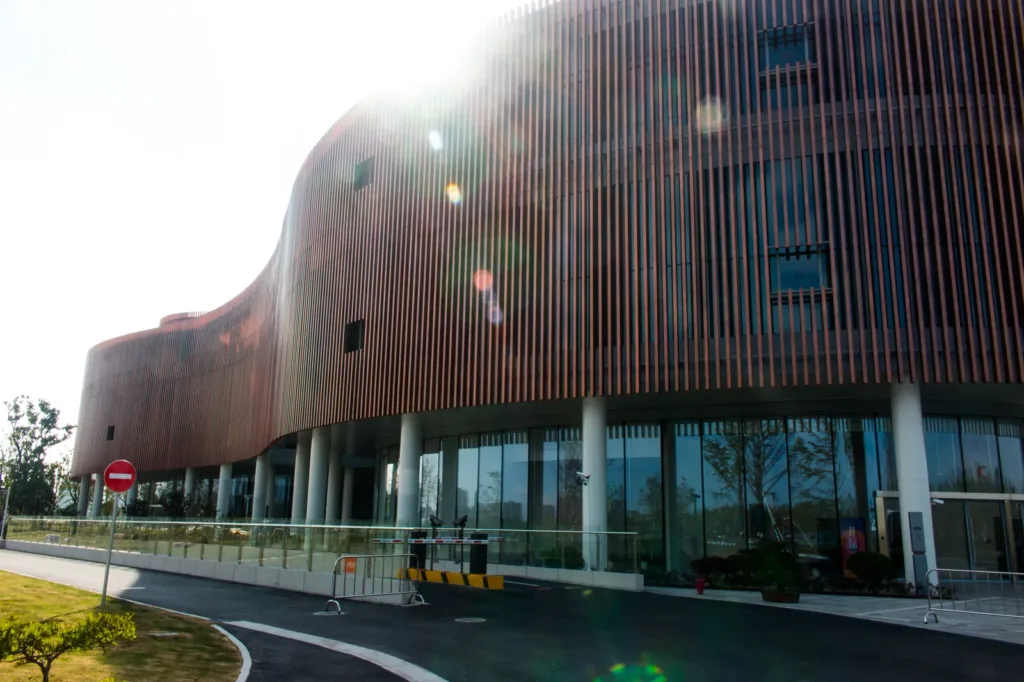 Fengxian Museum's curved copper-toned screen and glazed ground floor, viewed from outside. Photo: Stevenliuyi · CC BY-SA 4.0
Fengxian Museum奉贤博物馆
Beside Jinhai Lake in Shanghai's Fengxian District, Fengxian Museum pairs a striking three-part building by architect Sou Fujimoto with galleries on local history and the coastal seawalls that helped shape it. Go for the History Hall and Haitang Cultural Hall, then check the current temporary exhibition; admission is free and the museum's 2026 visitor notice describes walk-in entry.
Read the place guide → AI illustration · AI 示意图(仅供参考,非该地点实拍)
Qingxi Old Street青溪老街
In Qingcun, Fengxian, Qingxi Old Street follows a narrow lane beside the old town river. Historic bridges and local houses sit alongside repaired and newly created cultural spaces, while residents still live in the surrounding neighbourhood. Start near the southern screen wall on Nanfeng Highway, follow the waterside lanes, and pause at Nanhong Bridge; treat boat rides and indoor venues as separate, changeable experiences.
Read the place guide →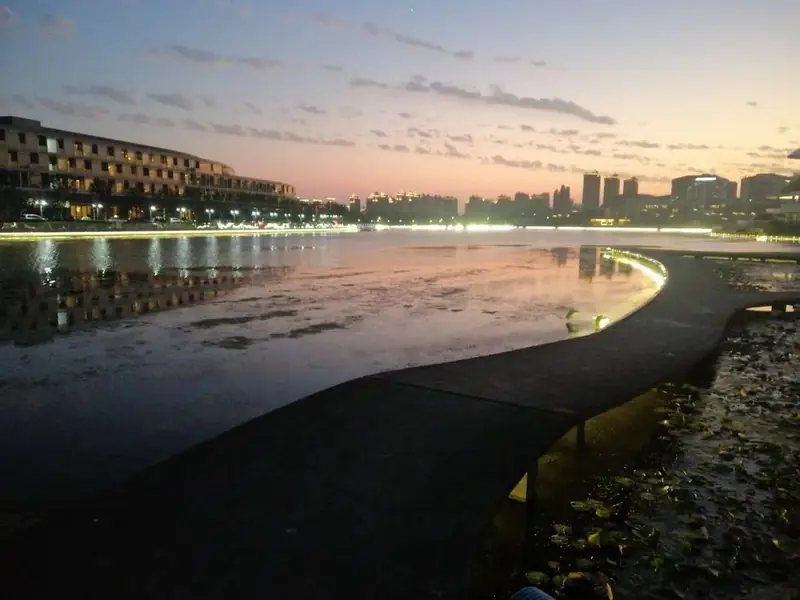 Shanghai Fish · Jinhai Lake Landscape (上海之鱼), Fengxian District. Photograph: "金海湖".
Shanghai Fish · Jinhai Lake Landscape上海之鱼
Shanghai Fish is Fengxian New Town’s broad, goldfish-shaped landscape around the man-made Jinhai Lake. Treat it as a collection of lake edges, parks and cultural venues rather than one attraction with a single gate: choose a shoreline walk or a specific park first, and add Fengxian Museum as a separate stop if its current opening arrangements suit your day.
Read the place guide →Plan your visit
Getting there
Fengxian District is about 40 km (straight-line distance) from central Shanghai. Search for 奉贤区 in a map app to find stations and your accommodation.
Where to stay →Build your route
Fengxian Museum and Qingxi Old Street are about 3 km apart (straight-line distance). The linked place guides have entrance and visit details.
Continue with Shanghai →More in Shanghai
Sources & geographic information
Administrative names and parent areas: Official geographic directory (dmfw.mca.gov.cn) · Reference date 2026-09-06.
Background text adapted from Fengxian, Shanghai — Wikipedia contributors, under CC BY-SA 4.0. Text has been shortened and reorganized; source revision 1371560267.
Photo: Shanghai Fish · Jinhai Lake Landscape · 中文維基百科20021024 · CC BY-SA 4.0. Resized for the web; the photo itself has not been edited. Thumbnails may show a cropped view.

Map data © OpenStreetMap contributors. Pins mark approximate centres, not entrances or boundaries.
Image credits & notes (2)
- The exterior of Fengxian Museum, Shanghai · 奉贤博物馆. Shown locality: Fengxian Museum, Fengxian District. Source-recorded photograph date: 12 June 2019.Photo: Stevenliuyi · CC BY-SA 4.0Resized for the web; the photo itself has not been edited. Thumbnails may show a cropped view.
- Fengxian Museum beside Jinhai Lake. Photo: StevenliuyiPhoto: CC BY-SA 4.0
