

Explore the region
Tap any red Chinese text to hear it in Mandarin.
Visitor information checked: 21 October 2026. Exhibition dates and visitor arrangements can change; check the museum’s live notices before you go.
Read the building before the galleries
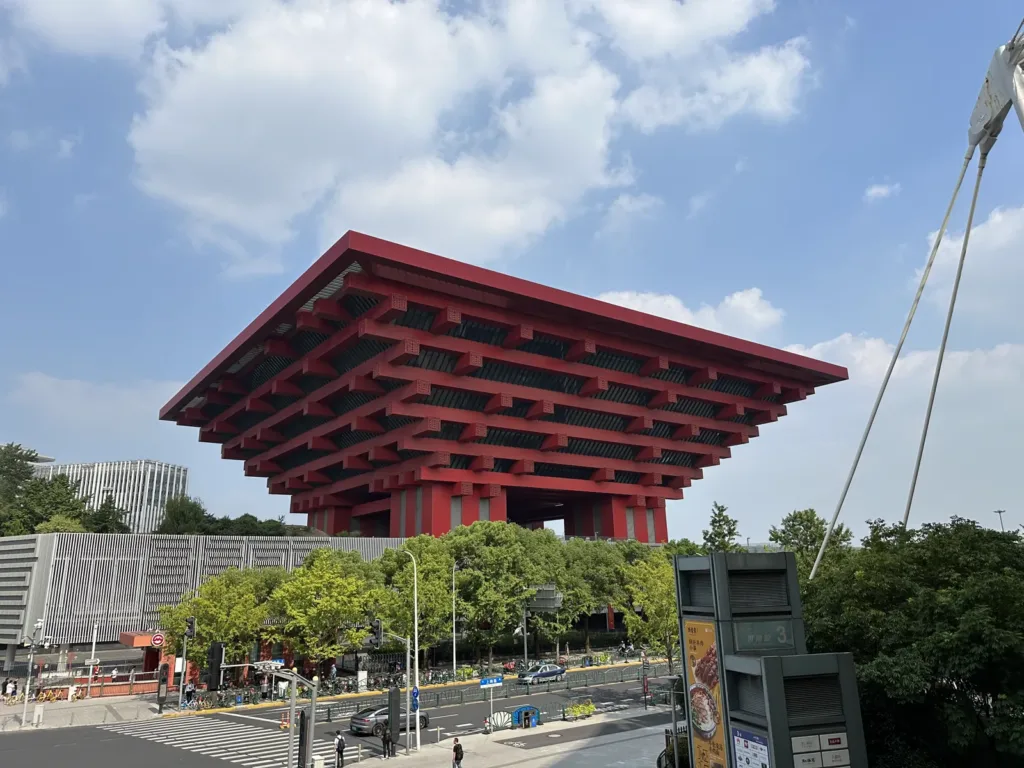
The huge red roof is the first exhibit in its own right. From outside, look at how its broad, projecting layers sit above tall supports: the structure references dougong, the traditional bracket system fitted between columns and crossbeams. At 63 metres tall, this was the former China Pavilion at Expo 2010. The Shanghai Art Museum moved into it in October 2012, giving the exposition landmark a continuing role as a museum.
Inside, think of the visit as a changing programme rather than a fixed collection route. The museum’s permanent displays cover modern Chinese art, notable artists, and Shanghai’s history and culture. Start at the 0-metre level to orient yourself and see what is on there, then use the current map and staff advice to choose other galleries. The museum lists information desks on the 0-, 9- and 49-metre levels; audio-guide devices for permanent exhibitions can be rented at the 0- and 49-metre service centres.
Exhibitions listed for October 2026
On the museum’s current listing when checked, the Fang Zengxian retrospective 突破无人之境——方增先回顾展 Tūpò Wúrén zhī Jìng — Fāng Zēngxiān Huígùzhǎn occupies the 0-metre preface and main halls and galleries 20–23 through 15 November 2026. Also on the 0-metre level, architect Yu Ting’s spatial-concept exhibition 《我与上海不可分割》 Wǒ yǔ Shànghǎi Bùkě Fēngē is listed through 31 December 2026. Both dates are tied to this check; neither is a permanent display.
If you want to add a different kind of art encounter, the B2 installation 布里奇曼名画奇旅 Bùlǐqímàn Mínghuà Qílǚ is listed through 30 June 2027. The museum describes it as an immersive art-education project featuring nearly 200 high-resolution reproductions drawn from 67 cultural institutions, spanning about 1,800 years and nearly 70 artists. It is a paid exhibition, not a room of original paintings from those institutions.
A practical editorial plan is to begin at 0 m, choose one ground-level exhibition that interests you, and visit B2 afterwards if the Bridgeman presentation is running and worth its separate ticket to you. Allow roughly two to three hours for that focused visit; this is a planning estimate, not an official duration. The gallery programme and route can change, so follow the day’s map rather than assuming that a past exhibition or room remains open.
Entry, tickets and getting there
The museum’s current visitor notice says to enter at the West Gate, 153 Shangnan Road, Pudong. This replaced the address used in older visitor listings from 15 September 2026. From China Art Museum Station on Metro Line 8, Exit 3, follow Shangnan Road about 100 metres south to the West Gate. From Yaohua Road Station on Line 7, Exit 1, walk about 600 metres north along Shangnan Road. Use 153 Shangnan Road for a taxi or ride-hail destination. The entrance notices do not identify a dedicated taxi drop-off bay, so follow local traffic controls for the actual set-down point. They do not publish a separate visitor exit route; follow signs at the museum when leaving.
The posted schedule is Tuesday–Sunday, 10:00 am–6:00 pm, with last entry at 5:00 pm. The museum closes on Mondays except statutory public holidays. The visitor-service page lists permanent exhibitions as free and special exhibitions at CNY 20; a particular show may have its own ticket conditions, so check its current notice before setting out. For groups of 30 or more, the museum specifies advance reservation seven days ahead. The page opened for this check does not spell out the advance-booking rule for individual visitors, so do not treat the group rule as an individual booking instruction. Its visitor-service page lists the 24-hour inquiry line as 400-921-9021.
For the permanent-exhibition audio guide, the museum lists a rental fee of CNY 20, plus a deposit of CNY 200 with valid ID or CNY 400 without ID. It can be rented at the 0- and 49-metre service centres.
Combine your visit
A suggested sequence linking the specific features of this visit.
-
Former China Pavilion exterior
Examine the projecting structure and traditional architectural references.
-
Current Chinese-art galleries
Continue with the museum programme available during your visit.
This order is editorial. Confirm access and any transfers between stops; it does not establish a walking route, same-day connection or common admission ticket.
Find China Art Museum
中华艺术宫 · 浦东新区
The pin marks the area, not the entrance.
More places nearby
Approximate straight-line distances between map pins, not travel distances.
Power Station of Art 上海当代艺术博物馆
2 km awayThe Power Station of Art occupies a former electricity-generating site beside the Huangpu. The building was reused for Expo 2010 before becoming a contemporary-art museum.
View guide →West Bund Museum 西岸美术馆
3 km awayWest Bund Museum occupies a triangular riverfront site designed by David Chipperfield. Three main galleries and additional project spaces accommodate changing art exhibitions.
View guide →Dongjiadu Cathedral 董家渡圣方济各沙勿略堂
4 km awayDongjiadu Cathedral, dedicated to St. Francis Xavier, stands in the former riverside district outside Shanghai’s old city walls. The church was completed in 1853 with a Baroque design recalling the church of Sant’Ignazio in Rome.
View guide →Sources & visit information
Sources checked on 21 October 2026. Hours, tickets, reservations and transport can change; confirm with the operator before you go.
- China Art Museum visitor service information ↗
- China Art Museum West Gate entrance notice ↗
- China Art Museum current exhibitions ↗
- Bridgeman Art Expedition at the China Art Museum ↗
- China Art Museum, Shanghai municipal government ↗
- Shanghai Municipal Administration of Culture and Tourism entrance repost ↗
- Wikidata China Art Museum item and coordinate record ↗
Image credits & notes (1)
- The former Expo pavilion in August 2023. Photo: A Chinese IDPhoto: CC BY-SA 4.0