

Explore the region
Read the building as part of the visit
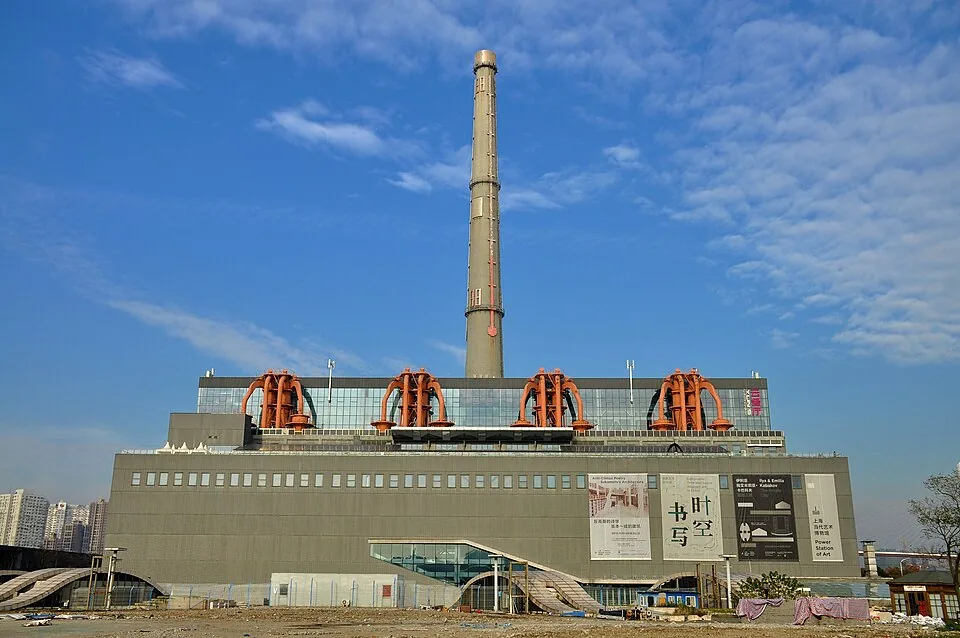
The Power Station of Art (PSA) opened on 1 October 2012 as mainland China’s first state-owned museum dedicated to contemporary art. It occupies the former Nanshi Power Plant, reused as the Pavilion of the Future for Expo 2010 before becoming the museum. PSA is the main venue of the Shanghai Biennale, although the Biennale itself is a periodic event rather than a year-round exhibition.
The industrial history is visible in the site’s scale. The museum lists 15,000 square metres of exhibition space and an interior height of up to 27 metres. Its 165-metre chimney is a city landmark and, according to PSA, an independent exhibition space; that does not mean it is open to visitors on every date, so check the current programme and on-site information before planning around it.
Start outside by taking in the contrast between the former plant and the riverfront city around it, then look up to the chimney. Inside, use the current exhibition guide to choose a route. The tall volume can change how an installation reads: notice whether the work draws your eye upward, spreads across the floor, or asks you to move close. These are prompts for looking, not promises about any particular show or gallery access.
The programme changes. On the museum’s listing checked on 21 October 2026, it showed Bulgari’s Kaleidos: Colors, Cultures and Crafts through 15 November 2026 and Lina Bo Bardi: A Poetics of Survival through 25 October 2026. Treat these as dated examples, not permanent displays; check the live calendar for your visit.
For a first visit, an editorial allowance of about two to three hours leaves time to read the exhibition information and experience the building without rushing. Begin with the show you most want to see, then use the museum’s current directions to add other open displays. There is no fixed route asserted here: exhibitions and accessible spaces can change. PSA also describes itself as a public platform for contemporary art, research and learning, so its programme may extend beyond gallery exhibitions.
Getting there and planning admission
The museum’s current visitor page gives the address as 678 Miaojiang Road, Huangpu District. It directs visitors from Xizang South Road (西藏南路) on Metro Lines 4 or 8, using Exit 2, then walking about 15 minutes. The museum also lists the Miaojiang Road–Wangda Road (Power Station of Art) stop on Puxi Riverside bus route 1 and the Zhongshan South Road–Nanchezhan Road bus stop, served by routes including 45, 66, 109, 144, 306, 327, 780, 869 and Daqiao Line 6. Confirm live service and walking directions on the day; the visitor page gives no street-by-street route from the metro exit.
For a taxi or ride-hailing car, set the destination to 上海当代艺术博物馆,上海市黄浦区苗江路678号. The visitor page does not identify a dedicated vehicle drop-off curb or a named public visitor gate. Follow on-site traffic directions and museum signs on arrival rather than treating a map pin as an entrance.
As checked on 21 October 2026, the museum listed opening hours as Tuesday–Sunday, 11:00–19:00, with 18:00 last entry; it is closed on Mondays and open on national public holidays. These are live operational details and may change for holidays or special events, so recheck before travel.
Admission is available at the first-floor service desk or through the museum’s official WeChat service account. The visitor page lists concessions and free-entry categories but did not state a general adult price in the information checked; exhibition charges and booking needs may differ. Check the specific show’s current ticket page before setting a budget. The page offers reservations for activities and says groups must book ahead; it does not say that every ordinary individual visit needs a general reservation.
Combine your visit
A suggested sequence linking the specific features of this visit.
-
Industrial exterior
Start by reading the building’s former power-station role.
-
Current exhibition spaces
Explore the contemporary-art programme available on your visit.
This order is editorial. Confirm access and any transfers between stops; it does not establish a walking route, same-day connection or common admission ticket.
Find Power Station of Art
上海当代艺术博物馆 · 黄浦区
The pin marks the area, not the entrance.
More places nearby
Approximate straight-line distances between map pins, not travel distances.
Dongjiadu Cathedral 董家渡圣方济各沙勿略堂
2 km awayDongjiadu Cathedral, dedicated to St. Francis Xavier, stands in the former riverside district outside Shanghai’s old city walls. The church was completed in 1853 with a Baroque design recalling the church of Sant’Ignazio in Rome.
View guide →China Art Museum 中华艺术宫
2 km awayChina Art Museum occupies the former China Pavilion of Shanghai’s 2010 Expo. The large red building on the Pudong side of the river was designed with references to traditional dougong brackets and the form of a bronze ding vessel.
View guide →Xiaotayuan Mosque 小桃园清真寺
2 km awayXiaotayuan Mosque stands in the southern part of Shanghai’s old-city area. Its architecture combines Chinese and Islamic elements, giving it a different visual character from the Buddhist and Taoist sites nearby.
View guide →Sources & visit information
Sources checked on 21 October 2026. Hours, tickets, reservations and transport can change; confirm with the operator before you go.
Image credits & notes (1)
- The former power station housing the Power Station of Art, photographed in 2015; foreground works reflect that date.Photo: Fayhoo · CC BY-SA 3.0Resized for the web; the photo itself has not been edited.
