

Explore the region
Tap any red Chinese text to hear it in Mandarin.
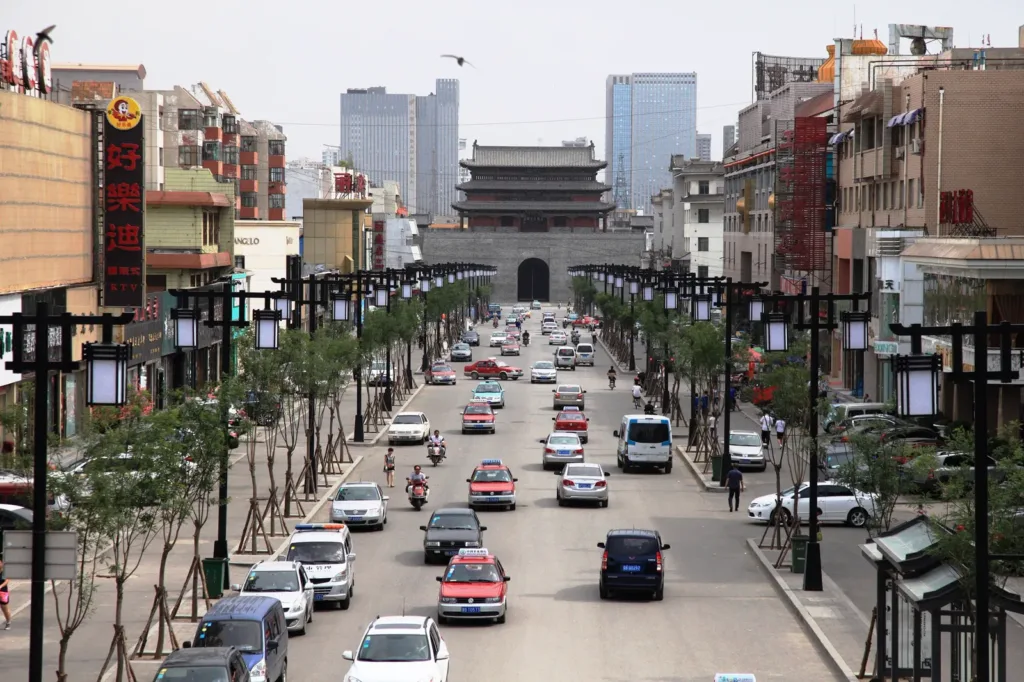
The wall is the clearest place to understand why Datong feels like a northern frontier capital rather than a collection of isolated monuments. From its upper walk, the old city’s rooflines and streets sit inside a defensive perimeter, while the moat and park mark the boundary between the historic core and the newer city. The view is architectural and urban at the same time: towers, gate enclosures and parapets explain the military plan, but the daily scene below includes residents walking, exercising and moving through the old centre.
The wall you see is not an untouched medieval shell. Datong had substantial city walls by the Northern Wei period, and in 1372 the Ming general Xu Da enlarged the city on earlier foundations. The official city account describes a roughly square stronghold with a rammed-earth core, a brick outer face, a moat and four principal gates: Heyangmen (和阳门) in the east, Yongtaimen (永泰门) in the south, Qingyuanmen (清远门) in the west and Wudingmen (武定门) in the north.
A conservation and old-city revival programme began in 2008. The four sides were joined again in 2016, following the Ming arrangement of gates and towers. That history makes the wall worth reading in two layers: its form recalls a major Ming military town, while much of the skyline is the result of modern reconstruction and landscape work.
What to look for
Start with the gate that fits the rest of your old-city walk, then look at the defensive sequence rather than only the gate tower. A barbican or outer enclosure, moat, projecting towers and the broad rampart surface show how the wall controlled movement and observation. The four gates are all named in Chinese on local visitor information, and all four can be used to go up or down the wall.
The moat and belt park are part of the experience, not just a backdrop. From the top, look for the contrast between the regular defensive circuit and the irregular life of the old city. On clear days, the height gives a useful overview of the historic centre; at street level, the gate approaches and park belt are better for seeing how the wall has become an everyday public space.
The wall also works as an anchor for a broader old-city visit. A walking guide places Huayan Temple, Shanhua Temple, the Nine-Dragon Wall and Drum Tower Street inside or alongside the walled centre. Treat those as separate places with their own opening conditions, and use the wall as the large-scale frame that connects them rather than assuming one ticket or one entrance covers everything.
Visiting and access
A local report dated 14 June 2026 said that the scenic area had moved to free access across the whole wall from 07:00 to 22:00. The same report warned that sections could close temporarily during phased lighting and maintenance work. Check the latest notice before setting out, especially after strong wind, rain or snow.
An earlier visitor notice attributed to the scenic-area official account described free entry with reservation through the Alipay mini-program “大同古城墙景区” and gave seasonal hours. That notice predates the 2026 all-area announcement, so treat the current mini-program or on-site notice as decisive rather than carrying the old seasonal timetable forward. The sources read for this guide do not specify how a foreign passport is handled in any reservation or identity-checking system; confirm the accepted document type before relying on an online booking.
Getting there and back
The wall is in Pingcheng District, around the old city. Keep the Chinese name 大同古城墙 Dàtóng Gǔchéng Qiáng and add the gate you want: 和阳门 (east), 永泰门 (south), 清远门 (west) or 武定门 (north). Using the gate name is more useful than searching only for “Datong Ancient City,” because the circuit has four practical access points.
Datong’s visitor-service information names three major arrival hubs: Datong Railway Station (大同站), Datong South Railway Station (大同南站) and Datong Yungang International Airport (大同云冈国际机场). From either railway station, the simplest direct last leg is a taxi or ride-hailing car to the Chinese destination 大同古城墙 Dàtóng Gǔchéng Qiáng plus the chosen gate name. For the return, request that same gate first, then continue to 大同站 Dàtóng Zhàn or 大同南站 Dàtóng Nán Zhàn; do not assume that a station shuttle stops beside the wall.
From 大同云冈国际机场 Dàtóng Yúngāng Guójì Jīchǎng, official airport and city information describes bus 67 between 大同云冈国际机场 Dàtóng Yúngāng Guójì Jīchǎng and 大同综合客运中心(大同南站). The city notice says the South Station departure window begins at 07:00 and ends at 19:00, with return services linked to arriving flights; confirm the day’s operation before using it. Route 67 is an airport–South Station connection, not a wall entrance, so continue from the South Station to a named gate by taxi or ride-hailing. The same connection works in reverse for an airport departure.
For city buses near the wall, an English visitor guide lists Route 35 for 永泰门 Yǒng Tài Mén or 教场街口 Jiào Chǎng Jiēkǒu, Routes 38, 27 and 59 for 和阳门 Hé Yáng Mén stops, Route 35 for 武定门 Wǔ Dìng Mén, and Routes 2, 4, 11, 15, 18, 26, 601 and 603 for 清远街口 Qīngyuǎn Jiēkǒu. This is useful orientation, but it is not a live operator timetable. Verify the route and stop in Amap or with the bus operator on the day, and use the Chinese gate name when returning to the old city or a railway station.
Find Datong Ancient City Wall
大同古城墙 · 平城区
The pin marks the area, not the entrance.
Sources & visit information
Sources checked on 25 October 2026. Hours, tickets, reservations and transport can change; confirm with the operator before you go.
Image credits & notes (1)
- Datong Ancient City Wall's south gate, viewed from the Drum Tower; Datong, Shanxi. Photo: ChlukoePhoto: CC0 1.0