

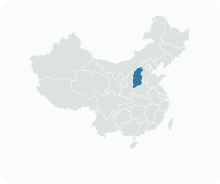
Get to know Pingcheng District

Photo adjustments
Full frame retained; proportionally resized and converted to WebP. No retouching or changes to the photographed subject. Card displays may crop the view.
- Administrative area
- District · 市辖区
- Part of
- Datong
- Chinese name
- 平城区
- Local areas
- District guide
Area & population
- Area in the source
- 46.13 km²
- Population · 2020
- 1,105,699
Source: cited geographic source, as of the dates shown.
History
The Northern Wei moved its capital to Pingcheng in 398 and stayed until Emperor Xiaowen moved the court to Luoyang (洛阳) in 494. The present city wall was raised by the Ming general Xu Da (徐达) in 1372 on the base of the Liao, Jin and Yuan walls. When Qing forces under Dorgon (多尔衮) took the city in 1649, he ordered its people massacred and the wall cut down by five chi. The district itself is recent: it was created in February 2018 from the old Chengqu (城区) and parts of Nanjiao District (南郊区).
What to see
The Datong city wall (大同古城墙) runs 7,270.7 metres around an old town of 2.63 square kilometres, with a moat outside. Its north, east and west gates were pulled down around 1952; the city began restoring it in 2008 and the circuit was closed again on 18 November 2016. It is a Shanxi provincial protected site.
Huayan Temple (华严寺), inside the west gate, was founded in 1038 as a Liao imperial temple and faces east. Its Mahavira Hall, rebuilt in 1140, stands on a four-metre platform and is listed by Chinese Wikipedia as the largest surviving ancient Buddhist hall in China, while the Bhagavat Sutra Library Hall (薄伽教藏殿) in the lower temple dates from the Liao. Shanhua Temple (善化寺), inside the south gate, keeps a Liao main hall with 34 Jin clay statues, and a Jin Hall of the Heavenly Kings (天王殿), Hall of the Three Sages (三圣殿) and Puxian Pavilion (普贤阁). Both temples were in the first national list of protected sites in 1961.
The Nine-Dragon Wall (九龙壁), 45.5 metres long and 8 metres high, was built between 1392 and 1396 and is generally taken to be the screen wall of the palace of Zhu Gui (朱桂), Prince of Dai and thirteenth son of the Hongwu Emperor. Its dragons have four claws, the rank allowed to a prince. The Datong Museum (大同市博物馆) grew out of a relics exhibition opened in the lower Huayan Temple in 1959 and shares the Northern Wei lacquer screen from the tomb of Sima Jinlong (司马金龙) with the Shanxi Museum.
Highlights
- Huayan Temple 华严寺: Liao temple of 1038 with a Jin main hall and a Liao sutra library hall; national protected site since 1961.
- Shanhua Temple 善化寺: Liao main hall and three Jin buildings inside the south gate.
- Nine-Dragon Wall 九龙壁: Screen wall of 1392-1396, generally linked to the Prince of Dai's palace.
- Datong city wall 大同古城墙: Ming wall of 1372, restored from 2008 and closed as a full circuit in 2016.
Sources for this guide
平城区 - 维基百科,自由的百科全书 · Wikipedia (Chinese) · CC BY-SA 4.0
大同市 - 维基百科,自由的百科全书 · Wikipedia (Chinese) · CC BY-SA 4.0
大同城墙 - 维基百科,自由的百科全书 · Wikipedia (Chinese) · CC BY-SA 4.0
华严寺 (大同) - 维基百科,自由的百科全书 · Wikipedia (Chinese) · CC BY-SA 4.0
善化寺 - 维基百科,自由的百科全书 · Wikipedia (Chinese) · CC BY-SA 4.0
大同九龙壁 - 维基百科,自由的百科全书 · Wikipedia (Chinese) · CC BY-SA 4.0
Original English written from the listed sources and checked sentence by sentence against quoted extracts by a separate reviewer. Updated 2026-09-25.
Explore Pingcheng District
Core places to explore, with English and Chinese names.
Places to explore around Pingcheng District
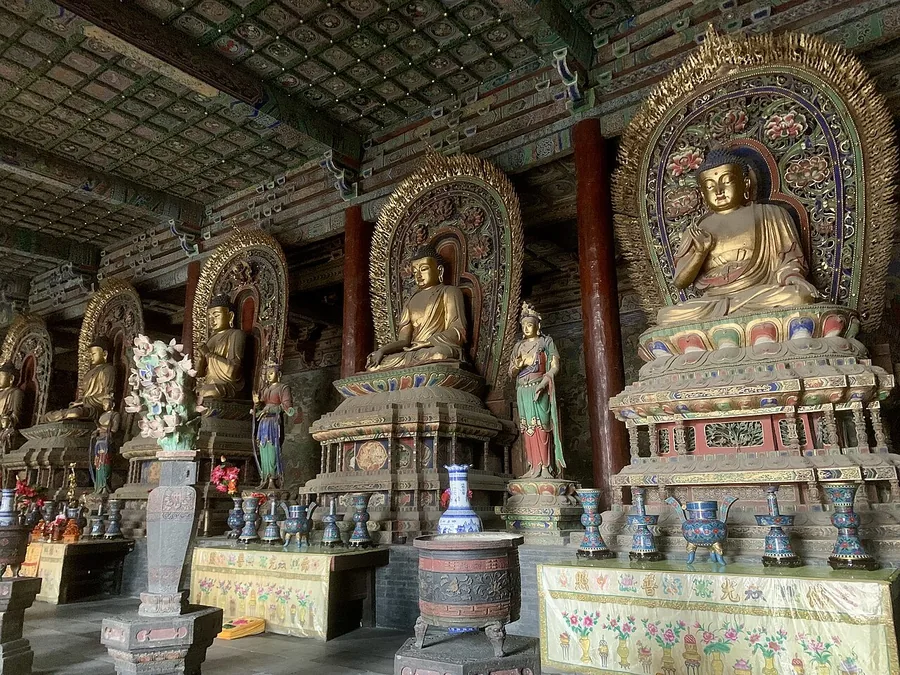 The interior of the main hall at Huayan Temple, Datong; 23 March 2025.
Huayan Temple华严寺
Huayan Temple is particularly rewarding for the contrast between its two great historic halls. The Jin-period Daxiongbao Hall creates a broad ceremonial interior beneath a large roof, while the earlier Bojia Jiaozang Hall…
Read the place guide → Daxiongbao Hall and its courtyard at Shanhua Temple in Datong, August 2013.
Shanhua Temple善化寺
Shanhua Temple is a clear lesson in the progression of a northern Buddhist monastery: a substantial gate, the Sansheng Hall and the raised Daxiongbao Hall follow one axis. The main hall preserves Liao-period architecture around…
Read the place guide → The north face of Datong's Nine-Dragon Wall, August 2013.
Nine-Dragon Wall (Datong)九龙壁
Datong's Nine-Dragon Wall survives from the Ming Prince of Dai's residence, whose original palace was lost. Its glazed surface turns a long screen into a procession of nine differently posed dragons among clouds and waves, with…
Read the place guide →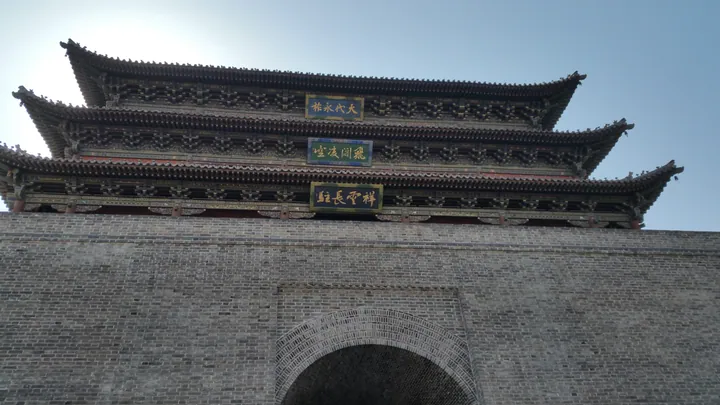 A gate tower of the Datong city wall, Pingcheng District · 大同古城墙城门楼,平城区 Source-recorded photograph date: 2016-10-09 11:21:57.
Datong Ancient City Wall大同古城墙
Datong Ancient City Wall (大同古城墙) is the restored defensive circuit around Datong's old city in Pingcheng District, following the form of a major Ming frontier stronghold.
Read the place guide → The colonnaded entrance porch of Datong Museum, Shanxi · 山西大同市博物馆门廊柱廊 Source-recorded photograph date: 2011-07-06.
Datong Museum大同市博物馆
Datong Museum introduces the successive identities of a northern Chinese city: the ancient Dai region, Northern Wei Pingcheng, Liao and Jin Xijing, and the fortified city of the Ming and Qing periods.
Read the place guide →Plan your visit
Getting there
Pingcheng District is about 6 km in a straight line from central Datong. Search for 平城区 in a map app to find stations and your accommodation.
Where to stay →Build your route
Huayan Temple and Shanhua Temple are about 2 km apart in a straight line. The linked place guides have entrance and visit details.
Continue with Datong →More in Datong
Sources & geographic information
Administrative names and parent areas: Official geographic directory · Reference date 2026-09-06.
Some facts checked against 平城区 — Wikipedia contributors, CC BY-SA 4.0.
Some facts checked against 大同市 — Wikipedia contributors, CC BY-SA 4.0.
Some facts checked against 大同城墙 — Wikipedia contributors, CC BY-SA 4.0.
Some facts checked against 华严寺 (大同) — Wikipedia contributors, CC BY-SA 4.0.
Some facts checked against 善化寺 — Wikipedia contributors, CC BY-SA 4.0.
Some facts checked against 大同九龙壁 — Wikipedia contributors, CC BY-SA 4.0.
Photo: Huayan Temple · Dudva · CC0. Proportionally resized and converted to WebP without cropping, retouching or changing the photographed subject.
.jpg)
Photo: Shanhua Temple · Zhangzhugang · CC BY-SA 3.0. Proportionally resized and converted to WebP without cropping, retouching or changing the photographed subject.

Photo: Nine-Dragon Wall (Datong) · Zhangzhugang · CC BY-SA 3.0. Proportionally resized and converted to WebP without cropping, retouching or changing the photographed subject.

Photo: Datong Ancient City Wall · Veo0607 · CC BY-SA 4.0. Full frame retained; proportionally resized and converted to WebP. No retouching or changes to the photographed subject. Card displays may crop the view.

Photo: Datong Museum · 猫猫的日记本 · CC BY-SA 3.0. Full frame retained; proportionally resized and converted to WebP. No retouching or changes to the photographed subject. Card displays may crop the view.

Map data © OpenStreetMap contributors. Pins mark approximate centres, not entrances or boundaries.