

Explore the region
Tap any red Chinese text to hear it in Mandarin.
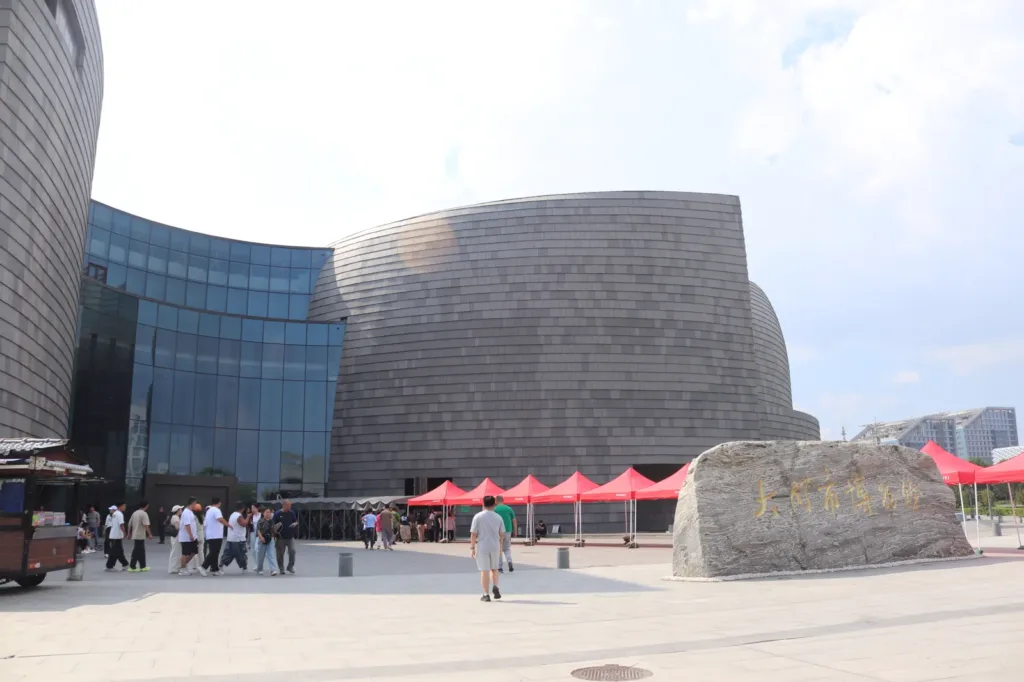
Datong’s identity is easier to read here as a sequence than as a single dynasty. The main building is a regional comprehensive museum in Pingcheng District, and its double-S form draws on Datong’s volcanoes, dragon screens and Yungang Grottoes. The building’s shape is not the main reason to come, but it prepares you for the museum’s central idea: a border city repeatedly reshaped by contact between northern and farming cultures.
Start with the four permanent historical displays: “Vicissitudes of the Dai Region” (沧桑代地), “Wei Capital City” (魏都平城), “Liao–Jin Xijing” (辽金西京) and “Ming and Qing Important Town” (明清重镇). The sequence moves from early regional history to Northern Wei Pingcheng, then to the Liao–Jin western capital and the later fortified town. It gives the monuments elsewhere in Datong a shared historical frame without collapsing different periods into one story.
What to look for
The Northern Wei section is the strongest reason to slow down. Recent reporting describes a 238-piece procession from the tomb of Sima Jinlong: riders, infantry and armoured cavalry follow Chinese ritual order while their clothing also shows northern steppe influence. That combination makes cultural exchange visible in the arrangement of the figures, rather than leaving it as an abstract label.
Look also for the stone-carved coffin bed from the same tomb, with musician figures and ornament that bring together local carving, Buddhist imagery and instruments associated with wider regional networks. A Han-period “Pingcheng” roof tile, Northern Wei blue glass and other objects help connect the city to trade and craft exchange. The Liao glazed chiwen from Huayan Temple is another useful comparison: it is a large architectural fitting, reported at 2.86 metres high, shown here as evidence of Datong’s later building culture.
The main building also has special displays on Datong dinosaurs and Buddhist and Daoist statues, plus temporary exhibition halls. Displays can change, so use the current labels and notices rather than treating every object mentioned in a past report as guaranteed to be on view.
Plan the visit
The main building is free to enter. The current Chinese visitor notice says that ordinary opening is Tuesday to Sunday, 09:00–17:00, with entry stopping at 16:30; Mondays are closed except for the holiday arrangements announced by the museum. Visitors should make a timed, real-name reservation up to seven days ahead through the official WeChat account and bring a valid identity document for verification. The official API still contains an embedded English object that says entry stops at 16:00, so check the Chinese notice or the museum’s official account on the day you go. The notice does not specify which foreign documents are accepted, so passport-based visitors should confirm this before reserving.
“Datong Museum” is a museum system, not one address. The official description lists the main building and nine branches, including the Liang Sicheng Memorial Hall, Pingcheng Memory Museum and Mingtang Site Museum. This page is for the main building; a branch exhibition may have a different address, opening arrangement and route.
Getting there
Use this Chinese destination in a map or when speaking to a driver: 大同市博物馆(主馆), 山西省大同市平城区太和路506号. A visitor guide lists buses 38, 64 and 70 to 大同大学东站 (Datong University East Station), followed by a walk east, and bus 65 to 博物馆站 (Museum Station). Bus assignments can change, so confirm the direction and stop in a live map before boarding; no metro route is assumed here.
If your ticket says 大同站 (Datong Railway Station), 12306 lists the station at 山西省大同市城区站前街4号. If it says 大同南站 (Datong South Railway Station), keep that name separate from 大同站. For either station, the most reliable last leg supported here is a taxi or ride-hailing trip to the exact Chinese destination above; ask for the same station name for the return, rather than relying on an English translation or a fixed fare and travel time.
From 大同云冈国际机场 (Datong Yungang Airport), the airport’s transport page lists bus 67 between the airport and 大同综合客运中心(大同南站). The return service from the South Station is described as connecting with flight arrivals. From the South Station, continue by taxi or ride-hailing to the museum’s Chinese destination, and reverse that sequence for an airport departure. A local report in May 2025 also described a South Station–Yungang scenic shuttle that returned via Datong Museum; treat that as a dated lead, not a current timetable, and verify it before using it.
Find Datong Museum
大同市博物馆 · 平城区
The pin marks the area, not the entrance.
Sources & visit information
Sources checked on 25 October 2026. Hours, tickets, reservations and transport can change; confirm with the operator before you go.
Image credits & notes (1)
- The main building of Datong Museum in Pingcheng District, photographed from the entrance plaza. Photo: Liuxingy (Wikimedia Commons)Photo: CC BY-SA 4.0