

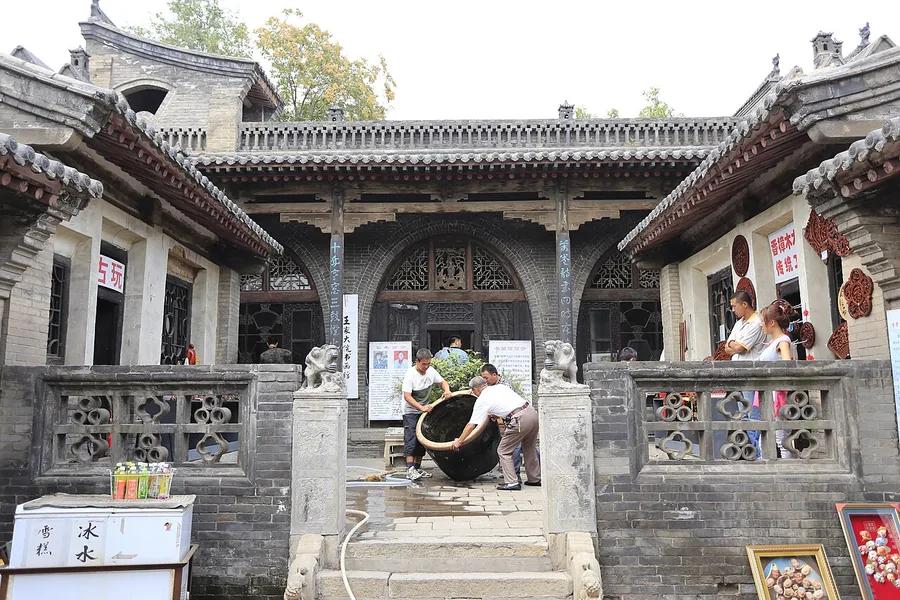
Photo adjustments
Proportionally resized and converted to WebP without cropping, retouching or changing the photographed subject.
Explore the region
About Wang Family Compound
Its courtyards unfold across different levels rather than around one flat garden. Gaojiaya and Hongmenbao form the principal surviving groups, where carved door surrounds, stone bases and brick panels show the family's investment in domestic architecture. The visit involves substantial changes of level, so a shorter route through one group can be more rewarding than rushing the entire complex.
The Wang clan of Jingsheng (静升) traced its origins to Langya (琅琊). Wang Shi (王实), a clan member, moved from Taiyuan to Gouyutan Village (沟峪滩) in Lingshi during the early Southern Song dynasty. In 1313, Wang Chengzhai (王诚斋) led the family to Jingsheng Village to farm.
More clan members turned to commerce during the Ming dynasty. From the early to mid-Qing, their business expanded from grain and horses into salt and tea monopolies. The family declined after Wang Hongjian (王鸿渐) was killed and substantial funds were lost when Taiping forces took Yangzhou in 1853. The compound was repeatedly expanded during the Kangxi (康熙), Yongzheng (雍正), Qianlong (乾隆) and Jiaqing (嘉庆) reigns.
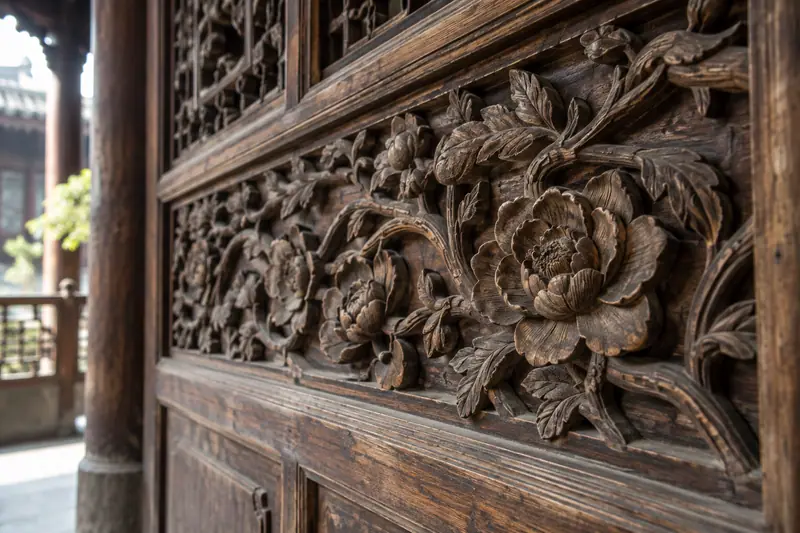
The compound covers 150,000 square metres and includes 123 courtyards and 1,118 rooms built on a south-facing hillside. Its main sections are the East Courtyard (东大院), also called Gaojiaya (高家崖), the West Courtyard (西大院) and Xiaoyi Shrine (孝义祠). Brick, stone and wood carvings decorate the buildings. Hongmenbao (红门堡) houses a Wang clan museum (中华王氏博物馆), while Gaojiaya houses a residence-art museum (中国民居艺术馆). The compound was listed as a Major Historical and Cultural Site Protected at the National Level (全国重点文物保护单位) on 25 May 2006.
What to look for
- The elevated courtyards of Gaojiaya and the more fortress-like arrangement of Hongmenbao.
- Stone, brick and wood carving around gateways and residential courtyards.
Location & getting there
Getting to Wang Family Compound
Approach Jingsheng Village in Lingshi County and use the Wang Family Compound visitor entrance. Decide at the entrance which courtyard groups your visit will include.
Combine your visit
Suggested order within this visit:
-
Gaojiaya courtyards
Study the hillside residential layout.
-
Carved residential gateways
Slow down for the carved details between courts.
-
Hongmenbao
Compare the fortified group if the connecting visitor route is open.
This sequence is an editorial suggestion based on the features described in the sources. Access to individual buildings or areas should be checked locally; no travel time or shared admission is implied.
Find Wang Family Compound
王家大院 · 晋中市
The pin marks the area, not the entrance.
More places nearby
Approximate straight-line distances between map pins, not travel distances.
Zhangbi Castle 张壁古堡
11 km awayZhangbi is a fortified village where domestic streets, small temples and defensive structures share a compact hilltop setting. Ravines protect three sides, while the north gate's offset entrances explain the importance of…
View guide →Jiexiu City God Temple 介休城隍庙
16 km awayJiexiu's City God Temple is distinguished by coloured glazed decoration and the tightly composed theatre buildings at its entrance. The stage projects between bell and drum towers, making performance architecture an essential…
View guide →Mount Mian 绵山
29 km awayMount Mian combines precipitous scenery with temples fitted into cliffs and enormous rock recesses. Daluo Palace supplies a dramatic, vertically stacked Daoist ensemble, while Yunfeng Temple sits beneath the great Baofu Rock…
View guide →Sources & visit information
The linked encyclopedia sources support background and place descriptions. Current opening hours, ticket prices, booking rules and transport schedules have not been independently verified for this guide. Confirm them with the venue or operator before travelling.
Visitor information adapted and edited from Wikipedia contributors · CC BY-SA 4.0. Source revision 1315787271.
Background paragraphs translated and condensed from Wikipedia contributors, "王家大院", Chinese Wikipedia · CC BY-SA 4.0. Source revision 92132317.