

Photo adjustments
Full frame retained; proportionally resized and converted to WebP. No retouching or changes to the photographed subject. Card displays may crop the view.
Explore the region
About Mount Mian
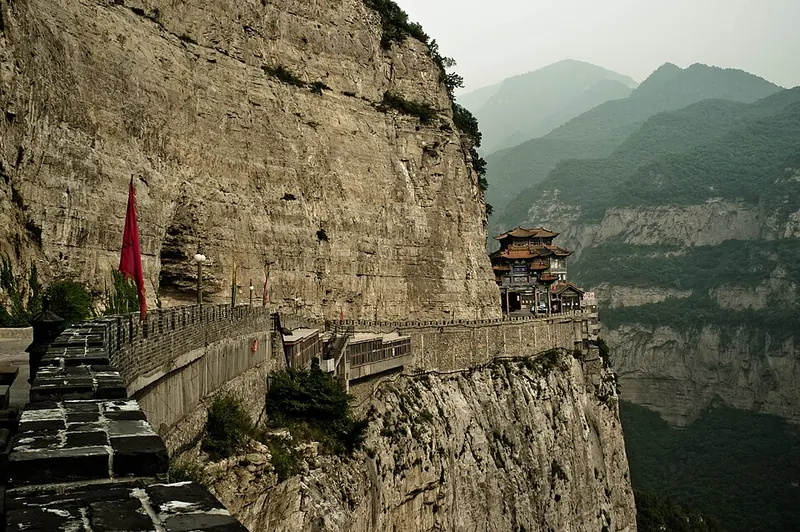
Daluo Palace supplies a dramatic, vertically stacked Daoist ensemble, while Yunfeng Temple sits beneath the great Baofu Rock overhang. Much of the visitor architecture has been rebuilt, so its impressive appearance should be distinguished from the age of the religious traditions. The wider mountain includes numerous separate valleys and shrines; choosing one connected sector makes a more coherent visit.
According to tradition, Mount Mian was the site of a retreat where Jie Zhitui and his mother died in a forest fire set by his lord, Duke Wen of the state of Jin, in the 7th century BC; Duke Wen's remorse led him to build a temple in Jie's honour, supported by sacrifices funded from nearby land. By the Han dynasty, people around Taiyuan were treating Jie as a tutelary deity.
The mountain's official scenic area opened in 2000 and covers 75 square kilometres, with about 400 attractions grouped into 14 tourist areas. It lies in the town of Mianshan in Jiexiu, Jinzhong, part of the Taihang Mountains south of the Fen River; its ridgeline runs for more than 160 kilometres, reaching 2,440 metres at its highest point. Its long, unbroken ridge is said to have given the mountain its name, from an old word for silk floss later extended to mean soft or downy before becoming the modern word for cotton. Notable rock features include Buddha Embrace Rock, Tiesuo Ridge, Yinkong Cavity and the Mosta Dome, and the area's vegetation has been studied by Shanxi University.
What to look for
- Daluo Palace, a tall sequence of Daoist halls rising against the mountain.
- Yunfeng Temple beneath Baofu Rock, where the natural overhang defines the religious setting.
Location & getting there
Getting to Mount Mian
Reach the Mianshan scenic-area entrance from Jiexiu and confirm the internal transport serving Daluo Palace and Yunfeng Temple.
- The mountain's separate sectors are not one continuous easy walk; plan the return to the entrance before adding another valley.
Combine your visit
Suggested order within this visit:
-
Daluo Palace
Begin with the mountain's vertical temple architecture.
-
Yunfeng Temple and Baofu Rock
Continue to the contrasting shrine beneath a natural rock shelter.
This sequence is an editorial suggestion based on the features described in the sources. Access to individual buildings or areas should be checked locally; no travel time or shared admission is implied.
Find Mount Mian
绵山 · 晋中市
The pin marks the area, not the entrance.
More places nearby
Approximate straight-line distances between map pins, not travel distances.
Shuanglin Temple 双林寺
15 km awayShuanglin Temple in Qiaotou Village is best approached as a sculpture visit. Its halls contain painted clay figures whose postures, clothing and expressions reward slow looking. The forceful guardian Weituo in the Thousand…
View guide →Zhangbi Castle 张壁古堡
18 km awayZhangbi is a fortified village where domestic streets, small temples and defensive structures share a compact hilltop setting. Ravines protect three sides, while the north gate's offset entrances explain the importance of…
View guide →Pingyao Ancient City 平遥古城
19 km awayPingyao's walled centre preserves a merchant city whose courtyard houses, shops and financial institutions grew around long-distance trade. The city walls establish its compact outline, while South Street and the Rishengchang…
View guide →Sources & visit information
The linked encyclopedia sources support background and place descriptions. Current opening hours, ticket prices, booking rules and transport schedules have not been independently verified for this guide. Confirm them with the venue or operator before travelling.
Visitor information adapted and edited from Wikipedia contributors · CC BY-SA 4.0. Source revision 1351284055.
Background paragraphs condensed from Wikipedia contributors, "Mount Mian", English Wikipedia · CC BY-SA 4.0. Source revision 1351284055.