

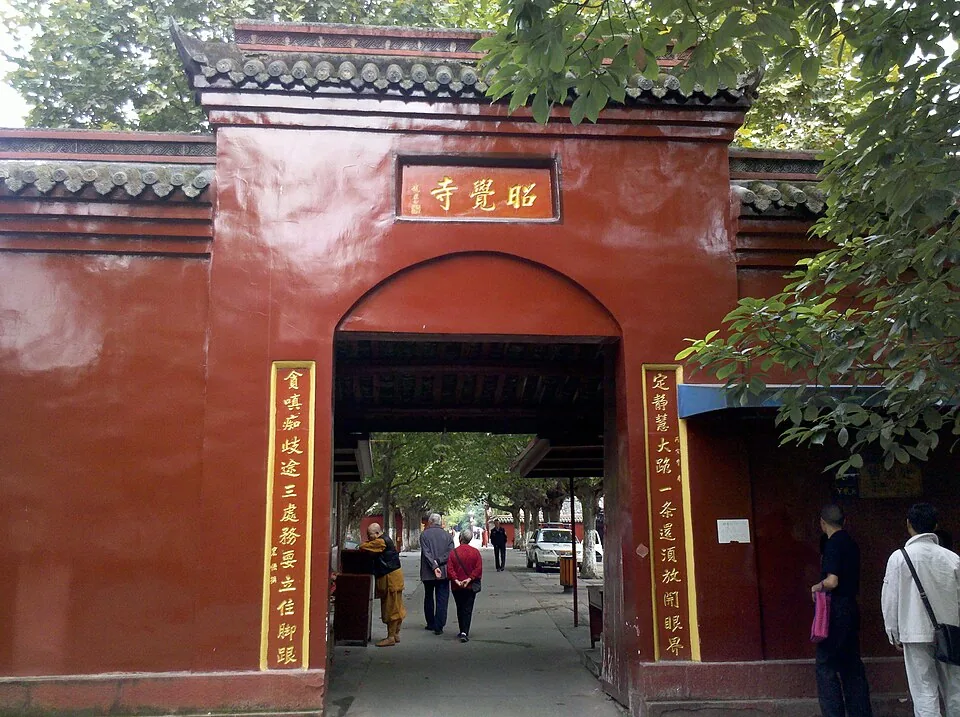
Photo adjustments
Converted to WebP and resized without changing the subject or cropping the source frame.
Explore the region
About Zhaojue Temple
The Mahavira Hall contains three principal Buddha images, while arhat figures stand along its sides. An octagonal pavilion and the succession of smaller devotional halls add variation to the route. Read the complex as a renewed active religious site, looking at the arrangement of spaces and images rather than assuming every building survives unchanged from its early history.
The temple originated as the home of Dong Chang (董常), a Han-dynasty military officer of Meizhou, and was converted into a Buddhist temple during the Zhenguan era of the Tang dynasty to revive Buddhism, then known as Jianyuan Temple (建元寺). In 877, in the Qianfu era of Emperor Xizong of Tang, Chan master Xiumeng Liaojue (休梦了觉) became abbot and renamed it Zhaojue (昭觉). The painter Zhang Daqian lived at the temple four years studying painting, leaving manuscripts that remain.
In March 1917, Zhu De (朱德) and Zhou Guanhe (周官和) took refuge at Zhaojue Temple. During the Cultural Revolution the temple was severely damaged, its buildings, statues, pagodas and ritual objects destroyed and its land requisitioned; it was rebuilt afterward under the management of the Chinese Buddhist community. The rebuilt Mahavira Hall was consecrated on 21 May 1991; its three principal images are Vairocana, Rocana and Sakyamuni Buddha.
Zhaojue Temple was designated one of the Han-area National Key Buddhist Temples (汉族地区佛教全国重点寺院) by the State Council in 1983, and was listed as a Chengdu municipal cultural-relic protection unit (成都市文物保护单位) in its ninth batch on 5 March 2026. Its abbot Ciqing (慈青) served as head of the Chengdu Buddhist Association and as a Sichuan provincial congress delegate.
What to look for
- The Mahavira Hall contains the Three-Body Buddha images and side groups of arhats.
- The octagonal pavilion contrasts with the larger rectangular temple halls.
Background & history
Zhaojue Temple (simplified Chinese: 昭觉寺; traditional Chinese: 昭覺寺; pinyin: Zhāojué Sì) is a Buddhist temple located in Chenghua District of Chengdu, Sichuan, China. Zhaojue Temple has been burned down and rebuilt several times, due to natural disasters and wars; the modern temple was completed in 1984.
Excerpt from Wikipedia: Zhaojue Temple · Wikipedia contributors · CC BY-SA 4.0. Selected introductory sentences; formatting simplified. Background information, not current visitor-service advice.
Location & getting there
Getting to Zhaojue Temple
Approach the temple gate from Qinglong Road in Chenghua district. Use the signed pedestrian entrance to Zhaojue Temple; the similarly named coach station is a separate facility.
Combine your visit
Suggested order for the visit:
-
Temple gate and octagonal pavilion
Begin with the entrance sequence.
-
Mahavira Hall
Observe the principal Buddha images.
-
One subsidiary hall
Compare a smaller devotional space.
This is an editorial sequence of named spaces or places. It does not imply a verified walking connection or promise opening, ticket availability or a journey time.
Find Zhaojue Temple
昭觉寺 · 成华区
The pin marks the area, not the entrance.
More places nearby
Approximate straight-line distances between map pins, not travel distances.
Chengdu Zoo 成都动物园
Less than 1 km awayChengdu Zoo is a conventional city zoo near Zhaojue Temple, with animal areas distributed across a broad site. Giant pandas are part of a wider collection that also includes elephants, giraffes, tigers and primates. Plan by…
View guide →Chengdu Open Air Music Park 成都露天音乐公园
4 km awayChengdu Open-Air Music Park is organised around a large performance structure shaped to suggest a phoenix spreading its wings. Sloping lawns face the stage, while smaller themed theatre spaces distribute the music idea through…
View guide →Dongjiao Memory 东郊记忆
4 km awayDongjiao Memory reuses the former Hongguang electronic-tube factory as a district for music, design and creative businesses. Red-brick workshops, chimneys and pipe structures preserve the industrial setting, while shops, cafés…
View guide →Sources & visit information
The sources below support the place-specific description and arrival information. Suggested combinations are editorial planning ideas; confirm current opening, entry arrangements and transport services for your date.
- Zhaojue Temple ↗
- Chengdu traffic police visitor guidance ↗
- Chinese Wikipedia: 昭觉寺 (revision 91868327, 2026-03-13) ↗
Visitor information adapted and edited from Wikipedia contributors, “Zhaojue Temple” · CC BY-SA 4.0. Source revision 1366891360.
Background paragraphs translated and condensed from Wikipedia contributors, "昭觉寺", Chinese Wikipedia · CC BY-SA 4.0. Source revision 91868327.