

Explore the region
About Fengtongzhai Dengchigou Village
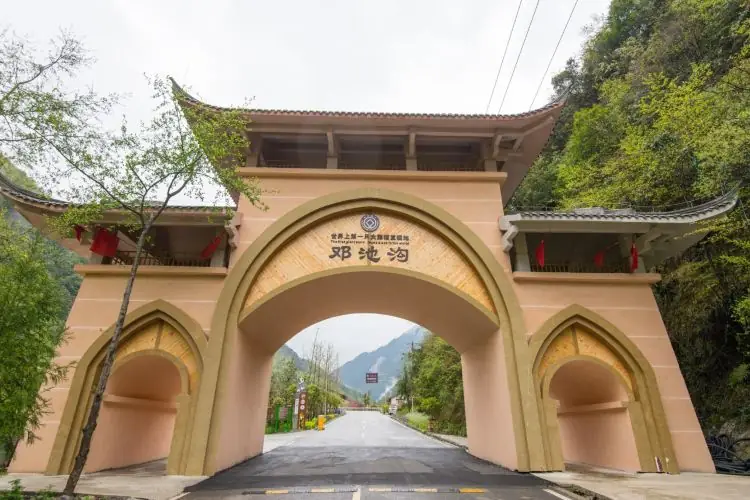
Ya'an's municipal civil affairs bureau records Dengchi Gou at about 1,750 metres elevation on the middle section of the Qionglai range, on the south slope of Jiajin Shan, with forest cover of 71.39 per cent, habitat for giant pandas and golden snub-nosed monkeys and growing ground for dove trees and Cercidiphyllum; the village's name comes from Qing-dynasty residents surnamed Deng who lived beside a natural pond. In 1839 the French Foreign Missions built a Catholic church on the Shilongmen hillside there, combining western-Sichuan courtyard style with European Gothic elements, which the source describes as the oldest surviving all-timber-structure church in Sichuan. In 1869 Armand David discovered the world's first live giant panda at Dengchi Gou, making it the giant panda's scientific discovery site and type-specimen locality; as the core zone of Fengtong Zhai National Nature Reserve, the source describes it as a 'world gene bank of animals and plants'.
The Ministry of Ecology and Environment's registry lists Fengtong Zhai as a national-level nature reserve in Baoxing County, established 20 March 1975 and covering 39,039 hectares, with giant pandas and other rare wildlife and the forest ecosystem as its main protected objects. In recent years Dengchi Gou has built a giant panda culture education centre, a giant panda origins hall and the Fengtong Zhai natural history museum, and local residents have developed homestays, ecological agriculture and cultural products around what the Ya'an source calls a 'panda economy'.
What to look for
- The 1839 Catholic church on the Shilongmen hillside, combining western-Sichuan courtyard style with European Gothic elements.
- The site of Armand David's 1869 discovery of the giant panda, the species' scientific discovery site and type-specimen locality.
- The giant panda culture education centre, the giant panda origins hall and the Fengtong Zhai natural history museum built in the village.
- The wider Fengtong Zhai National Nature Reserve, established in 1975 and covering 39,039 hectares, of which Dengchi Gou is the core zone.
Location & getting there
Getting to Fengtongzhai Dengchigou Village
Check the open visitor route and follow the site’s rules on distance, food and photography. Conservation areas may limit access beyond designated paths.
- Search for 蜂桶寨邓池沟 with 雅安市 and 宝兴县.

Find Fengtongzhai Dengchigou Village
蜂桶寨邓池沟 · 宝兴县
No reliable map pin yet: search by the Chinese name.
Sources & visit information
The linked sources support the identity and background described in this introduction. Opening hours, admission, activity availability and exact arrival arrangements have not been comprehensively checked. Confirm current visitor information with the venue; the original catalogue locality and editorial review flag are retained.
Image credits & notes (1)
- Fengtongzhai Dengchigou Village · 蜂桶寨邓池沟Photo: gs.ctrip.comResized for the web; the photo itself has not been edited.