

Explore the region
About Fushun Confucian Temple
Fushun Confucian Temple (富顺文庙) is a temple to Confucius in the old town of Fushun County (富顺县), Zigong (自贡), Sichuan. Founded in 1044, it was rebuilt between 1836 and 1840 to plans of the Confucius temple in Qufu (曲阜).
Fushun became a county in 567 and grew on salt, but produced its first jinshi (进士), a graduate of the metropolitan exam, Li Mian (李冕), only in 1042. Two years later the county raised money for a temple at the south gate of the town centre, which housed both the rites for Confucius and the official school; it has been called Wenmiao since the Ming Yongle era. A Sichuan local-gazetteer article says the official then in charge of Fushun turned his own office to face west to give the temple the best site. In the Ming, more than 130 Fushun men passed the highest exam, a thirteenth of Sichuan's total, which earned the county the saying "its scholars top western Shu" (才子甲西蜀).
By the Qing the temple had fallen into ruin. In 1836 the magistrate called the local gentry together, and one of them, Xiao Yongsheng (萧永升), offered to pay for the whole rebuilding; it took four years and 36,000 taels of silver and was finished in 1840. Plans came from Qufu through its magistrate Zhang Zhen (张震), a Fushun native, and the head of the county heritage office told Sichuan Online that most materials were also bought to match Qufu's. Unlike most Confucian temples, it is built up a slope, with three courtyards rising one behind another.
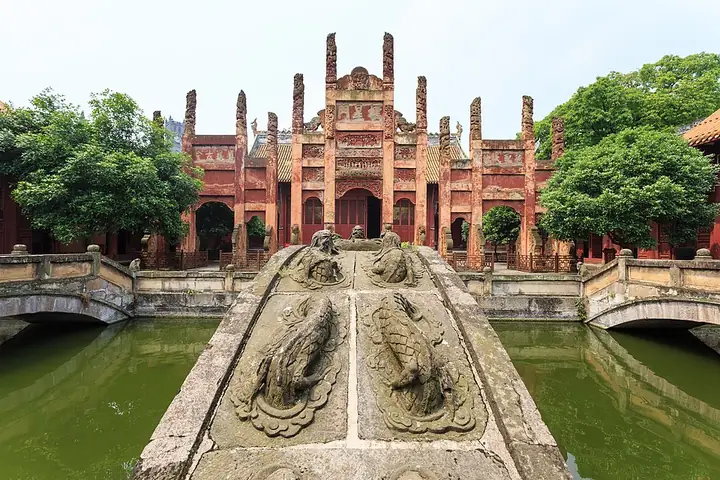
The temple faces south and measures 46 m by 160 m. Walking north up its main line, a visitor passes the Pan Pool (泮池), Lingxing Gate (棂星门), Dacheng Gate (大成门), the main hall, Dacheng Hall (大成殿), and Chongsheng Shrine (崇圣祠), ending at Jingyi Pavilion (敬一亭). Sichuan Online counts more than 320 dragons in wood, stone, clay and glazed tile across the complex. Sichuan made it a provincial protected site on 7 July 1980, and it joined the fifth batch of national key protected sites on 25 June 2001; since 2018 it has formed a national AAAA scenic area together with Fushun's West Lake (西湖).
What to look for
- Lingxing Gate (棂星门), three stone archways on twelve dragon-carved columns, 12.8 m high; Sichuan Online lists it as the tallest of any Confucian temple in China, above Qufu's
- Zhuangyuan Bridge (状元桥), a stone arch bridge over the Pan Pool carved in openwork with nine dragons
- The three-layer nine-dragon stone ramp (九龙丹陛) in front of Dacheng Hall
- Dacheng Hall's 17 statues of Confucius and his followers; the Confucius figure was made in 1994 by specialists from the Qufu temple
- Jingyi Pavilion (敬一亭), at the highest point of the temple, with a stone incised with a seated Confucius after a drawing attributed to Wu Daozi (吴道子)
- The small glazed figure of a boy on the ridge of Chongsheng Shrine, found during repairs in 1986, which local historians read as the child Confucius
Location & getting there
Getting to Fushun Confucian Temple
- Search for 富顺文庙 with 自贡市 and 富顺县.
Find Fushun Confucian Temple
富顺文庙 · 富顺县
No reliable map pin yet: search by the Chinese name.
Sources & visit information
Written from the linked sources and fact-checked against them on 2026-09-23. Opening hours, admission and access arrangements are not covered; confirm current visitor information with the site.
- 富顺文庙 - 维基百科,自由的百科全书 ↗
- 【方志四川•历史文化】刘安龙 刘恪生 ‖ 富顺文庙 造就”才子甲西蜀“_文化纵横_四川省情网 ↗
- 探访蜀地趣味博物馆①丨走!到富顺文庙 拜望别样孔子_四川在线 ↗
Some facts checked against Wikipedia contributors, "富顺文庙" · CC BY-SA 4.0.
Image credits & notes (1)
- The Panchi pond and Lingxing Gate of Fushun Confucian Temple · 富顺文庙泮池和棂星门Photo: Zhangzhugang · CC BY-SA 3.0 · taken 2014-04-23Resized for the web; the photo itself has not been edited. Marks added by the source remain. Thumbnails may show a cropped view.
