

Explore the region
Tap any red Chinese text to hear it in Mandarin.
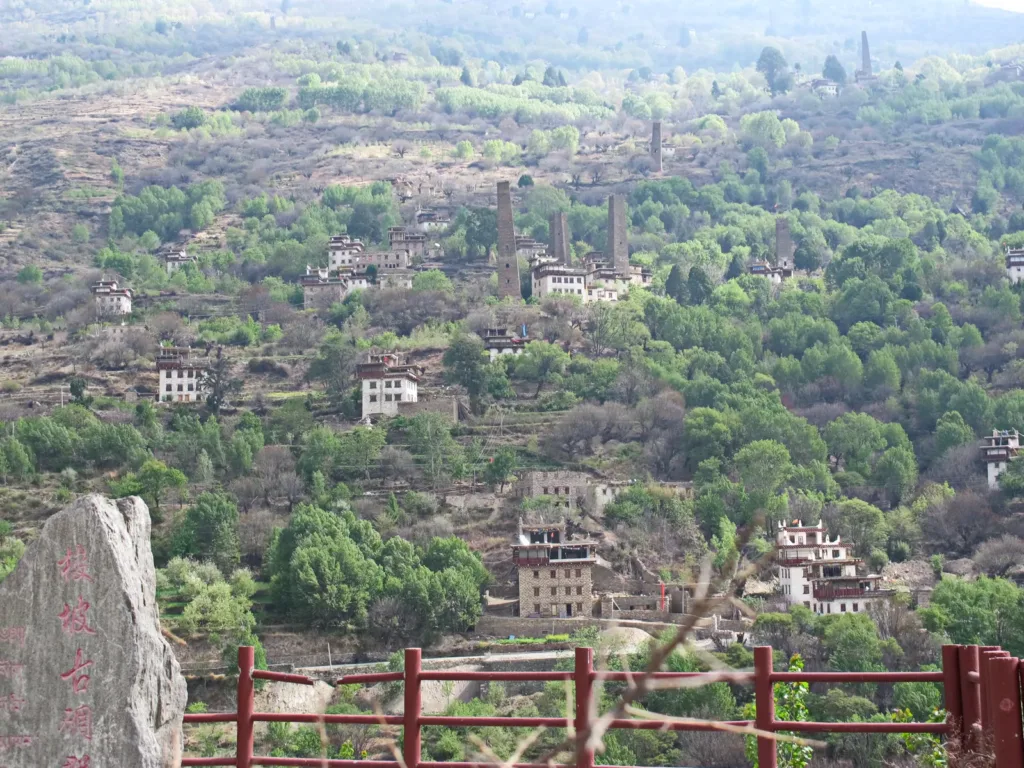
Suopo is best understood as a hillside settlement rather than a single monument. Danba County describes the towers as scattered along the valley slopes, sometimes in small groups and sometimes standing alone, with Tibetan houses running through the same landscape. From across the Dadu River, the towers rise above the slope in broken lines rather than forming one façade. A current visitor listing places the named attraction at Suopo Ancient Watchtower Residences in Molu Village, Suopo Township, Danba County, about five kilometres from the county seat. Use that as a practical locality, not as proof of a single official gate.
What to look at
Begin with the overall relationship between tower, house, field and river. The best view is not necessarily the closest one: from a public road or an open viewpoint across the river, separate towers become a pattern in the terrain, while the village houses show that this is a lived-in settlement rather than a reconstructed fort.
Then look at the masonry and the corners. Accounts of Danba’s towers describe stone walls that taper inward as they rise and plans ranging from four to thirteen corners. Some towers stood independently; others were built against family houses and served practical storage and defensive roles. The domestic buildings and the towers therefore belong to one architectural system, not two unrelated attractions.
The cluster also carries a wartime history. A 2015 report in the Ganzi Daily describes Suopo and Zhonglu as places recovered early in the second Jinchuan campaign of the 1770s, helping their towers survive while other parts of the region suffered heavy destruction. Published counts do not agree: different sources count a township, a cluster or surviving towers at different dates. It is more useful to read the surviving pattern on the hillside than to treat one number as a current visitor statistic.
Visiting with care
Many towers are interwoven with village homes and older structures. Stay on public paths, do not enter a courtyard or family tower without permission, and do not climb a tower simply because an opening is visible. An old architectural account records fragile interiors and high entrances; that description is historical rather than a promise of current access. Treat active worship spaces, private homes and protected structures as separate boundaries.
One current travel listing labels the attraction open all day year-round, but that does not establish that every tower, courtyard or interior is open. No current official ticket price, reservation rule or single visitor entrance was located for this dispersed heritage area. Confirm the day’s public access and any local charge at the village before entering.
Getting there
For a taxi or private car from Danba, give the driver the Chinese destination 梭坡古碉民居 Suōpō Gǔdiāo Mínjū, with the locality 甘孜藏族自治州丹巴县梭坡乡莫洛村 Gānzī Zàngzú Zìzhìzhōu Dānbā Xiàn Suōpō Xiāng Mòluò Cūn. This is the address shown by the current visitor listing. Ask where visitors may legally get out and arrange the return before walking into the village; no fare or journey time is assumed here. The sources used for this entry do not establish a dedicated bus, rail connection or shuttle to the towers.
Keep the Chinese name with you because the cluster is not a confirmed single-gate attraction. If the first drop-off looks like a private residence or a restricted structure, stop there and ask locally rather than crossing a courtyard or following an unmarked path.
Find Suopo Watchtowers
梭坡碉楼 · 丹巴县
The pin marks the area, not the entrance.
Sources & visit information
Sources checked on 1 November 2026. Hours, tickets, reservations and transport can change; confirm with the operator before you go.
Image credits & notes (1)
- Suopo's watchtower-and-village landscape on a Danba hillside, photographed from an opposite viewpoint. Photo: Nyx NingPhoto: CC BY-SA 3.0