

Explore the region
Why visit
Dege Parkhang began in 1729 under the Dege ruler Chokyi Dengba Tsering. The complex was expanded in stages, with major building and decoration work continuing into the mid-18th century. It was listed as a national-level Major Historical and Cultural Site Protected for its importance in 1996.
Its interest is not limited to the age of the building. The place brings together the physical tools of Tibetan book production, the texts those tools preserve, and a religious setting that is still part of Gengqing town. The operator describes holdings that include Tibetan Buddhist scriptures and other works, while a recent Dege County account describes the craft of carving and printing as an active local tradition rather than a display detached from its setting.
What to look at
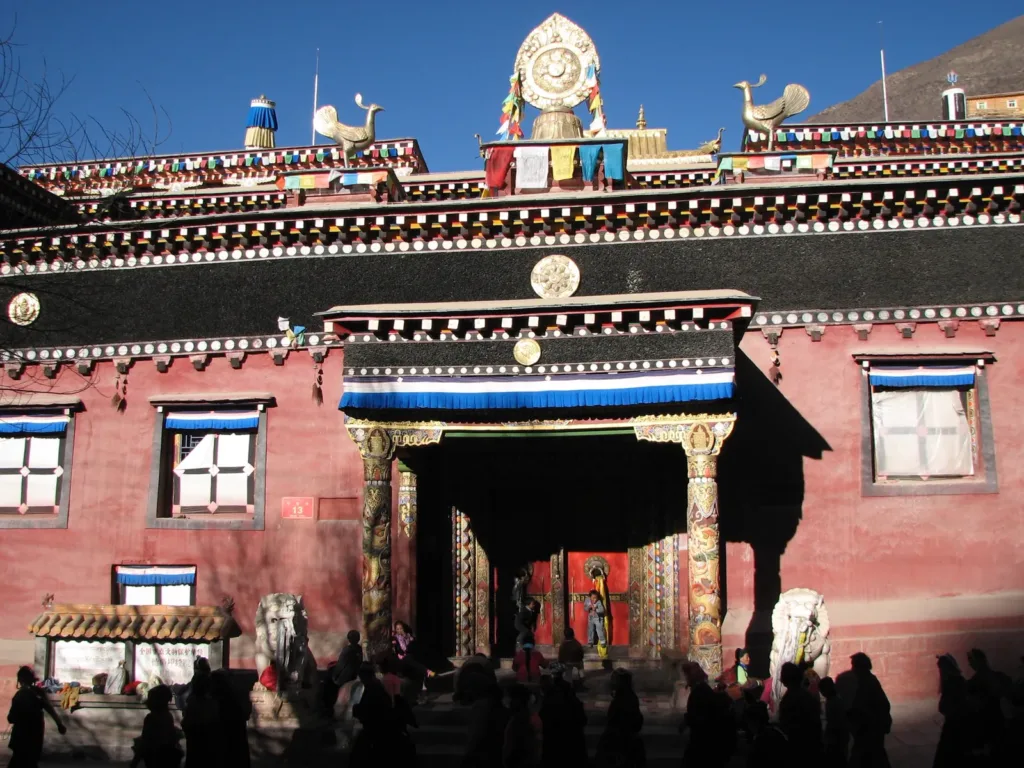
Begin with the exterior and the building form on Wenhua Street, then follow only the areas marked open to visitors. Inside, the most useful thing to notice is the relationship between the tightly stored wooden blocks and the finished pages they make possible. Look for the depth and regularity of the carved type, the wear on frequently used surfaces, and the way the racks turn a text tradition into a physical archive. The historic building also contains painted and sculpted decoration; view it as part of the site rather than as a separate gallery.
The printing process is unusually legible when explained step by step. The operator’s craft account describes locally prepared birch blocks, a writing stage followed by carving, and a washing and storage process after the block has been treated. It also describes smoke ink made from the bark of a local large rhododendron and paper made from the roots of a plant known in Chinese as 瑞香狼毒. Printing then moves through paper preparation, ink mixing, block selection, printing, drying, washing, collation, proofreading and binding. These stages explain why a page is not simply a modern reproduction with an old design: its texture records a chain of handwork.
If a printing room is open, watch the sequence and the tools rather than waiting for a staged demonstration. The operator does not publish a fixed demonstration timetable, and current access to storage, workrooms, murals or sculpture may vary. Do not cross barriers or handle blocks; keep the visit quiet around active religious and craft work.
Practical visit
The operator lists the address as 四川省甘孜州德格县更庆镇文化街17号 and gives the visitor number +86-836-8222096. Use the Chinese name 德格印经院 and this full address for the final approach. The public pages I could read do not identify a separate entrance, a current ticket price or a passport-specific reservation process, so call before setting out and ask which rooms are open, how entry is arranged on your date, and whether foreign visitors need any additional booking.
A Trip.com visitor listing displayed 09:00–11:30 and 14:00–16:30 when checked on 1 November 2026. This is a current listing rather than an official timetable; confirm the hours by phone, especially if you are travelling outside the usual season. The operator’s craft page says that printing traditionally runs roughly from the 15th day of the third Tibetan month to the 20th day of the ninth month, but that older description should not be treated as a promise of current production or visitor access.
There is no practical metro or rail leg to the site. The operator’s visitor guide, published in 2018, says that Chengdu did not then have a direct coach to Dege and described transfers through Ganzi or Kangding. It does not give a current arrival station or timetable, so confirm the road connection before departure rather than treating that old guidance as a live schedule. Once in Gengqing, show a local driver the Chinese destination and address above and ask them to confirm the present visitor entrance; do not assume that a map pin marks the gate.
The same visitor guide describes the Kham area as highland country with large temperature changes between day and night. Bring a warm layer and sun protection, and keep enough flexibility for road or weather delays.
Combine your visit
Suggested order for the visit:
-
Printing-house exterior
Look at the Tibetan building form.
-
Woodblock storage and permitted printing areas
Understand how texts are preserved and reproduced.
-
Murals and sculptural details
Continue only through spaces open to visitors.
This is an editorial sequence of named spaces or places. It does not imply a verified walking connection or promise opening, ticket availability or a journey time.
Find Dege Parkhang
德格印经院 · 德格县
The pin marks the area, not the entrance.
More places nearby
Approximate straight-line distances between map pins, not travel distances.
Litang Monastery 长青春科尔寺
257 km awayLitang Monastery, also called Changqingchun Ke’er Temple, spreads across the northern hillside of Litang. Its large temple halls and tiered setting make it more than a single shrine. Much of the visible complex has been…
View guide →Tagong Monastery 塔公寺
325 km awayTagong Monastery is a Sakya Buddhist temple within the highland town of Tagong. Thangka paintings, painted sculpture and wall decoration provide an intimate counterpoint to the open grassland outside. Its stupa group adds a…
View guide →Zhonglu Tibetan Village 中路藏寨
335 km awayZhonglu’s appeal is the pattern of terraced fields, clustered Tibetan houses and older watchtowers beneath the Muerduo mountain landscape. The buildings occupy different heights on the slope, so a village-lane view and a wider…
View guide →Sources & visit information
Sources checked on 1 November 2026. Hours, tickets, reservations and transport can change; confirm with the operator before you go.
Image credits & notes (1)
- Exterior façade and central doorway of Dege Parkhang, photographed on 30 March 2015. Photo: 6-A04-W96-K38-S41-V38Photo: CC BY-SA 4.0