

Explore the region
About Huili Ancient City
Huili was anciently called Huiwu and Huichuan; a county was founded here in 111 BC under the Western Han, and Huili was in turn the territory of a commandery, a prefecture, a circuit, a garrison and a department before it ceased to be a county and became a city in 2021; Sichuan Online derives the name from the phrase chuan yuan bing hui, zheng ping song li. Liangshan Daily describes the place as long a military and economic town on the Sichuan-Yunnan border and a collecting point for goods moving between the two provinces, noting that the ancient Southern Silk Road crosses the municipality from north to south for more than 100 km and through 44 townships, with the urban area an important staging post on it. Both papers record the old epithet for Huili, chuandian suoyue, the lock and key of Sichuan and Yunnan. In May 1935, after the Central Red Army crossed the Jinsha river and moved through Tong'an town towards the county town, the CPC Central Political Bureau held the enlarged meeting since known as the Huili Conference on 12 May at Tiechang, on the outskirts rather than inside the old city.
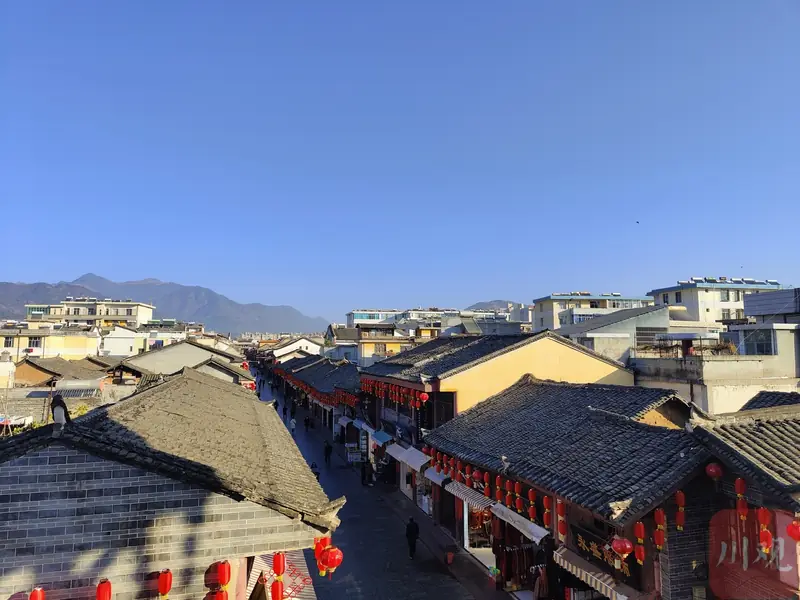
The old city is made up of an inner and an outer town, about 1,770 m north to south and 920 m east to west, and buildings of the Yuan, Ming, Qing and modern periods all survive within it. Four main streets run east, south, west and north from the bell-and-drum tower; the north and south streets are the commercial ones, the east and west streets carry the eating places, and with the three guan streets around the north gate they make seven principal streets. Huili's housing and urban-rural construction bureau describes the plan as four streets, three guan and twenty-three lanes on a north-south central axis, with shops that are mostly traditional earth-and-timber buildings of one storey over a ground floor under grey tile, and with Ming and Qing buildings, guild halls, dwellings and courtyard houses in its streets and lanes. Sichuan Online puts 170,000 square metres of old buildings and traditional dwellings in these streets. The old city tourist area was assessed by the Sichuan provincial tourism standards evaluation committee and approved as a national 4A-grade tourist scenic area.
What to look for
- Gongji Lou, the tower at the north entrance, standing on the thick old city wall – earth before the Yuan and faced with stone blocks in the Ming Hongwu reign.
- Lingxiao Lou, the bell-and-drum tower at the centre, begun in the twelfth year of Yongzheng and completed under Qianlong, its roof using the wuxing baoyue design of the Forbidden City corner towers.
- The Hu family courtyard house, lived in by fourteen generations over more than 400 years, where long eaves project in front of the main and wing rooms and join the door gallery – a form the family explains as suited to the local climate, letting the household move about in the rain and protecting the wall faces.
- The seven principal streets, four radiating from the bell-and-drum tower and three around the north gate, with shops on the north and south streets and eating places on the east and west.
- The twenty-three lanes of the grid, which the construction bureau describes, together with the streets, as carrying Ming and Qing buildings, guild halls, dwellings, old houses and courtyard houses.
Location & getting there
Getting to Huili Ancient City
Identify the main visitor approach and any separately managed houses, museums or performances. Ask before entering residential spaces or photographing residents.
- Search for 会理古城 with 凉山彝族自治州 and 会理市.

Find Huili Ancient City
会理古城 · 会理市
No reliable map pin yet: search by the Chinese name.
Sources & visit information
The linked sources support the identity and background described in this introduction. Opening hours, admission, activity availability and exact arrival arrangements have not been comprehensively checked. Confirm current visitor information with the venue; the original catalogue locality and editorial review flag are retained.
Image credits & notes (1)
- Huili Ancient City · 会理古城Photo: sichuan.scol.com.cnResized for the web; the photo itself has not been edited.