

Explore the region
About Tiangong Temple
Yuan Tiangang, from Chengdu, held the Tang-dynasty office of 火山令, thought to be a divination-related post; Li Chunfeng, an early-Tang Grand Astrologer from Qishan County, Shaanxi, is described by People's Daily Overseas Edition as the world's first scientist to grade wind by scale. Both are described as noted historical astronomers and fengshui masters, co-authors of the 'Pushing Back the Chart' (推背图), which the China News Service article calls a legendary work of Eastern prophecy, with Yuan Tiangang described as honored as the founding figure of Chinese fengshui.
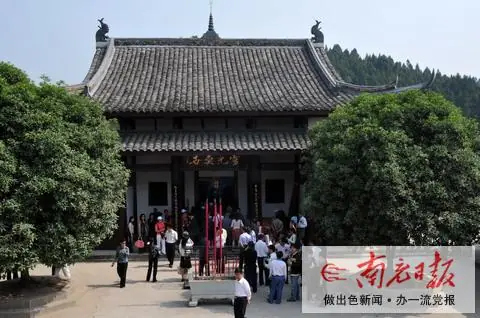
Local tradition, as recounted by He Huijun, deputy curator of the Langzhong Fengshui Museum, holds that the two men surveyed the whole layout of Langzhong's old city in the Tang dynasty and moved it south to its present site, after the Han-dynasty city had repeatedly flooded; a related legend recorded by China News Service describes Yuan Tiangang being sent by Emperor Taizong to sever a 'dragon vein' at nearby Panlong Mountain to block an omen of dynastic change, an episode still marked by the place name 'Sawn Mountain Pass'. Yuan is said to have then resigned his post to settle in Langzhong, followed two years later by Li Chunfeng, and the two together built Tiangong Yuan.
A temple docent recounted to China News Service a further legend that the pair chose the temple's site, 'Shengbao Hill', by each independently searching for a burial spot — Yuan with a copper coin, Li with a golden needle — and finding the needle exactly through the coin's hole when they compared results. The temple sits amid nine surrounding mountain ranges, described in a People's Daily Overseas Edition account as forming a pattern of 'nine dragons honoring the sage'; both masters are said to be buried on two hills near the temple, their tombs facing each other: Yuan Tiangang on Guanjia Hill and Li Chunfeng on a terrace hill that China News Service calls Wuli Terrace and the People's Daily Overseas Edition calls Wulong Terrace. The two accounts invert the compass sides: the China News Service sentence pairs Guanjia Hill and Wuli Terrace with south and north in that order, while the People's Daily Overseas Edition puts Guanjia Hill north of the temple and the terrace to its south. Neither reading is adopted here over the other.
What to look for
- Tiangong Yuan, the temple built to commemorate Yuan Tiangang and Li Chunfeng
- the tombs of Yuan Tiangang and Li Chunfeng, on hills to the north and south of the temple
- 'Sawn Mountain Pass' at nearby Panlong Mountain, the site of the dragon-vein legend
Location & getting there
Getting to Tiangong Temple
Check which interiors and courtyards are accessible. Active places of worship and protected monuments may have different visitor rules.
- Search for 天宫院 with 南充市 and 阆中市.
Find Tiangong Temple
天宫院 · 阆中市
No reliable map pin yet: search by the Chinese name.
Sources & visit information
The linked sources support the identity and background described in this introduction. Opening hours, admission, activity availability and exact arrival arrangements have not been comprehensively checked. Confirm current visitor information with the venue; the original catalogue locality and editorial review flag are retained.
Image credits & notes (1)
- Tiangong Temple · 天宫院Photo: baike.baidu.comResized for the web; the photo itself has not been edited.