

Photo adjustments
Full-frame source proportionally resized and converted to WebP for display. No subject alteration. Source-supplied marks and edits remain; cards may crop the view.
Explore the region
About Lotus Pond
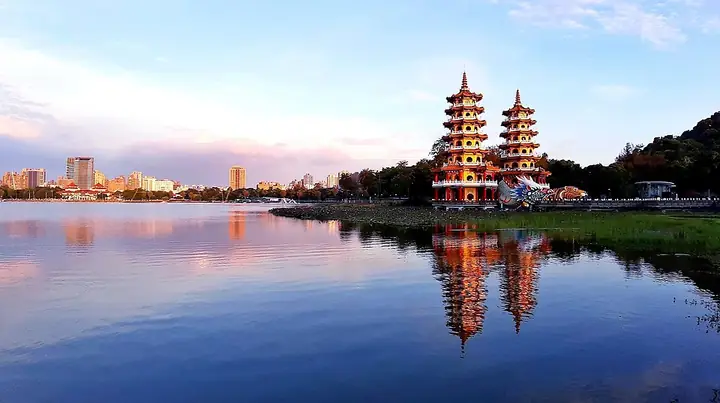
The Dragon and Tiger Pagodas are its best-known pair: the entrance bridge leads to sculpted animal gateways, and the interiors contain narrative decoration. Follow the site’s signed visitor route rather than assuming every level is open.
The Spring and Autumn Pavilions provide another landmark along the shore. At the northern end, Kaohsiung Confucius Temple offers a more formal courtyard-and-hall setting. Choose a section of the waterfront and a few temples so the visit includes time to look at details rather than simply circle the lake.
What to look for
- The Dragon and Tiger Pagodas combine sculpted gateways and decorated interiors.
- The Spring and Autumn Pavilions add another waterside temple ensemble.
- The northern Confucius Temple contrasts with the more colourful lakeside shrines.
The surrounding area
A distinct southern port city for Pier-2 and harbor-oriented cultural exploration.
Location & getting there
Getting to Lotus Pond
Use Liantan Road in Zuoying District as the lakeside arrival anchor. Zuoying high-speed rail and MRT station is a transfer point for onward bus or taxi travel; it is not directly at the pagoda entrance.
Combine your visit
Build the visit around these complementary stops.
-
Dragon and Tiger Pagodas龍虎塔
Begin with the entrance bridge and decorated gateways.
-
Spring and Autumn Pavilions春秋閣
Continue to another distinctive lakeside ensemble.
-
Kaohsiung Confucius Temple高雄孔子廟
Add the northern temple if your chosen route and time allow.
Use the current visitor programme and local conditions to choose which stops to include.

Find Lotus Pond
蓮池潭 · 高雄市
The pin marks the area, not the entrance.
More places nearby
Approximate straight-line distances between map pins, not travel distances.
Pier-2 Art Center 駁二藝術特區
7 km awayPier-2 turns former harbour warehouses into a district of exhibitions, public art and open pedestrian spaces. The industrial buildings remain an important part of the experience: broad doors, loading areas and railway remnants…
View guide →Cijin District 旗津
14 km awayCijin is a long coastal district at the mouth of Kaohsiung’s harbour. The ferry arrival brings you into a neighbourhood of temples, food streets and seafront paths. Cihou Fort adds defensive history through its brickwork…
View guide →Fo Guang Shan Monastery 佛光山
17 km awayFo Guang Shan is a hillside Buddhist monastery founded by Hsing Yun in 1967. Its halls, courtyards and large Buddha figures occupy several connected hills, making the layout part of the visit. The Great Hero Hall is a principal…
View guide →Sources & visit information
The sources below support the place-specific description and arrival information. Suggested combinations are editorial planning ideas; confirm current opening, entry arrangements and transport services for your date.