


Photo adjustments
Proportionally resized and converted to WebP without cropping, retouching or changing the photographed subject.
Explore the region
About Qingwang Mansion
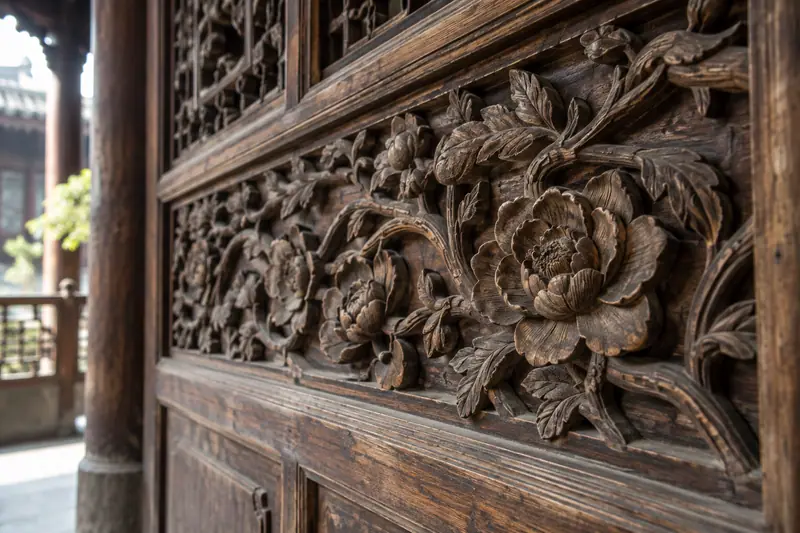
Built first for the former court eunuch Zhang Lande and later acquired by Prince Qing's son Zaizhen, it centers on a tall square atrium surrounded by rooms and galleries. Colored glazed balustrades, stained glass and carved woodwork provide the most distinctive details. The compound is part of the Five Avenues' changing residential history, so compare the interior's ceremonial character with the quieter villa streets outside.
The mansion was originally built as a private residence for Zhang Lande (张兰德), the eunuch known as Xiao Dezhang, who left the Qing palace in 1913 and settled in Tianjin's British concession. He bought the land in 1922 and completed the house the following year, living there for three years. In 1925 Zaizhen (载振), son of Prince Qing Yikuang, purchased the building, renamed it Qingwang Mansion, added an extra story as an ancestral hall, and lived there until his death on 31 December 1947, a residence of twenty-one years.
After 1949 the mansion was taken over by the military control commission and later served as the Tianjin branch of the Sino-Soviet Friendship Association and as offices for municipal foreign-trade and commerce agencies; from 1968 it housed the Tianjin municipal foreign affairs office for more than forty years. It was listed as a Tianjin cultural relic in 1991, and a restoration led by the Tianjin historic-building management company, working with several Tianjin universities, was completed in 2010-2011.
As part of the Five Avenues' modern architecture complex, the mansion has also been approved by the State Council as a Major Historical and Cultural Site Protected at the National Level (全国重点文物保护单位), and it is a heritage building under special protection (特殊保护等级历史风貌建筑).
What to look for
- The tall central atrium and surrounding galleries.
- Blue, green and yellow glazed balustrades, stained glass and carved interior decoration.
Location & getting there
Getting to Qingwang Mansion
Qingwang Mansion is at 55 Chongqing Road in Heping, within the Five Avenues neighborhood.
Combine your visit
Suggested order within this visit:
-
Courtyard and exterior galleries
Begin with the mixture of brickwork and glazed detail.
-
Central atrium
See the organizing space of the mansion if included in admission.
-
Minyuan Square民园体育场
Continue along Chongqing Road to the former sports ground.
This sequence is an editorial suggestion based on the features described in the sources. Access to individual buildings or areas should be checked locally; no travel time or shared admission is implied.
Find Qingwang Mansion
庆王府 · 和平区
The pin marks the area, not the entrance.
More places nearby
Approximate straight-line distances between map pins, not travel distances.
Minyuan Stadium 民园体育场
Less than 1 km awayMinyuan began as a sports ground in Tianjin's former British concession and later became a familiar football venue. Its association with Olympic runner and missionary Eric Liddell connects the site with the city's international…
View guide →Five Great Avenues 五大道
Less than 1 km awayThe Five Great Avenues are a residential district of former concession-era villas, not five grand monuments. Chongqing, Changde, Dali, Munan and Machang roads carry a mixture of European architectural influences, with…
View guide →Astor Hotel Heritage Museum 利顺德博物馆
1 km awayThe Astor Hotel's museum turns a working historic hotel into a window on Tianjin's treaty-port society. Portraits, documents and objects recall its guests and diplomatic role, while items associated with early electric lighting…
View guide →Sources & visit information
The linked encyclopedia sources support background and place descriptions. Current opening hours, ticket prices, booking rules and transport schedules have not been independently verified for this guide. Confirm them with the venue or operator before travelling.
Visitor information adapted and edited from Wikipedia contributors · CC BY-SA 4.0. Source revision 90268845.
Background paragraphs translated and condensed from Wikipedia contributors, "天津庆王府", Chinese Wikipedia · CC BY-SA 4.0. Source revision 90268845.