

Entry & permits for Tibet (Xizang)
Foreign tourists need Tibet entry approval, commonly called a Tibet Travel Permit, and an organised visit arranged through a specialist travel agency in China. Confirm your approved route before booking transport. Requirements differ for Taiwan residents and for travellers using mainland or Hong Kong/Macao Chinese resident documents; check the document guide before you book.
Check the travel-document requirements →Policy scope verified: 2026-09-06. UK FCDO: China regional travel advice ↗ State Council Taiwan Affairs Office: Tibet entry approval ↗ Xizang Department of Culture and Tourism: Medog border permit notice ↗
Explore the region
Tap any red Chinese text to hear it in Mandarin.
Why visit
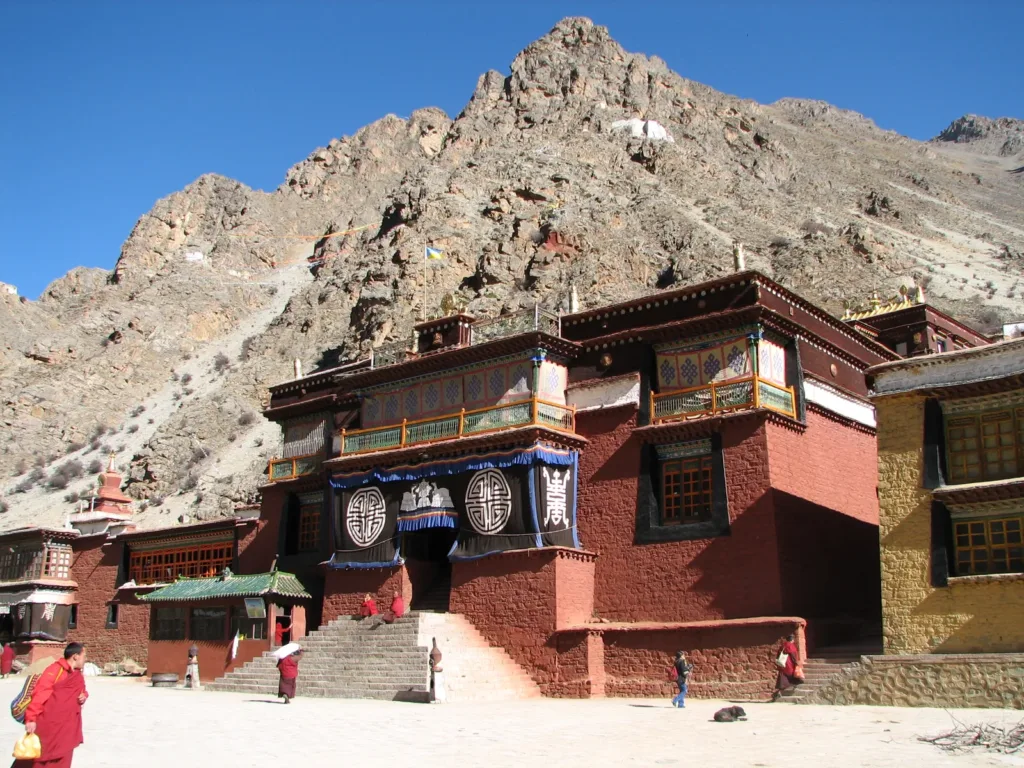
The monastery was established in the late 12th century by Düsum Khyenpa, the first Karmapa; sources date the main foundation to 1187 or 1189. The complex was badly damaged during the Cultural Revolution and rebuilding began in 1980. It remains an important Karma Kagyu monastery, with halls and retreat sites spread through the valley rather than arranged as a compact old-town attraction.
From the monastery, pay attention to the south-facing main complex beside the Chubu River, the surrounding slopes, prayer flags, and the line of halls connected with the Karmapa tradition. A visitor guide describes a roughly 4 km kora that rises about 150 metres past springs, shrines, and meditation retreats. At this altitude, that walk is a demanding mountain outing, not a casual extension of the courtyard visit.
Rituals and what you may see
The best-known public ritual is the annual unfolding of a 26-metre-wide Sakyamuni appliqué thangka. A report from Tsurphu places it on the 11th day of the fourth Tibetan month: the image is carried from the Great Buddha Hall towards the protector mountain Magala, above 4,700 metres, and unrolled down the slope. Another report describes the annual Li Taqin rite, meaning the raising of a prayer-flag pole, at which large numbers of worshippers gathered. These are religious observances, not scheduled performances, and a particular year’s date, access, or viewing area must be confirmed before you plan around them.
Access, permits and practical limits
Tsurphu is a religious site in a remote, high-altitude valley. Foreign tourists must obtain Tibet travel approval through a specialist travel agent in China and travel on an organised tour, according to current UK government travel advice. Put Tsurphu on the approved itinerary before booking your transport. Do not assume that holding a monastery ticket permits entry into Tibet, and do not assume that a general Tibet permit or a domestic visitor reservation automatically proves access to this specific site. The permit requirement and the monastery’s admission charge are separate matters; this guide does not offer a way around either.
The monastery’s own current ticketing and visitor notice were not available in the sources reviewed. One commercial visitor guide lists CNY 45 and 09:00–14:00, while labelling both as reference information; treat those figures as provisional and confirm them through your permitted tour operator or the monastery before departure. Opening a hall, joining a ritual, and entering the wider religious compound may not have identical rules.
Getting there
Use the Chinese destination name 楚布寺 Chǔbù Sì, with 堆龙德庆区 Duīlóngdéqìng Qū and 古荣/楚布沟 as the location context. No current metro link or reliably verified public bus timetable was found. A secondary guide records a bus near Jokhang Temple with a 07:00–08:00 departure and a 15:00 return, but it does not provide a current operator notice; do not treat that listing as a guaranteed service. The practical plan is a pre-arranged road transfer with the specialist agency running your organised Tibet itinerary. Confirm the exact visitor entrance, road conditions, and the vehicle waiting for your return before leaving Lhasa.
Respect and altitude
Allow time to acclimatise in Lhasa before attempting the higher slopes or kora, and stop rather than pushing on if you feel unwell. Follow monastery instructions, keep clear of religious work and worshippers, and ask before taking photographs; this is an active Buddhist institution, not a staged cultural display.
Find Tsurphu Monastery
楚布寺 · 堆龙德庆区
The pin marks the area, not the entrance.
Sources & visit information
Sources checked on 23 October 2026. Hours, tickets, reservations and transport can change; confirm with the operator before you go.
Image credits & notes (1)
- The main hall of Tsurphu Monastery beneath the barren mountain slope in the Tsurphu valley, Tibet. Photo: McKay SavagePhoto: CC BY 2.0