

Entry & permits for Tibet (Xizang)
Foreign tourists need Tibet entry approval, commonly called a Tibet Travel Permit, and an organised visit arranged through a specialist travel agency in China. Confirm your approved route before booking transport. Requirements differ for Taiwan residents and for travellers using mainland or Hong Kong/Macao Chinese resident documents; check the document guide before you book.
Check the travel-document requirements →Policy scope verified: 2026-09-06. UK FCDO: China regional travel advice ↗ State Council Taiwan Affairs Office: Tibet entry approval ↗ Xizang Department of Culture and Tourism: Medog border permit notice ↗
Explore the region
Tap any red Chinese text to hear it in Mandarin.
Why visit
Reting is a religious site in a quiet mountain valley, not a city-centre stop. The monastery was founded by Dromtonpa in 1056–1057 after the arrival of Atisha’s teachings, and it became the first monastery of the Kadam school, the tradition that later developed into the Gelug school. The site remains a monastery rather than a museum reconstruction.
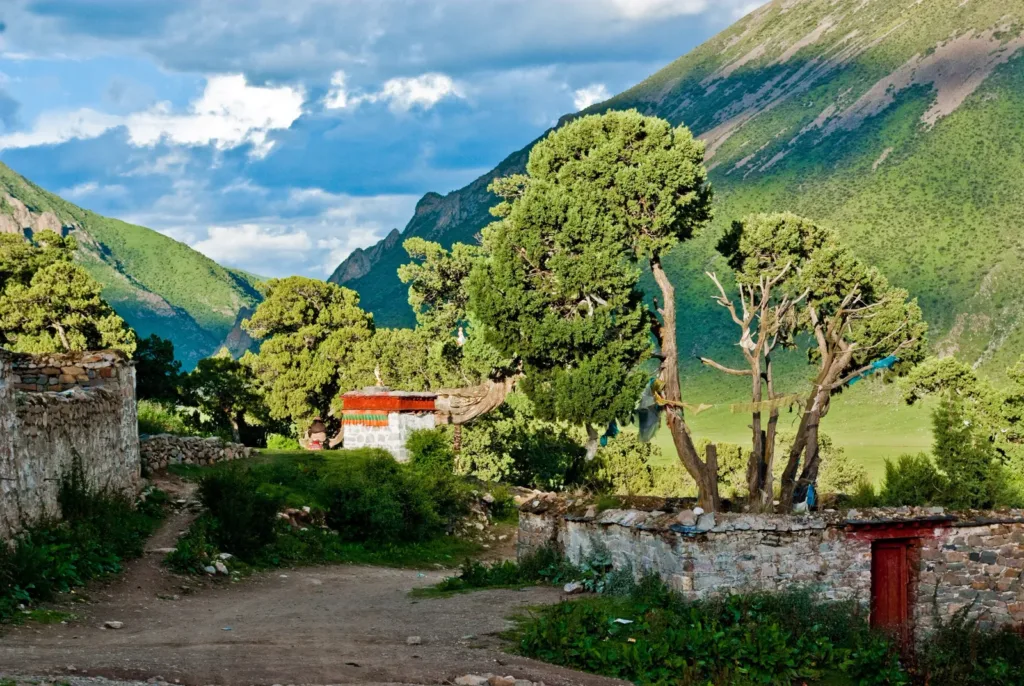
The approach is part of the experience. Reting National Forest Park surrounds the monastery with old cypresses and a valley landscape; a 2025 Lhasa government report specifically describes a forest-park viewing trail and ancient cypresses around the temple. At roughly 4,200–4,230 metres, the forest, thin air and changing weather are part of the visit, not background scenery.
What to look for
Start outside with the cypress-covered hillsides and the monastery’s setting below Puyang Gangqin Mountain. Inside, the main Tsokchen assembly hall is the place to look for Jowo Jampel Dorje, an unusual image associated with Atisha, together with the hall’s scripture-lined double walls and thangkas. The three-storey Reting Labrang, the lama’s residence west of the main hall, is another useful architectural reference point. These are objects and spaces of worship, so observe quietly and follow local instructions rather than treating the interiors as a photo set.
Reting’s history is also unusually concentrated in a small site. The monastery was later absorbed into the Gelug tradition, was connected with the Reting Rinpoche lineage, and suffered major destruction before restoration began in the 1980s. Those layers are why the surviving hall, relic shrines and rebuilt areas should be read as a living religious complex with a difficult history, not as a single intact medieval building.
Visiting and access
Tibet entry permission is separate from monastery admission
For foreign tourists, the UK Foreign, Commonwealth & Development Office advises that travel to Tibet and the Tibet Autonomous Region requires a permit arranged through a specialist travel agent in China and an organised tour; permits or regional access can also change without notice. Confirm that Reting is included in the approved itinerary before booking the road transfer. This Tibet entry and hosting requirement is separate from any monastery admission, local site ticket or reservation. Do not assume that a ticket, a map listing or a visit to central Lhasa makes an independent trip to Reting lawful.
Reting is a Buddhist monastery. Ask before photographing, especially inside shrines, and do not photograph worshippers or monastics without permission. Keep voices low, stay on marked or clearly open paths, and treat any devotional objects or ritual activity as part of an active religious place.
Current official visitor information for opening hours, admission fees, reservation procedure and foreign-passport ticketing was not found in the sources read for this entry. A commercial guide lists a 07:00–19:00 opening window, a CNY 30 admission fee and a 07:30 bus from Lhasa East Suburb Station, but it does not provide current operator confirmation; treat those figures as leads only and verify them through the approved agency or the site before travelling.
Getting there and returning
This is a remote road excursion from Lhasa in Tanggu Township, Lhünzhub County. No current public-bus timetable and return service could be independently verified. The practical option for a foreign visitor is an approved organised road transfer with the agency and guide responsible for the Tibet itinerary. Give the driver the Chinese destination 热振寺,林周县 Rèzhèn Sì, Línzhōu Xiàn and confirm the actual visitor entrance, road condition and same-day return before departure. Keep the arranged vehicle for the return rather than relying on an unverified local bus.
There is no useful metro or city-bus connection to the monastery. Build in time for a high-altitude road day, and confirm weather, seasonal forest access and any local religious or safety restrictions close to departure. The monastery’s high setting makes acclimatisation in Lhasa and a conservative pace sensible, but it does not replace medical advice for altitude illness.
Find Reting Monastery
热振寺 · 林周县
The pin marks the area, not the entrance.
Sources & visit information
Sources checked on 23 October 2026. Hours, tickets, reservations and transport can change; confirm with the operator before you go.
- Lhasa Municipal Government report on Reting Monastery and Reting National Forest Park ↗
- China Tibetology Research Center, Reting Monastery: A History and Reflection ↗
- People's Daily citing Xinhua, Reting Monastery in the Forest ↗
- UK Foreign, Commonwealth & Development Office, China regional risks ↗
- Tibet Vista, Reting Monastery travel guide ↗
Image credits & notes (1)
- Reting Monastery grounds with old cypresses, stone walls, a small shrine-like structure and steep mountain slopes behind, Tibet. Photo: Antoine TaveneauxPhoto: CC BY-SA 3.0