

Entry & permits for Tibet (Xizang)
Foreign tourists need Tibet entry approval, commonly called a Tibet Travel Permit, and an organised visit arranged through a specialist travel agency in China. Confirm your approved route before booking transport. Requirements differ for Taiwan residents and for travellers using mainland or Hong Kong/Macao Chinese resident documents; check the document guide before you book.
Check the travel-document requirements →Policy scope verified: 2026-09-06. UK FCDO: China regional travel advice ↗ State Council Taiwan Affairs Office: Tibet entry approval ↗ Xizang Department of Culture and Tourism: Medog border permit notice ↗
Explore the region
Tap any red Chinese text to hear it in Mandarin.
Why this place is worth the detour
The name on this page brings together two linked sides of Bomi’s landscape. 波密桃花沟 Bōmì Táohuā Gōu and 波堆桃花谷 Bōduī Táohuā Gǔ are used by official tourism pages for the broad blossom country around Bomi. A county tourism notice describes the valley across 扎木镇, 古乡 and 倾多镇, while a city tourism guide lays out village-to-village spring routes. 岗云杉林 Gǎng Yúnshānlín is the forest side of the same wider outing, not a second name for a single peach-blossom gate.
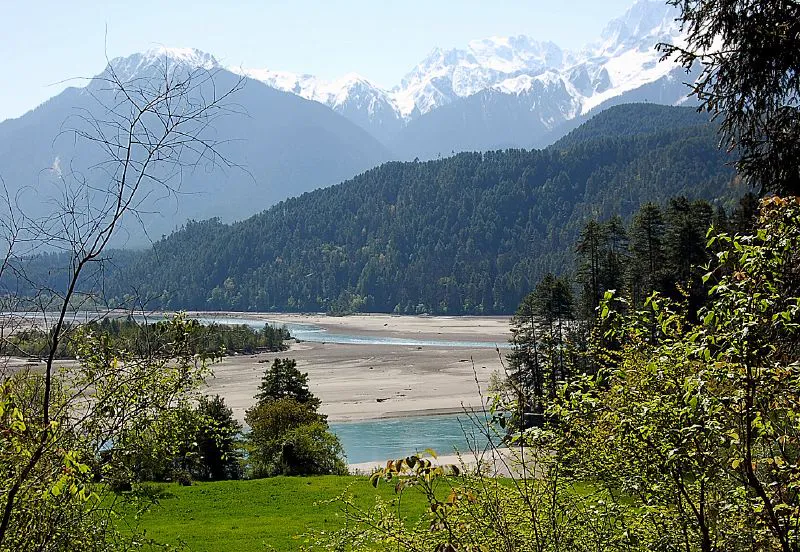
Come for the way the flowers occupy a working valley rather than a landscaped garden. The peach trees stand beside barley fields, village houses, river corridors and mountain roads, with snow peaks appearing beyond them when the weather clears. Official descriptions identify the wild trees as 光核桃 Guānghétáo and give landscape-scale estimates of roughly 180,000–200,000 trees, with average ages described in different years as about 360 to 400 years. These are survey and tourism estimates, not a current tree census.
The forest changes the rhythm of the visit. In Gangxiang Spruce Forest, tall spruce, fir and other conifers mix with broad-leaved trees; spring rhododendrons, streams and 草湖 Cǎo Hú give you details to watch after the open blossom views. An older Ministry of Culture and Tourism route description places the forest south of 古乡巴卡村, about 6 km from G318, and names 草湖 as a meadow lake formed where water from the 帕隆藏布 reaches the grassland. Treat that description as useful orientation, not proof of a current gate or trail schedule.
What to look for
For the blossom valley, slow down at the village and field edges instead of trying to photograph every tree from the road. Look for the contrast between the low, spreading 光核桃 crowns, new barley, dark forested slopes and snow. The 2024 city tourism guide’s blossom route links 如纳村、倾多镇、巴康村、玉许乡 and 古通村 before returning to G318. Those are village stops within a long landscape, not separate attractions with guaranteed facilities.
Use the forest route for a different scale of view. The same guide links Bomi county town, G318, 嘎朗村, 古乡, 岗云杉林 and 扎木镇岗美村. Inside the forest, notice the straight trunks and the change from open farmland to shaded woodland; if 草湖 is open, read it as part of the meadow and water system rather than as a standalone lake attraction. Do not leave signed or locally indicated paths to reach water, steep slopes or unmarked forest areas.
Villages here are lived-in places. Photograph fields, houses and people only from places where you are welcome, ask before taking portraits, and do not enter yards or trample crops for a better angle. A festival or blossom-season gathering is not a promise that a performance happens every day.
Season, tickets and practical limits
The blossom window is short and varies by year. A 2024 Bomi guide gives mid-March to mid-April; older official descriptions extend the useful period into late April, while a 2025 tourism feature describes the strongest display as roughly two to three weeks. Plan around the current Linzhi/Bomi flower forecast rather than carrying a past season’s dates forward.
The reviewed official pages do not establish a current unified ticket, forest admission fee, reservation channel or opening-hours notice for this composite landscape. Do not assume that “桃花沟” is either permanently free or a single paid scenic area. Ask locally which road, viewing ground or managed section is open that day, and keep any separate forest, shuttle or village activity charge distinct from a general landscape visit.
The forest and mountain roads need a conservative approach. Stay on open roads and marked or locally designated paths, follow conservation instructions, and do not turn a blossom stop into an unmanaged forest trek. Weather can alter road and trail conditions even when flowers are in bloom.
Foreign visitors must settle Tibet access before planning this stop: the current UK government travel advice says that travel to Tibet and the Tibet Autonomous Region requires a permit obtained through a specialist travel agent in China and an organised tour, and that permits or regional access can be restricted without notice. A domestic-ID booking rule should not be read as a passport-ticket guarantee.
This entry does not grant access to 墨脱 or other border-management areas. If an itinerary continues into a border area not open to foreign visitors, an official notice hosted by the Xizang culture and tourism authority lists additional requirements for foreign nationals, including a valid travel document, an 进藏批准函 Jìn Zàng Pīzhǔnhán and a 中华人民共和国外国人旅行证 Zhōnghuá Rénmín Gònghéguó Wàiguórén Lǚxíngzhèng. Check the exact route with the organising agency and authorities; do not add a border detour on the assumption that it is covered by a Bomi blossom visit.
Getting there and getting back
Road travel is the practical way to combine these places. The official 2024 route descriptions give two useful frameworks:
- For the blossom valley: 波密县城 → 如纳村 → 倾多镇 → 巴康村 → 玉许乡 → 古通村 → G318.
- For the forest side: 波密县城 → G318 → 嘎朗村 → 古乡 → 岗云杉林 → 扎木镇岗美村.
These are route relationships, not current public-transport timetables. Use a private or chartered road vehicle, or travel inside the organised Tibet itinerary that is handling your permit, and agree the return connection before entering the long, distributed valley. The official sources reviewed here do not establish a current scheduled bus, railway arrival or seasonal shuttle serving each village.
For a driver, show 波密桃花沟(波堆桃花谷) for the blossom landscape. For the forest, show 岗云杉林(古乡巴卡村南部). The Ministry of Culture and Tourism’s route page gives the forest’s orientation as south of 巴卡村 and about 6 km from G318; it does not establish one current visitor gate. Confirm the day’s open road and drop-off point with the driver or local visitor staff before leaving Bomi.
There is no applicable metro or water transport. Do not replace the distributed valley with a guessed map pin, and do not plan a late return around an unverified coach departure. The county town, 古乡 and the villages named above are useful road anchors, but they are not interchangeable entrances.
Find Gangxiang and Bomi Peach Blossom Valleys
岗乡桃花与波密桃花沟 · 波密县
The pin marks the area, not the entrance.
Sources & visit information
Sources checked on 1 November 2026. Hours, tickets, reservations and transport can change; confirm with the operator before you go.
Image credits & notes (1)
- A landscape in Gangxiang Nature Reserve, Bomê County, with forested slopes, turquoise water and snow peaks; photographed in May 2007. Photo: Gao (Flickr user star_trooper)Photo: CC BY 2.0