


Get to know Bomê County
- Administrative area
- County · 县
- Part of
- Nyingchi
- Chinese name
- 波密县
- Local areas
- County guide
Area & population
- Area
- 16,072.00 km²
- Population · 2020
- 34,858
Source: English Wikipedia, as of the dates shown.
A county of changing landscapes
Bomê is not a single scenic gate. Its inhabited valleys and roads run between the Nyenchen Tanglha and Himalayan ranges, with forests, meadows, rivers, lakes and glaciers appearing at different elevations. The official county description presents the Parlung corridor as a broad valley and identifies National Highway G318 as the main east–west road, while county roads branch into the Yigong and other tributary valleys.
That geography shapes the visit. Zhamu, the county seat, is the sensible service base. West of town, the Guxiang and Galang area combines lake, village and forest scenery; Gangyun Spruce Forest lies near Baka Village in Gangxiang. Farther east, Yupu Township leads toward Midui Glacier. Yigong, with its lake, tea-growing area and historical sites, is another separate extension rather than a spare stop on a town walk.
What to look for
Start with the transition between cultivated valley and old forest. Gangyun Spruce Forest is in Baka Village, Zhamu Town, at about 2,700 metres; the local tourism authority describes stands dominated by spruce and pine, with many trees around 70–80 metres tall and roughly 300–400 years old. Walk slowly enough to notice the change in light, the wet ground and the scale of the trunks, rather than treating the forest as a single photo point.
Galang Lake, in Galang Village in the Guxiang area, is a gentler companion to the forest. The lake and nearby houses, fields and peach trees show how the valley is lived in, while local accounts associate the place with the former Galang kingdom. Keep to public paths and viewpoints, and do not turn residents or working farmland into a staged attraction.
Midui is the county’s clearest ice-to-village experience. The glacier is in Midui Village, Yupu Township, about 100 kilometres east of the county seat and 8 kilometres from G318 according to official tourism descriptions. Forest, fields and village life remain part of the view as the ice descends toward the valley. The final visitor route has had a shuttle-and-walk or other locally arranged combination in recent guidance; confirm the current entrance, vehicle service and walking boundary before setting out.
Yigong is worth treating as its own valley excursion. The county government describes the area through Yigong Lake, the tea-producing area and mountain scenery, and the national rural-tourism route also lists the Yigong General’s Building among its historical sites. Allow the road distance and current local access to determine whether it belongs in your itinerary; do not imply that a single county-town ticket or shuttle covers it.
Planning the visit
A compact plan can use Zhamu for arrival and accommodation, group the western Guxiang–Galang–Gangyun sights on one outing, and reserve a separate full road day for Midui. If your approved route and road conditions allow more time, add Yigong as another corridor. This is a planning scale, not a promise of travel time: the county is large, and a map pin for Bomê does not identify a scenic entrance.
Spring is the season associated with the peach valleys. A Ministry of Culture and Tourism rural-tourism route gives roughly mid-March to late April as the main blossom period, but flowering varies with weather and altitude. Treat that as a seasonal indication, not a guaranteed event calendar.
Do not carry over the 15 October 2024–15 March 2025 winter campaign as a current price or admission rule. That campaign offered free admission at some Linzhi A-level attractions but still charged a shuttle fee at Midui; its dates have passed. Check each attraction’s current ticket, shuttle and reservation terms separately.
Travel, permits and boundaries
The currently documented visitor connections to Bomê are road-based. Linzhi tourism guidance published in November 2024 described a coach from the Linzhi Passenger Transport Centre to Bomê county town, followed by a hired vehicle or charter for Midui or Gangyun. The same guidance gave a historical fare and schedule context, not a standing timetable; confirm the next departure, price and return arrangement locally before relying on it.
The county’s January 2026 government report discusses the Sichuan–Tibet Railway, the proposed Bomê–Ranwu railway and a general airport as projects or works in progress. They should not be used as current passenger stations or airport services in a Bomê itinerary.
For foreign visitors, the current UK government regional advice says Tibet and the Tibet Autonomous Region require a permit arranged through a specialist travel agent in China and an organised tour. Confirm that your approved route specifically includes Bomê before booking the road section; a domestic-ID instruction at a scenic gate does not by itself establish foreign-passport acceptance. Older Chinese government guidance also described separate border-area travel documentation, so any extension toward Motuo, Chayu or another border-sensitive route needs a fresh check with the authorised operator and local authorities. Do not infer permission for those routes from a Bomê county visit.
Mountain weather, landslides and road works can change access. Keep a return plan, do not enter glacier ice, lake margins or forest tracks that are closed or unmanaged, and follow the current signs and instructions at each local visitor area.
Entry & permits for Tibet (Xizang)
Foreign tourists need Tibet entry approval, commonly called a Tibet Travel Permit, and an organised visit arranged through a specialist travel agency in China. Confirm your approved route before booking transport. Requirements differ for Taiwan residents and for travellers using mainland or Hong Kong/Macao Chinese resident documents; check the document guide before you book.
Check the travel-document requirements →Policy scope verified: 2026-09-06. UK FCDO: China regional travel advice ↗ State Council Taiwan Affairs Office: Tibet entry approval ↗ Xizang Department of Culture and Tourism: Medog border permit notice ↗
Explore Bomê County
Core places to explore, with English and Chinese names.
Places to explore around Bomê County
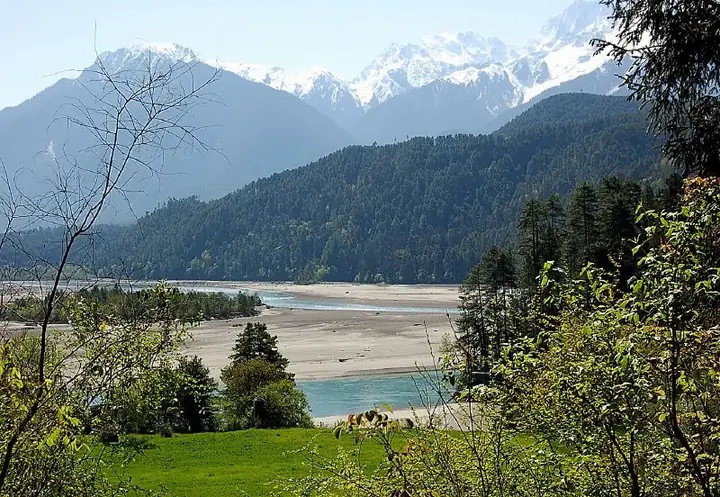
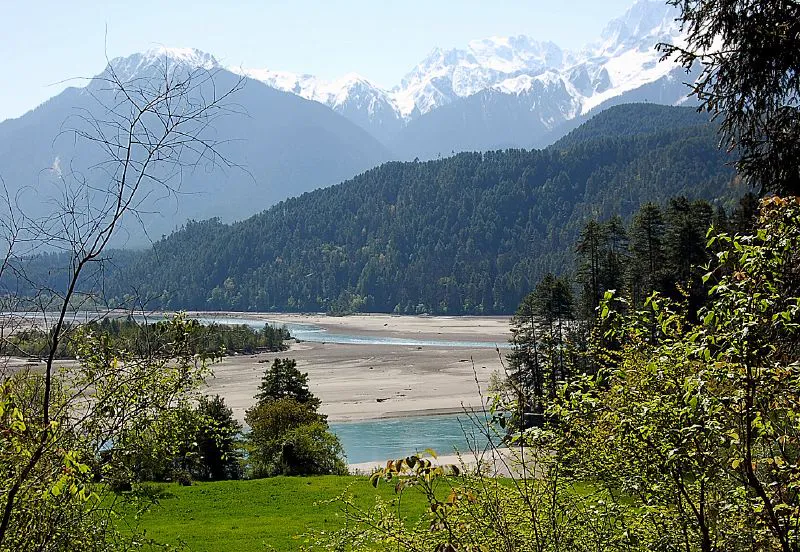 A landscape in Gangxiang Nature Reserve, Bomê County, with forested slopes, turquoise water and snow peaks; photographed in May 2007. Photo: Gao (Flickr user star_trooper) · CC BY 2.0
Gangxiang and Bomi Peach Blossom Valleys岗乡桃花与波密桃花沟
This is a distributed spring landscape in Bomi County rather than one fenced park: wild peach woodland runs through villages and fields, while Gangxiang Spruce Forest adds a separate forest-and-lake walk. The Chinese names 波密桃花沟 and 波堆桃花谷 are the most useful search terms; flower timing, road access and any local visitor controls change by season.
Read the place guide →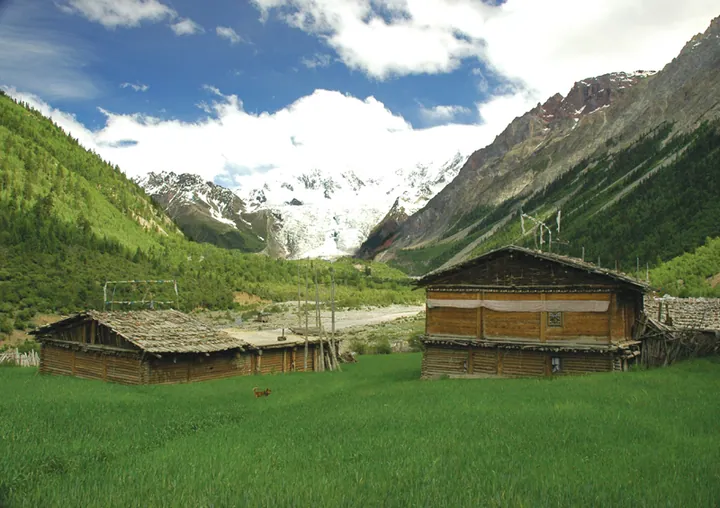 Midui Glacier descending toward the valley near Midui village, Bomi County · 西藏波密县米堆冰川,冰舌延伸至米堆村附近山谷 Source-recorded photograph date: 22 May 2010 (original upload date).
Midui Glacier米堆冰川
Midui’s icefalls descend into a landscape of mixed forest, fields and village life in Bomi’s Yupu area. The contrast is its defining feature: high ice and steep rock sit above a green valley rather than an empty polar-looking…
Read the place guide →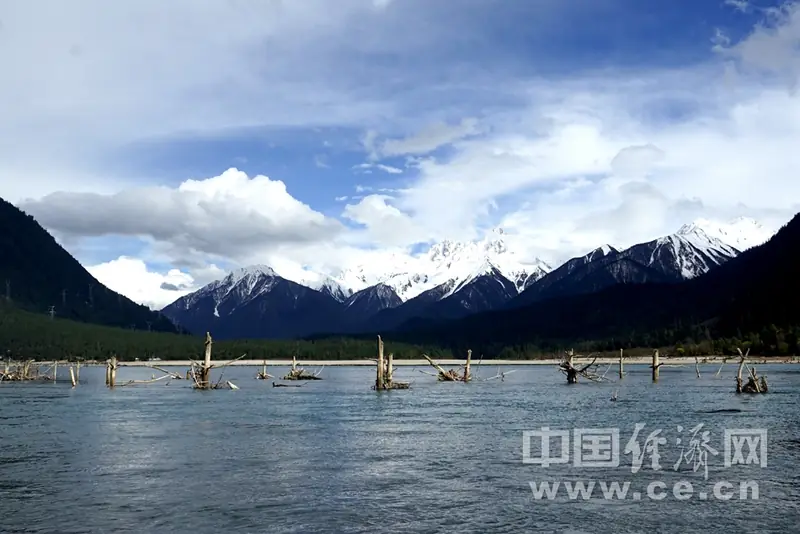 Guxiang Lake · 古乡湖
Guxiang Lake古乡湖
> Short summary: Guxiang Lake is a 2,600-metre freshwater barrier lake on the Parlung Tsangpo near Guxiang in Bomi County. Its quiet appeal is geological and visual: a 1953 debris flow blocked the river, leaving dead roots in clear water, a soft-sand shore, forest and snow mountains.
Read the place guide →Plan your visit
Getting there
Bomê County is about 140 km (straight-line distance) from central Nyingchi. Search for 波密县 in a map app to find stations and your accommodation.
Where to stay →Build your route
Gangxiang and Bomi Peach Blossom Valleys and Midui Glacier are about 100 km apart (straight-line distance). The linked place guides have entrance and visit details.
Continue with Nyingchi →More in Nyingchi
Sources & geographic information
Administrative names and parent areas: Official geographic directory (dmfw.mca.gov.cn) · Reference date 2026-09-06.
Background text adapted from Bomê County — Wikipedia contributors, under CC BY-SA 4.0. Text has been shortened and reorganized; source revision 1372397806.
Photo: Midui Glacier · 牛糞 · CC BY-SA 3.0. Resized for the web; the photo itself has not been edited. Thumbnails may show a cropped view.

Photo: Guxiang Lake · m.ce.cn. Resized for the web; the photo itself has not been edited.
Map data © OpenStreetMap contributors. Pins mark approximate centres, not entrances or boundaries.
Image credits & notes (1)
- The river valley, forests and snow-covered mountains of Gangxiang Nature Reserve in Bome County. Photo: 2007-05-01 10:46.Photo: Gao from Beijing, China · CC BY 2.0Resized for the web; the photo itself has not been edited. Thumbnails may show a cropped view.
