

Entry & permits for Tibet (Xizang)
Foreign tourists need Tibet entry approval, commonly called a Tibet Travel Permit, and an organised visit arranged through a specialist travel agency in China. Confirm your approved route before booking transport. Requirements differ for Taiwan residents and for travellers using mainland or Hong Kong/Macao Chinese resident documents; check the document guide before you book.
Check the travel-document requirements →Policy scope verified: 2026-09-06. UK FCDO: China regional travel advice ↗ State Council Taiwan Affairs Office: Tibet entry approval ↗ Xizang Department of Culture and Tourism: Medog border permit notice ↗
Explore the region
Tap any red Chinese text to hear it in Mandarin.
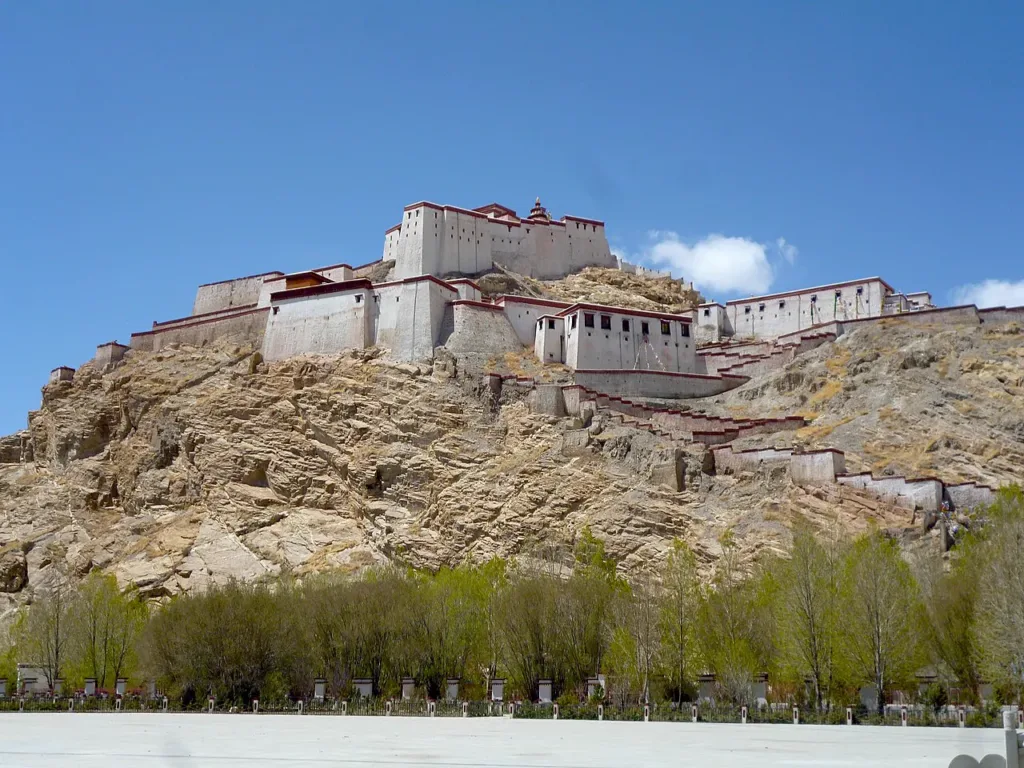
Gyantse is a high valley town where fields and the Nyang Chu plain sit beneath a compact defensive hill. Gyantse Dzong, also called the Gyantse Dzong Anti-British Resistance Site, is the place to read that relationship at close range: walls and buildings follow the rock, while the view down to the town and plain explains why the hill mattered. The fortress stands in the centre of Gyantse old town and has been a National Key Cultural Relic Site since 1961.
Read the site as a fortress and a town
The first palace-fortress on the hill is dated to 967. The site later became the setting for the 1904 fighting at Gyantse, after which the town acquired its enduring “Hero City” association. This is a memorial landscape as well as a ruin: visit quietly, read the historical displays in context, and do not treat the battle sites or memorials as theatrical scenery.
From below, study how the walls grip the steep rock and how the hill overlooks the old town. On an open route, look for the anti-tax hall, the old government council hall, the anti-British gun position and the border-inspection inscription described in the heritage account. The hill also has a 650-square-metre anti-British memorial hall, with photographs and historical objects reported from inside.
The most rewarding view is not a single monument detail. From a safely accessible upper point, turn back toward Gyantse, the Nyang Chu valley and the agricultural plain; the relationship between a fortified administrative seat and its surrounding landscape becomes clearer than it does from a list of dates. Access to individual restored rooms and displays may change, so do not assume that every part of the hilltop is open on the day of your visit.
Entry, permits and practical limits
Gyantse Dzong is in Gyantse County, Shigatse City, at roughly 4,187 metres above sea level. Current opening hours, ticketing, reservation arrangements, the exact visitor entrance and the route into each restored building are not reliably confirmed in the sources used here. Check with your licensed Tibet tour operator or the site locally before setting out; a map label is not proof that every interior space is accessible.
For travellers using a foreign passport, entry to Tibet requires a Tibet Travel Permit arranged through a licensed travel agency. Travel beyond Lhasa, including Shigatse, may require additional local permits, and the approved itinerary and guide arrangements govern where you may travel. Confirm that the paperwork explicitly covers Gyantse before booking the road leg; a passport and ordinary China visa alone should not be treated as permission to visit this site.
The hill is a high-altitude walk, not a casual city-centre staircase. If Gyantse is your first high-altitude stop, keep the first visit short and unhurried. Headache, dizziness, unusual fatigue, nausea or vomiting after ascent are warning signs of acute mountain sickness; stop exertion and tell your guide. The CDC notes that acclimatization takes time and that symptoms can improve after a descent, so worsening symptoms call for medical help and lower altitude rather than a determined climb.
Getting there and back
Gyantse Dzong is reached from Gyantse town, not from a rail platform at the site. If you are coming from Shigatse, have your guide or transport operator confirm the day’s road service to Gyantse before departure; a current timetable and a dependable Shigatse departure station were not confirmed for this guide. The local transport reference lists 江孜县汽车站 (Gyantse County Bus Station) near 英雄路 Yīngxióng Lù in Gyantse.
At the town end, show the Chinese destinations 江孜宗山抗英遗址 Jiāngzī Zōngshān Kàngyīng Yízhǐ or 英雄广场 Yīngxióng Guǎngchǎng to a locally arranged driver or taxi. The exact designated drop-off point and walking minutes to the visitor entrance are not confirmed, so do not rely on a guessed exit, distance or arrival time. Before climbing, confirm the same day’s return from 江孜县汽车站 Jiāngzī Xiàn Qìchēzhàn to Shigatse or your next approved stop. Do not assume that a local ring-bus pilot has a published tourist stop or a guaranteed timetable.
Combine your visit
Suggested order for this visit:
-
Fortress base
Understand how the rock shaped the defensive walls.
-
Open fortress route
Explore the restored and surviving structures.
-
Upper viewpoint
Read the relationship between fortress, town and valley from above.
This is an editorial sequence based on the features described in the sources. Confirm access locally; no walking time, shared admission or guaranteed interior access is implied.
Find Gyantse Dzong
江孜宗山 · 日喀则
The pin marks the area, not the entrance.
More places nearby
Approximate straight-line distances between map pins, not travel distances.
Palcho Monastery 白居寺
Less than 1 km awayPalcho, also called Pelkor Chode or Baiju Monastery, brings together several Tibetan Buddhist traditions at the foot of Gyantse’s hills. Its outstanding feature is the Kumbum: a stepped stupa filled with small chapels, sculpture…
View guide →Gyantse 江孜
2 km awayGyantse occupies the Nyang Chu valley at the meeting of old trade routes between central Tibet and the southern Himalayan passes. Two neighbouring landmarks make its history tangible: the Dzong crowns a rocky hill, while Palcho…
View guide →Naining Monastery 乃宁寺
12 km awayNaining Chode stands in the upper Nyang Chu valley at Nanni village, south of Gyantse. Its religious buildings and the memorial outside the gate reflect different parts of its history, including the fighting here during the…
View guide →Sources & visit information
Sources checked on 2 November 2026. Hours, tickets, reservations and transport can change; confirm with the operator before you go.
Image credits & notes (1)
- Gyantse Dzong's white-and-red fortified walls rise above the rocky hill in Gyantse. Photo: JanManuPhoto: CC BY-SA 4.0