

Entry & permits for Tibet (Xizang)
Foreign tourists need Tibet entry approval, commonly called a Tibet Travel Permit, and an organised visit arranged through a specialist travel agency in China. Confirm your approved route before booking transport. Requirements differ for Taiwan residents and for travellers using mainland or Hong Kong/Macao Chinese resident documents; check the document guide before you book.
Check the travel-document requirements →Policy scope verified: 2026-09-06. UK FCDO: China regional travel advice ↗ State Council Taiwan Affairs Office: Tibet entry approval ↗ Xizang Department of Culture and Tourism: Medog border permit notice ↗
Explore the region
Tap any red Chinese text to hear it in Mandarin.
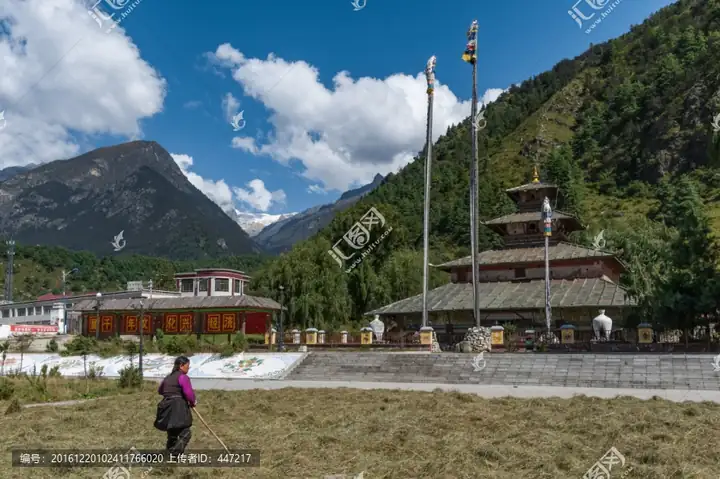
Phagpa Monastery (帕巴寺) stands on the east side of Gyirong Town (吉隆镇), in Gyirong County (吉隆县), Shigatse, at about 2,850 metres. A Shigatse government travel page dates the foundation to around 637 and preserves the local tradition that the Nepalese princess Bhrikuti carried three Shakyamuni images through the Mangyul/Gyirong route and left one at Gyirong. Treat that origin story as a tradition, not as a separately proven construction record.
The building is the reason to come. It is a four-storey stone-and-timber tower that narrows as it rises, with projecting eaves, small windows and a copper finial. The lower two storeys have flame-shaped copper corner fittings; the upper two use upturned brass eaves. The ground floor is a square shrine hall surrounded by inner and outer walkways, so the building is read from close range as both a tower and a space for circumambulation. Public listings identify Phagpa as a National Key Cultural Relics Protection Unit.
What to look for
Start outside and read the tower vertically: the changing eaves, copper and brass details, small windows and the painted Buddha figures around the upper doorway niches make the silhouette more informative than a quick photograph. Inside, if the shrine hall and corridors are open, notice how the inner and outer walkways organise movement around the central hall. Ask before photographing any religious image, and keep clear of worshippers and restricted areas; current travel advice specifically warns visitors to ask before taking photographs in Buddhist monasteries.
The murals are the main reason not to rush. Descriptions of the outer corridor record a roughly 9-metre panorama of the Potala Palace, Ganden, Drepung and Sera monasteries, alongside earlier layers showing a bodhisattva, a preaching master and the Tibetan king Trisong Detsen. Later scenes include court life, a head-shaving ordination and the Buddha’s nirvana; the porch is described with Padmasambhava and an eleven-headed, eight-armed Avalokiteshvara. These are subjects to look for, not a promise that every room or every layer will be visible on the day. Older accounts also describe statues and ritual objects that were destroyed during the Cultural Revolution, so do not assume that every historic object mentioned in a guide remains in the shrine.
Access, permissions and a realistic route
There is no verified railway, metro or regular urban-bus stop at the temple in the sources reviewed. A published Shigatse itinerary runs from Shigatse or Lhasa through Sakya County, Lazi County, Tingri County and Gyirong County, then onward to Nyalam (Zhangmu Town); it describes an eight-to-ten-day regional journey and says a border pass is needed after Lazi. That page was published in 2020, so use the place sequence as route context, not as a current timetable or an assurance that every road segment is open.
For an international visitor, Tibet is not an ordinary independent road trip. Current UK travel advice says visitors must obtain a Tibet/TAR permit through a specialist travel agent in China and travel on an organised tour; permits or access can be restricted without notice. Because Gyirong is a border county, ask the agency to confirm the exact Gyirong itinerary, any additional border-area permission, the approved vehicle and guide, and whether Phagpa is an authorised stop. A passport or an ordinary domestic attraction booking is not enough to establish access.
The last mile is deliberately conservative here. The documented location is the east side of Gyirong Town, but the current visitor gate, pedestrian approach, road drop-off and opening arrangements were not independently confirmed. Have the driver or guide search 帕巴寺 Pàbā Sì in Amap/Gaode Maps and confirm the exact entrance locally before leaving the vehicle; do not invent an exit number or walking time. Keep the same pre-arranged vehicle for the return to your approved accommodation or onward route, and confirm the return connection before entering the site.
Road conditions need a current check. A 26 August 2026 Xinhua report said that mudslides had led to a temporary two-way closure on the road from Gyirong Town towards the Gyirong Port national gate, while the FCDO’s current China advice warns that flooding and landslides had damaged roads, transport and communications in Gyirong County. This does not prove that Phagpa itself is closed, but it does mean that a previously published itinerary should not be treated as current access.
Opening hours, admission, reservation rules and a confirmed foreign-visitor entrance for Phagpa were not established by the sources reviewed. Confirm them through the operator of your permitted itinerary and local authorities before departure. At 2,850 metres, allow time to move slowly, protect yourself from sun and cold, and do not continue towards higher or restricted border areas without the permissions and safety arrangements for that part of the route.
Find Phagpa Monastery
帕巴寺 · 吉隆县
The pin marks the area, not the entrance.
Sources & visit information
Sources checked on 2 November 2026. Hours, tickets, reservations and transport can change; confirm with the operator before you go.
Image credits & notes (1)
- Phagpa Monastery · 帕巴寺Photo: huitu.comResized for the web; the photo itself has not been edited.