

Photo adjustments
Full frame retained; proportionally resized and converted to WebP. No retouching or changes to the photographed subject. Card displays may crop the view.
Explore the region
About Tuyugou Mazar Village
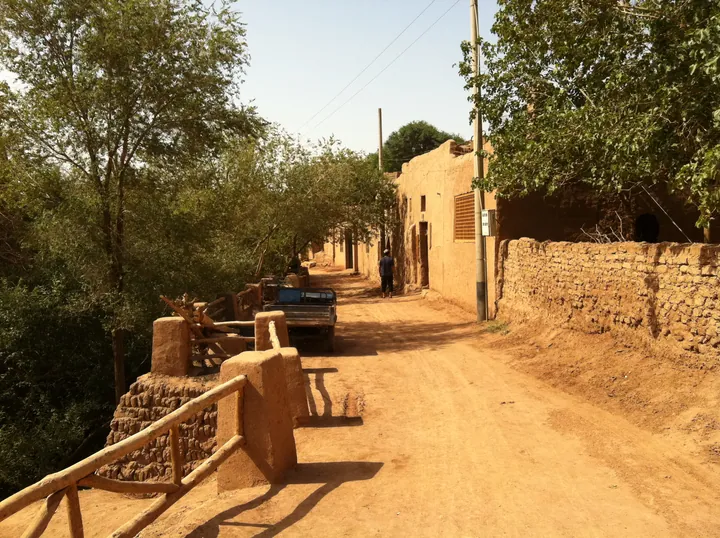
Tuyugou Mazar Village (吐峪沟麻扎村) is an old Uyghur settlement at the southern mouth of the Tuyugou gorge in the Flaming Mountains (火焰山), in Tuyugou Township (吐峪沟乡), Shanshan County (鄯善县), Turpan (吐鲁番); administratively it is part of Tuyugou Village (吐峪沟村).
The houses climb the south slope of the Flaming Mountains on an alluvial-fan oasis, and the Subeixi River (苏贝希河) runs through the village from north to south with the main street beside it. Summers here average over 40 degrees Celsius and annual rainfall is under 17 millimetres. Local yellow clay is the main building material, for houses and for village pottery. The ancient city of Gaochang (高昌古城) lies 13 kilometres to the southwest.
Mazar means tomb, and the full name, Mazar Aldi Maili (麻扎阿勒迪买里村), means 'the village before the tomb'. The tomb is the Ashab al-Kahf Mazar (艾苏哈卜·凯赫夫麻扎) northwest of the houses, one of several places across the Muslim world linked to the story of the sleepers in the cave told in the Quran and in Christian tradition. Most villagers descend from its former keepers, and Chinese Muslims have come here to worship before setting out on pilgrimage. People have lived in the area since the Neolithic. The village was named a Chinese Historical and Cultural Village (中国历史文化名村) in 2005 and entered the first list of Chinese Traditional Villages (中国传统村落) in 2012. A China Culture Daily (中国文化报) report published by the Ministry of Culture and Tourism puts the village's history at 1,700 years and its oldest surviving house at more than 700 years.
Tuyugou is known as a 'museum of earthen architecture'. Most houses have two levels: flat-roofed rooms above and cave rooms dug into the hillside below, joined house to house. Walls are yellow clay mixed with wheat straw, and many roofs carry brick drying rooms for raisins, their walls laid in open lattice patterns. Families of standing marked their doors with mendang (门当) and hudui (户对), projecting wooden pieces borrowed from central Chinese building, and carved kuba (库巴) panels over main doors once hinted at whether the owner traded or held office. From 2023 a conservation project repaired 78 houses and courtyards using traditional methods.
What to look for
- The green-domed Ashab al-Kahf Mazar (艾苏哈卜·凯赫夫麻扎) on high ground more than 50 metres above the village
- The village's North Mosque (吐峪沟村北清真寺) at the centre of the village, with a dome and four minarets on its south front
- The Sidike Abudu house (斯迪克·阿不都民居), more than 300 years old, with carved eaves on the west bank of the Subeixi River
- The adjoining two-storey earthen house where the German explorer Albert von Le Coq stayed twice
- The Tuyugou Grottoes (吐峪沟石窟) north of the village, a national key cultural relics protection unit begun in the 4th century
- Rooftop raisin-drying rooms with lattice brick walls
- Doorways with mendang and hudui wooden pieces and carved kuba panels
Location & getting there
Getting to Tuyugou Mazar Village
- Search for 吐峪沟麻扎村 with 吐鲁番市 and 鄯善县.
Find Tuyugou Mazar Village
吐峪沟麻扎村 · 鄯善县
No reliable map pin yet: search by the Chinese name.
Sources & visit information
Written from the linked sources and checked sentence by sentence against quoted extracts by a separate reviewer on 2026-09-23. Opening hours, admission and access arrangements are not covered; confirm current visitor information with the site.
- 千年古村吐峪沟重焕光彩 - 中华人民共和国文化和旅游部 ↗
- 火焰山下土村美(文化中国行·走进传统村落) ↗
- 新疆鄯善吐峪沟麻扎村入围首批中国传统村落名录-中新网 ↗
- 麻扎村 - 维基百科,自由的百科全书 ↗
Some facts checked against Wikipedia contributors, "麻扎村" · CC BY-SA 4.0.