

Explore the region
Tap any red Chinese text to hear it in Mandarin.
Xibe Ancient City is best understood as a purpose-built cultural tourism area, not as an old administrative city or a stand-in for the whole county. It stands in Sunzhaqi Niru Town’s Sunzhaqi Niru Village in Qapqal Xibe Autonomous County, within Ili Kazakh Autonomous Prefecture. The reason to come is the concentration of Xibe history and material culture in one walkable visitor setting: the museum, temple architecture, bilingual plaques and archery displays give context to the Xibe westward migration to Xinjiang during the Qing period and the community’s later garrison-farming history.
What to look for
Begin with the Xibe Ethnic Museum. The county tourism bureau says it was begun in 2002 and formally opened in August 2004; the same source identifies the destination as a national 4A scenic area and an autonomous-region patriotic education base. The regional culture-and-tourism department’s 2025 directory also lists Xibe Ancient City among Xinjiang’s 4A attractions.
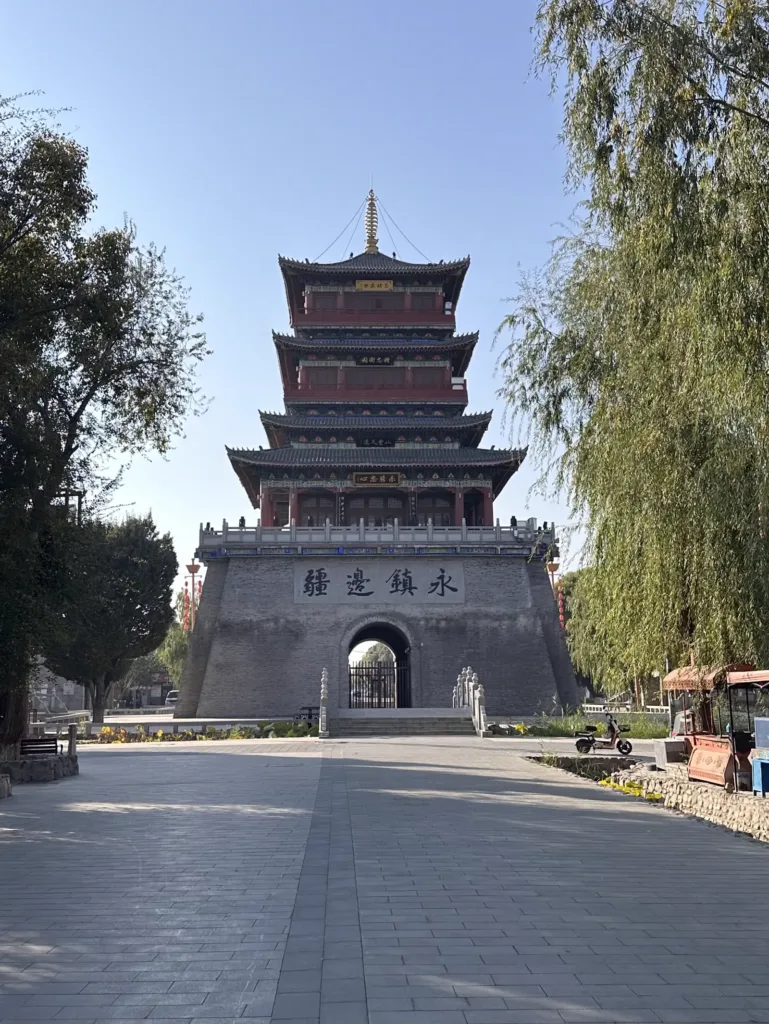
Jingyuan Temple is the architectural anchor. The county bureau describes it as one of Ili’s nine famous temples and says it entered the sixth batch of national key cultural heritage sites in 2006. Its eight buildings are arranged symmetrically along an axis, with carved brick and wood, painting and clay sculpture. Walk slowly along that axis rather than treating the compound as a generic “old town” backdrop. Notice the bell tower, also called Weizhen Tower (威震楼): the county describes it as the tallest building in the area, 38 metres high and five storeys tall, with Chinese and Xibe plaques on each level.
The bow-and-arrow museum is another focused stop. The county source describes it as China’s first museum devoted to archery; treat that as the local tourism bureau’s description, and look at how archery is presented as part of Xibe history rather than assuming that a demonstration or hands-on session runs every day. A China News Service photo report names traditional food, dress, embroidery, archery and dance among the cultural subjects presented at the destination. Those are useful themes to look for, but the report’s dated ceremonies and activities are not a promise of a daily programme.
Tickets, timing and practical checks
Trip.com’s 31 October 2026 attraction listing displays opening hours of 09:00–20:00, the address as S313 in Qapqal Xibe Autonomous County, and a ticket enquiry number, +86-999-3948889. This is a useful planning lead, not an official ticket notice: the listing does not state a current price or a complete list of what any ticket includes. Before setting out, call the number or check the venue’s current channel to confirm the entrance, price and inclusions, whether a passport can be used for any booking or identity check, museum and tower access, and that day’s activities.
The dated migration-themed event reported by China Daily in October 2024 and the entry ceremony photographed by China News Service on 10 January 2026 show that special programming can be seasonal or date-specific. Do not build a trip around a show, ceremony, archery session or winter activity unless the venue confirms that date. The core visit is a cultural site rather than a high-mountain route, so the main seasonal uncertainty is programming and individual venue access, not a scenic-area shuttle over a mountain pass.
Getting there and getting back
Keep the Chinese name 锡伯古城 Xībó Gǔchéng ready for Amap or Gaode Maps and add 察布查尔锡伯自治县 Chábùchá’ěr Xībó Zìzhìxiàn; the site is in Qapqal County, not at Yining Airport or Yining Railway Station. The official county location is Sunzhaqi Niru Town, Sunzhaqi Niru Village; the current third-party listing gives S313 as the address.
For a rail arrival, the Qapqal county transport page published on 27 May 2025 lists bus 506 between 锡伯古城风情园 Xībó Gǔchéng Fēngqíng Yuán and 伊宁市火车站 Yīníng Shì Huǒchē Zhàn, with a published route length of 51 km. It lists a full-route fare of 6 yuan and endpoint service times of 08:00–20:35. Because this is an older official timetable rather than a same-day departure board, confirm that the route and last return bus are operating before relying on it. The published endpoints make it a possible public-transport link in both directions, but the bus reaches the scenic-area endpoint—not every museum door—and it is not an airport shuttle.
Yining Airport is the area’s air gateway; an Ili government notice confirms its permanent international-airport status from March 2026. The cited notices do not state a direct airport-to-venue shuttle, a current taxi fare or a guaranteed foreign-passport ticket process. From the airport, arrange a taxi or ride-hail to the confirmed Chinese destination, or first reach Yining Station and check the 506 connection. Do not assume that a bus to Qapqal county centre finishes at Xibe Ancient City, and do not leave the return until after the displayed closing time without confirming the final connection.
Find Xibe Ancient City
锡伯古城 · 察布查尔锡伯自治县
The pin marks the area, not the entrance.
Sources & visit information
Sources checked on 31 October 2026. Hours, tickets, reservations and transport can change; confirm with the operator before you go.
Image credits & notes (1)
- Weizhen Tower on the central axis of Xibe Ancient City in Qapqal, photographed from the pedestrian forecourt. Photo: HaziiDozenPhoto: CC BY-SA 4.0