

Explore the region
Chengzi Old Village is a lived-in Yi–Han settlement on the slope of Feifeng Mountain in Yongning Township, Luxi County. Its identity is not a single restored gate or a row of souvenir shops: more than 1,000 earthen tuzhangfang homes climb the hill, with many roofs joining into long, usable terraces. The county describes the surviving group as more than 600 years old, while the provincial tourism account focuses on the way the settlement grew upward and later absorbed Han building techniques.
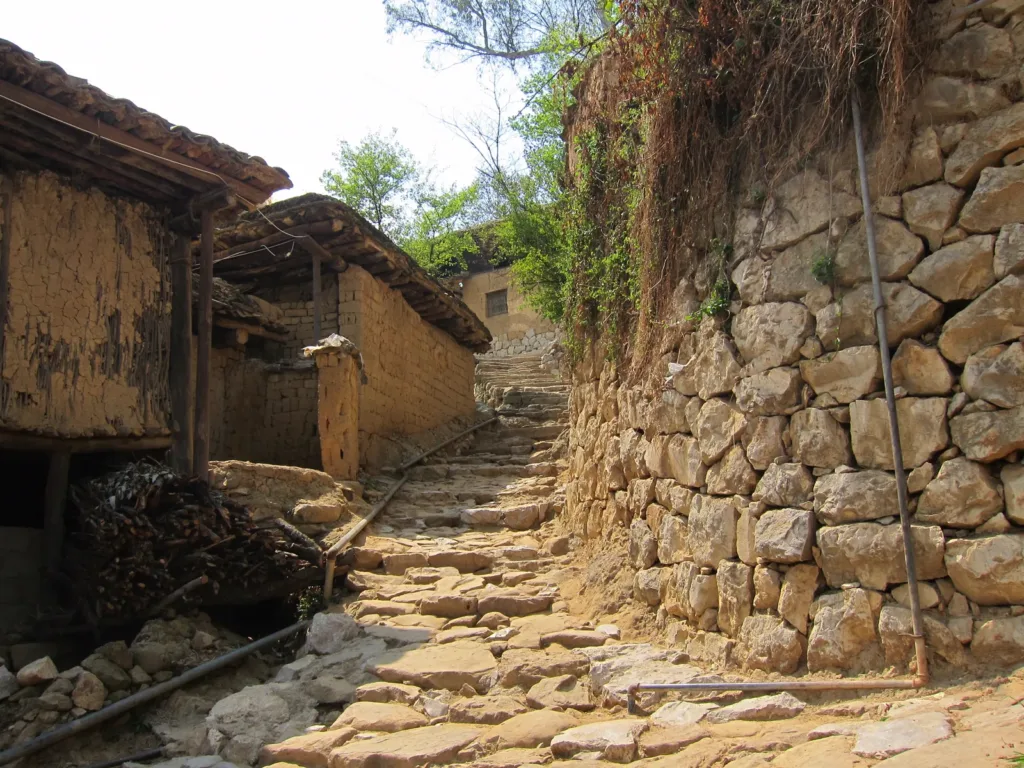
Come to read the village as a hillside building system. Start from a lower approach where you can see the roofs stacking like steps, then walk slowly through the stone lanes. Look for the change from early, plain earthen compounds to courtyard houses with a principal room, side rooms and a screen wall, and then to homes with Han-style doorheads and pitched-roof details. This sequence is more rewarding than treating every house as a separate photo stop: it shows how Yi construction practice and Han techniques were layered without losing the connected roofscape.
The official county project page places the village in Chengzi Village, Yongning Township, 25 km south of Luxi county seat and 2.5 km from the township government seat. It also identifies the Ang Native Chieftain’s Mansion site as one of the village’s historic elements. The setting is part of the experience: the settlement sits above farmland and water, so pause on a roof terrace or open lane only where residents allow access, and use the view to understand why the houses follow the slope.
This is a residential village, not a stage set. Ask before entering a courtyard, climbing a roof used by residents, or photographing people. Wear shoes with grip: rural lanes and earthen surfaces can be slippery after rain.
Getting there and back
For an independent visit, reach Luxi first. A regional transport guide lists direct coaches from Kunming East Bus Station (昆明东部汽车客运站) to Luxi Bus Terminal (泸西汽车客运站). It also identifies Mile Railway Station (弥勒站) as the usual rail gateway when arriving by high-speed train, followed by a road transfer to Luxi.
From Luxi, the practical choices are a self-drive or a pre-arranged car with driver. The same guide describes Yongning Township (永宁乡) as the transport gateway and says a rural coach toward Yongning may require a final local connection; do not assume a frequent direct bus all the way to the village. Agree the return pickup point and time before leaving Luxi, since village ride-hailing and late-day return services are less predictable. The exact rural stop, parking arrangement, current timetable and any formal visitor entrance were not consistently confirmed in the sources checked, so search the exact Chinese name “城子古村” in Amap or another current map and confirm locally on the day.
Current opening hours, admission, and reservation rules are not stated reliably enough here to publish as fixed facts. Check locally before setting out, especially if you need to enter a separately managed historic house. The village itself is worth visiting for the connected earthen architecture and the living street texture, even when no performance or ticketed program is available.
Find Chengzi Old Village
城子古村 · 泸西县
The pin marks the area, not the entrance.
Sources & visit information
Sources checked on 2 November 2026. Hours, tickets, reservations and transport can change; confirm with the operator before you go.
Image credits & notes (1)
- A stone lane between earthen houses in Chengzi Old Village, Luxi, Yunnan. Photo: Anders JohnsonPhoto: CC BY 3.0