


Get to know Luxi County
- Administrative area
- County · 县
- Part of
- Honghe Hani and Yi Autonomous Prefecture
- Chinese name
- 泸西县
- Local areas
- County guide
Area & population
- Area
- 1,674.00 km²
Source: English Wikipedia, as of the dates shown.
A county of caves, earthen roofs and slow streets
Luxi County sits in the north of Honghe Hani and Yi Autonomous Prefecture. It is a spread-out county rather than a single compact attraction: the county seat supplies everyday streets and services, while the best-known experiences lead west to a cave complex or south to a hillside village. The county profile also records Yi, Hui, Miao, Zhuang and Dai communities, a useful reminder that Luxi's cultural landscape is not reducible to one ethnic label.
Start in the county seat as a place where people still live, not as a staged ancient town. A 2024 regional culture-and-tourism report describes old streets, glass-front shops, street vendors selling local products and craftsmen working with silver. Look for these details as they appear during your walk, and ask before photographing people or entering a workshop.
The county's two strongest excursions show very different ways of reading the landscape. Alu Ancient Cave (阿庐古洞), about 2 km west of the county seat, is a developed karst cave complex associated with the local description “nine peaks, nine rivers and eighteen caves.” The county government names four developed sections—Luyuan Cave (泸源洞), Yuzhu Cave (玉柱洞), Biyu Cave (碧玉洞) and the Yusun River water cave (玉笋河)—and describes underground rivers, springs and more than 200 named features. In the cave, pay attention to where water has shaped the rock, rather than treating coloured lighting as the whole experience.
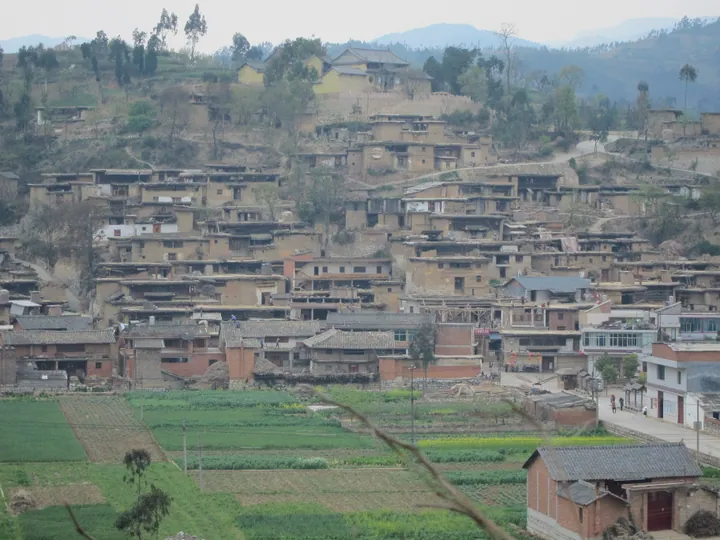
South of the county seat, Chengzi Old Village (城子古村) is a working hillside settlement in Yongning Township, about 25 km away. The county project page describes a Han, Yi and Miao mixed village with more than 1,000 interlinked earthen-house units and a building tradition of more than 600 years. From a public lane, look at how the rammed-earth walls climb the slope and how roofs and terraces connect the settlement; the linked platforms are part of the village's form, not an invitation to enter private homes. Ask locally before crossing a courtyard, climbing a roof or photographing residents.
Planning the county visit
Treat Luxi as a base-and-excursion destination. The county seat is the sensible place to arrange food, accommodation and a return vehicle, while Alu Ancient Cave and Chengzi Old Village should be planned as separate outings unless a current local driver confirms the day's road conditions and sequence. The cave and village are independently managed experiences: a county-wide description does not establish their current opening hours, ticket rules, guided activities or access to residential spaces.
Getting there and getting back
Luxi has no applicable metro system. For a rail-led approach, the county government's 2024 profile places the county about 40 km from Mile Station (弥勒站) on the Nankun high-speed railway and about 42 km from Shizong Station (师宗站) on the Nankun railway. Those figures identify useful rail anchors, but the source does not verify a current public last-mile shuttle, bus number or departure timetable from either station. Confirm the onward road transfer before buying a tight connection.
A road transfer or coach is the practical way to reach the county seat, but a current through-coach departure terminal and timetable from Kunming or nearby hubs were not established in the sources used for this guide. Check the live ticketing notice before departure and aim for “泸西县城” rather than assuming that a coach stops at either attraction.
Once in the county seat, search the exact Chinese names “阿庐古洞” and “城子古村” in Amap (高德地图). The evidence places Alu Ancient Cave about 2 km west of town and Chengzi Old Village about 25 km south in Yongning Township. A taxi, ride-hailing car or pre-arranged local driver is the practical last leg; this guide does not guess a fare, route number, exit, walking time or attraction shuttle. Arrange the return to the county seat in advance, then continue to your confirmed coach departure or back to Mile/Shizong Station.
Guide sources
Explore Luxi County
Core places to explore, with English and Chinese names.
Places to explore around Luxi County
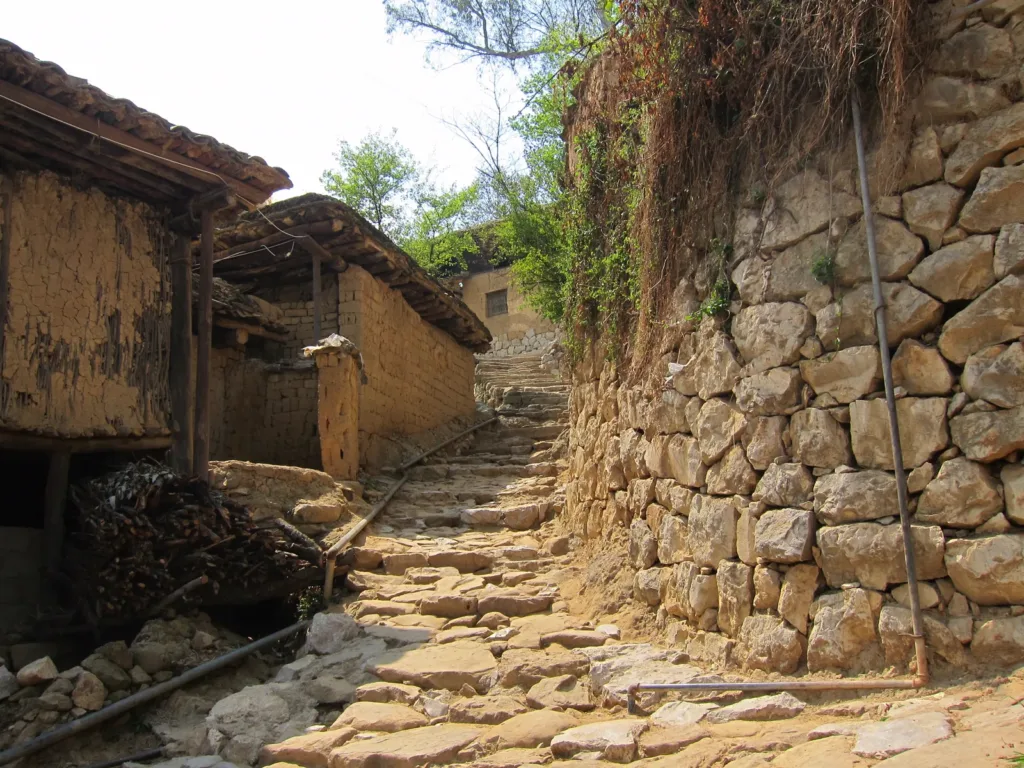 A stone lane between earthen houses in Chengzi Old Village, Luxi, Yunnan. Photo: Anders Johnson · CC BY 3.0
Chengzi Old Village城子古村
A lived-in Yi–Han hillside village in Luxi where more than 1,000 connected earthen tuzhangfang homes form terraces up Feifeng Mountain, best read slowly as a working settlement rather than a staged attraction.
Read the place guide →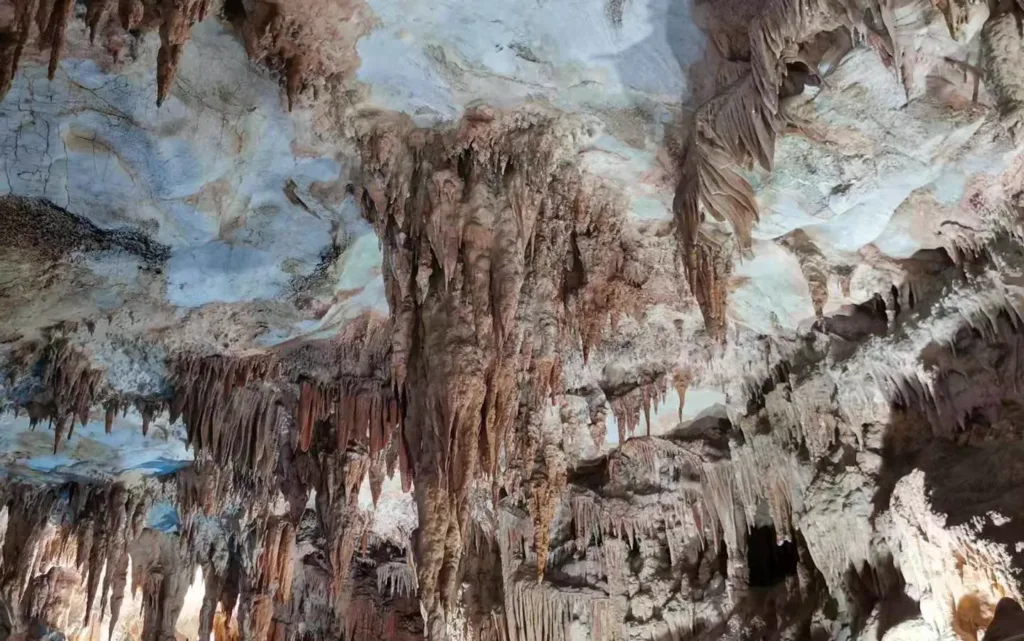 Stalactites and flowstone formations fill a chamber inside Alu Ancient Cave. Photo: Ping an Chang · CC BY-SA 4.0
Alu Ancient Cave阿庐古洞
Alu Ancient Cave is a karst cave complex just west of Luxi county town in Honghe. Its appeal is the way several cave environments connect: dry chambers and tall formations lead to a water-cave section associated with the Yusun River. It is a good stop for travellers who want to read a cave as geology and lived landscape, not just photograph coloured lights.
Read the place guide →Plan your visit
Getting there
Luxi County is about 135 km (straight-line distance) from central Honghe Hani and Yi Autonomous Prefecture. Search for 泸西县 in a map app to find stations and your accommodation.
Where to stay →Build your route
Chengzi Old Village and Alu Ancient Cave are about 25 km apart (straight-line distance). The linked place guides have entrance and visit details.
Continue with Honghe Hani and Yi Autonomous Prefecture →More in Honghe Hani and Yi Autonomous Prefecture
Sources & geographic information
Administrative names and parent areas: Official geographic directory (dmfw.mca.gov.cn) · Reference date 2026-09-06.
Background text adapted from Luxi County, Yunnan — Wikipedia contributors, under CC BY-SA 4.0. Text has been shortened and reorganized; source revision 1331072936.
Map data © OpenStreetMap contributors. Pins mark approximate centres, not entrances or boundaries.
Image credits & notes (1)
- Chengzi Village, a traditional earthen-house village in Luxi County · 泸西县城子村传统土掌房村落 Source-recorded photograph date: Taken on 7 March 2014.Photo: Anders Johnson · CC BY 3.0Resized for the web; the photo itself has not been edited. Thumbnails may show a cropped view.
