

Explore the region
Why visit
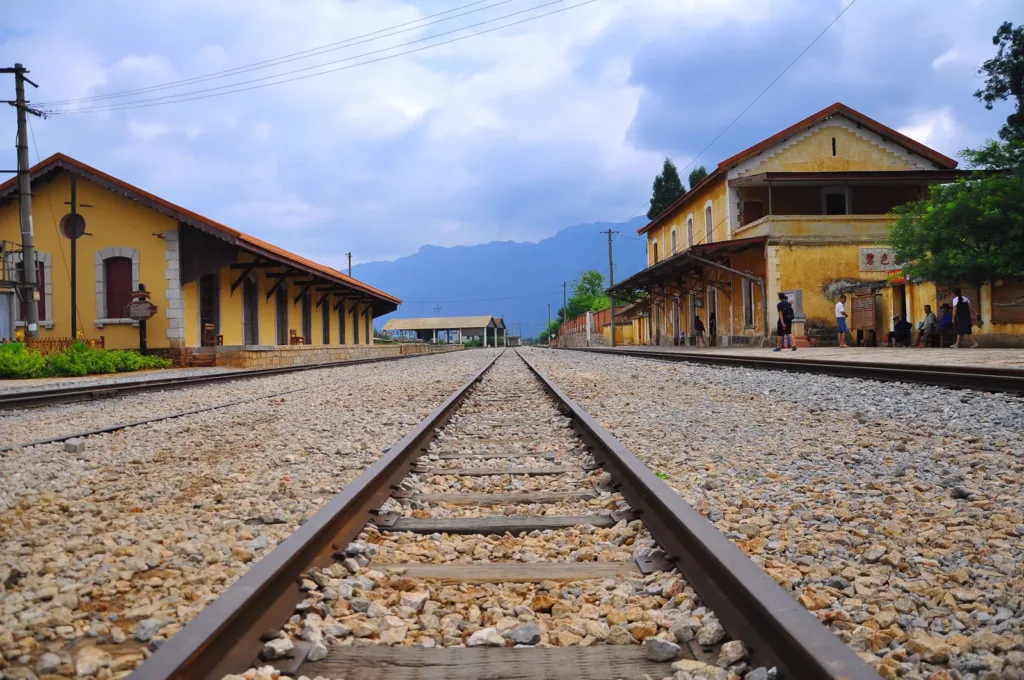
Bisezhai lies in Mengzi, Honghe, about 10 km north of the city centre, with Changqiao Lake to the west and Liba Mountain to the east. The place is simultaneously a former railway station, a village and a historic-cultural park. The Dian–Viet Railway reached Bisezhai on 13 April 1909 and opened through in 1910. A separate Ge-Bi-Shi Railway later made the site a transfer point between metre-gauge and narrow-gauge lines, turning a small settlement into a southern Yunnan trading centre.
That prosperity was part of a difficult history. The railway was built during French colonial expansion and relied on the labour and resources of southwest China. Read the grand station architecture together with the warehouses, customs and police buildings, not only as a nostalgic “Little Paris” story. In 2013, Bisezhai Station, including 11 associated historic buildings, was listed as a seventh-batch National Key Cultural Relics Protection Unit; the wider attraction was later recognised as a national 4A scenic area. Passenger service ended in 1992 and the station closed in 2010, so this is a heritage visit, not a train-ride destination.
How to look closely
Start at the northern Dian–Viet Railway station house: its two-storey brick-and-timber structure, red tiles and yellow walls make the French railway vocabulary easy to see. Then compare it with the smaller Ge-Bi-Shi station house at the southern end, built in 1917. Walk between the former platform area, the water tower, station clock, police buildings and the narrow-gauge locomotive shed. The Geluosi Hotel and Datong Company warehouse help explain how passengers, foreign firms and local merchants used the station; the red-earth tennis court is a reminder that this was also a colonial trading settlement with imported leisure habits.
Use the site as an outdoor reading exercise. Follow public paths and interpretive signs, note where the metre-gauge and narrow-gauge systems once met, and look for the changes from European railway façades to Chinese courtyard warehouses. Allow time for the village edges rather than photographing only the yellow station house. Do not enter locked buildings, climb historic structures or walk on any restricted track; residents still use the village, so ask before photographing people or private homes. The station’s appearance in the film Youth (芳华) is a useful cultural reference, but the surviving buildings and the railway’s colonial and labour history are the reason to come.
Entry and practical planning
Search the Chinese name “碧色寨” together with “蒙自市” in Amap/Gaode Maps or another map service. The historic station is in Bisezhai Village, Guanyin Subdistrict, Mengzi, but map labels may point to the broader scenic area or its visitor service centre rather than the station buildings themselves. Current official pages reviewed for this guide do not provide a stable visitor notice for opening hours, admission, reservations or internal shuttle arrangements. Confirm the gate, any traffic control and which buildings are open on the day of your visit; do not assume that an aggregator’s hours or “free entry” notice is current.
Getting there and back
Bisezhai is not a passenger railway stop today. From Mengzi North Bus Station (蒙自客运北站), the Honghe government’s published timetable lists a circulating Mengzi North Bus Station–Caoba (蒙自北站—草坝) service, 22 km and RMB 7, but it gives no fixed departure times. Ask the driver before boarding whether the vehicle can set you down for 碧色寨村 or 碧色寨站 and where to wait for the return vehicle; do not assume the route’s Caoba endpoint is the historic station.
Mengzi Bus Route 38 is also documented as reaching the Bisezhai scenic-area visitor service centre, but the station history source warns that the centre is some distance from the historic station. Treat it as a separate approach: confirm the final walk at the stop, and do not invent a walking time or an exit number. If you prefer a taxi or ride-hail, use the Chinese destination “碧色寨景区游客服务中心” or “蒙自市观澜街道碧色寨村”, then confirm with the driver whether the current road rule allows a drop-off nearer to the historic station.
Before entering the site, agree on your return plan. The official timetable does not give a Bisezhai-specific return schedule, and no reliable last-bus time was available in the sources read for this guide. Ask locally about the next vehicle back to 蒙自客运北站, or keep a taxi/ride-hail option available.
Find Bisezhai Railway Station
碧色寨 · 蒙自市
The pin marks the area, not the entrance.
Sources & visit information
Sources checked on 2 November 2026. Hours, tickets, reservations and transport can change; confirm with the operator before you go.
Image credits & notes (1)
- The preserved Bisezhai station area, with its historic station houses and railway tracks leading toward the surrounding hills. Photo: Zhangmoon618Photo: CC BY-SA 4.0