

Explore the region
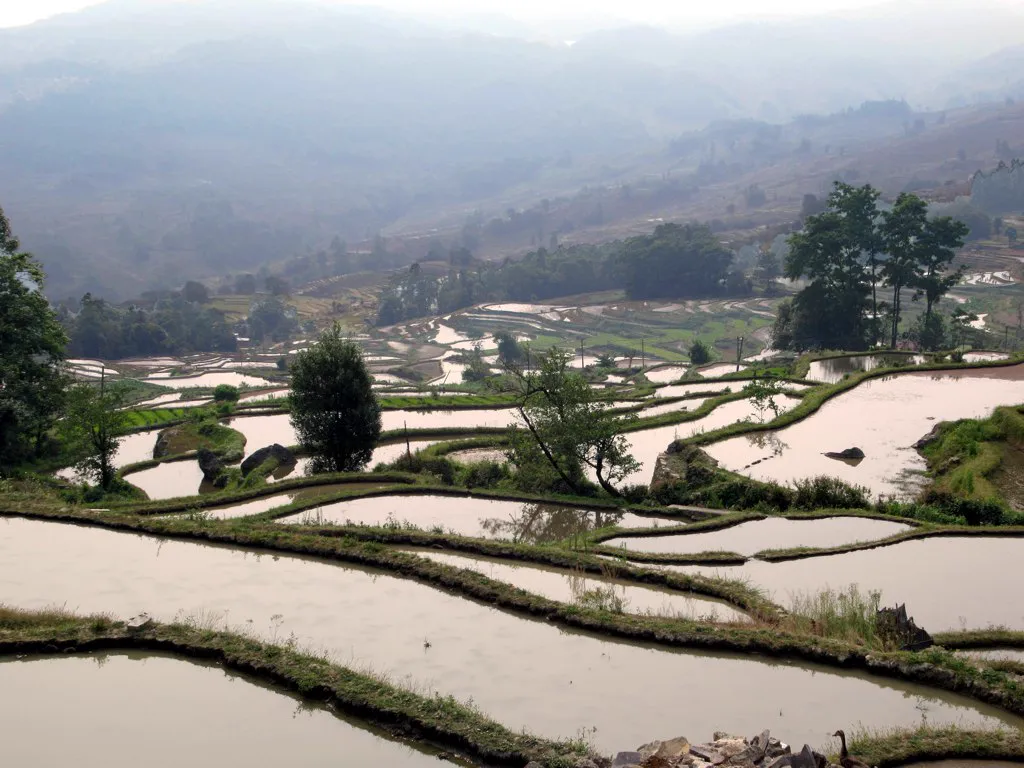
Yuanyang Hani Rice Terraces is not one lookout but a living mountain landscape in Yuanyang County, the core area of the wider Honghe Hani Rice Terraces. Hani communities have shaped irrigated fields along the slopes of the Ailao Mountains for more than 1,300 years. Forests collect and release water above the villages; channels carry it through settlements to the paddies below. The result is a working agricultural system, not a decorative pattern laid over an empty valley.
The terraces are especially rewarding when you slow down enough to read that system. Mist, water, houses and field edges change from one bend in the road to the next, while red rice and integrated farming remain part of the heritage story. The wider property covers 16,603 hectares and includes 82 villages; Yuanyang is one part of a larger cultural landscape that also extends through Honghe, Jinping and Lüchun counties.
What to look for
Use the viewpoints to compare landform rather than collecting identical photographs. UNESCO describes Bada as having a gentler gradient, Duoyishu as steeper, and Laohuzui as very steep. At each stop, look for the relationship between the forested upper slope, the village band and the water-filled or planted terraces below. Trace an irrigation channel where it is visible, and notice how the fields turn with the mountain instead of forming a regular grid.
Azheke Village (阿者科村) is a useful place to understand the human scale of the landscape. It is a traditional Hani settlement within the heritage area, with more than 60 surviving traditional “mushroom houses”; the Ministry of Ecology and Environment describes it as one of the five key villages in the heritage nomination and one of Yuanyang County’s best-preserved Hani architectural groups. The village government also describes guided walks, Hani songs, farm customs and fire-pit tea as possible cultural experiences. Treat these as locally managed activities, not a guaranteed daily performance. Ask before entering a home, photographing people or crossing a working field, and follow the current village route.
The visual season is part of the visit. An English guide updated in September 2025 places the most reflective, water-filled period roughly from November to early April, while a February 2025 county-government report calls the post-Spring Festival period a strong viewing season. These are useful seasonal patterns, not a promise of clear weather or identical farming conditions: fog, planting and harvest work can change what you see.
Going there and coming back
The terraces are reached by mountain road rather than by a railway or metro station. Long-distance coaches from Kunming have been described as serving Xinjie Town (新街镇), but services may instead terminate at Nansha (南沙), the county seat; confirm the actual destination on your ticket before leaving. If you arrive at Nansha, a published route reference describes the onward leg from Nansha Bus Station (南沙客运站) to Xinjie Bus Station (新街镇客运站), then a further road transfer to the viewing areas. The current departure hours, fare and last return coach were not independently confirmed, so do not plan around an old timetable.
From Xinjie, arrange a local car, minibus or the scenic-area transport available that day to the specific place you want to visit. Give the driver the Chinese name, such as 多依树观景台 (Duoyishu Viewpoint), 坝达观景台 (Bada Viewpoint), 老虎嘴观景台 (Laohuzui Viewpoint), 箐口 (Qingkou) or 阿者科村 (Azheke Village), rather than asking for “the terraces” in general. The viewpoints and villages are separated by winding roads; a third-party route guide describes Nansha → Yuanlü Highway (元绿公路, S214) → Xinjie as the approach, followed by local transfers.
Plan the return before setting out. Confirm whether the driver will wait, where you will meet again in Xinjie, and how you will reconnect with a coach from Nansha or Xinjie. Do not assume that a dawn visit to Duoyishu or a sunset visit to Bada/Laohuzui leaves a public minibus or coach running after dark. Current opening times, ticket arrangements and the access status of individual viewpoints should be checked in the official notice or at the visitor centre on the day; a current third-party listing itself shows different hours for the visitor centre and several viewpoints.
The terraces are a working heritage landscape. Stay on signed paths and public village routes, keep away from irrigation channels and field edges when conditions are slippery, and do not treat villagers, homes or religious spaces as staged scenery. The most useful observation is quiet: watch how water, forest, houses and rice plots fit together, then leave the route as you found it.
Combine your visit
Suggested order for the visit:
-
Duoyishu viewpoint
Study the terrace pattern and seasonal surface.
-
Bada viewpoint
Compare another slope and its forest–village–field arrangement.
This is an editorial sequence of named spaces or places. It does not imply a verified walking connection or promise opening, ticket availability or a journey time.
Find Yuanyang Hani Rice Terraces
红河哈尼梯田 · 元阳县
The pin marks the area, not the entrance.
More places nearby
Approximate straight-line distances between map pins, not travel distances.
Jianshui Confucian Temple 建水文庙
59 km awayJianshui Confucian Temple occupies a sequence of six courtyards in Lin’an town. The complex developed through successive periods, but its strongest visitor impression comes from the progression of open courts and formal halls…
View guide →Jianshui 建水
61 km awayJianshui’s old centre combines a city gate, scholarly buildings and traditional streets. Chaoyang Gate Tower marks the eastern approach, while the Confucian Temple opens into an unusually spacious setting around Xuehai, the Sea…
View guide →Sources & visit information
Sources checked on 2 November 2026. Hours, tickets, reservations and transport can change; confirm with the operator before you go.
Image credits & notes (1)
- Water-filled rice terraces in Yuanyang's mountain landscape, with forested slopes and fields prepared for replanting. Photo: David Stanley from Nanaimo, CanadaPhoto: CC BY 2.0