

Explore the region
Tap any red Chinese text to hear it in Mandarin.
Why this old town matters
Guandu sits in Guandu District on Kunming’s southeast side, near the northeastern shore of Dianchi and the lower Baoxiang River. Archaeologists found a Neolithic shell mound here about 10,000 square metres in area and three to eight metres thick, evidence of settlement roughly 4,000 years ago. The names Wodong (蜗洞) and the Yi name Agoulou both refer to a “Snail City” built on shells.
Its character changed with the water. In the Nanzhao period, when Dianchi stood higher, a landing at Wodong served travellers crossing from the Western Hills. The name Guandu, “official ferry”, appeared in the Song period. After river works in the early Yuan period reduced the lake’s shoreline, the town became a land route and trading point between Kunming and southern Yunnan. That earlier transport role is why the surviving temples, market streets and courtyard houses feel like a town centre rather than a single isolated monument.
What to look for
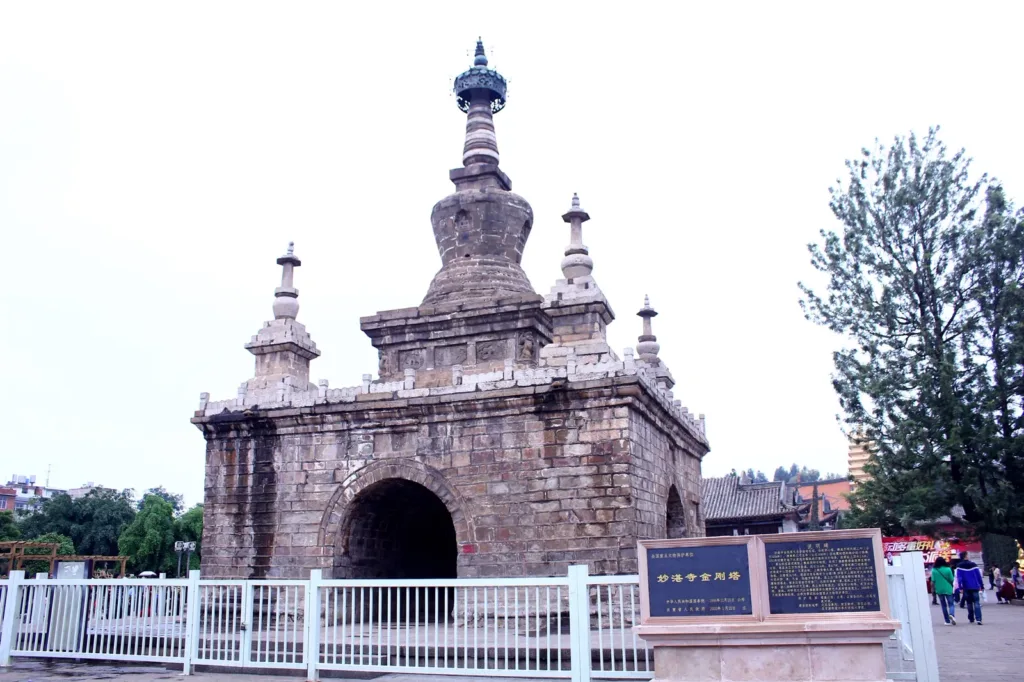
Start at the square around the Vajra Pagoda of Miaozhan Temple (妙湛寺金刚塔). The sandstone pagoda was built in 1457–58 and has a five-spire form; four arched passages cross through its square base. Look for the Chinese and Tibetan inscriptions on the base, then notice how the square links Miaozhan Temple to the north, Tuzhu Temple (土主庙) to the south, Sansheng Palace (三圣宫) to the east, and Confucian and Guan Yu temples to the west. The pagoda is a national-level protected site, so treat the square as a heritage and religious setting rather than a photo prop.
Walk outward from the square instead of treating the gate street as the whole town. Wenming Pavilion (文明阁), Kuixing Pavilion (魁星阁), the old streets and the surviving “one-seal” (一颗印) courtyard houses show the local building scale. The district archives describe more than ten protected sites and more than a hundred courtyards of this type, alongside the town’s traditional grouping of hills, temples, pavilions and shrines. Where a temple or pavilion is closed, remain in the public circulation areas and follow the signs.
Crafts and something to eat
The Yunzi Go academy (云子棋院) is a useful stop for understanding a local craft through its material rather than just its display cases. Yunzi stones use locally associated mineral materials such as purple stone and agate; the archive account describes the white stones as jade-like and the black stones as dark with a green or blue halo when held to the light. Demonstrations or hands-on activities depend on the workshop’s current programme, so ask before joining.
At a wutong zouyin (乌铜走银) workshop, look for the process: a pattern is cut into a black-copper body, molten silver or gold is run into the engraved lines, and the piece is cooled, polished and darkened so the pale metal stands out against the copper. It is a craft associated with Yunnan and listed as a national intangible cultural heritage; the workshop is a place to watch skilled work, not to handle finished heritage objects without permission.
For a local snack, try Guandu griddle cake (官渡粑粑) if a current stall is operating. The dough is made from flour, water and yeast, then lightly adjusted with alkaline powder; fillings can combine sugar with sesame, peanuts, walnuts, hemp seed, perilla or red-bean paste. It is flattened into a round cake and cooked on a broad pan with repeated turning. Recipes vary, so ask about the filling and possible allergens.
You may also see erkuai (饵块), a Yunnan rice food rather than a Guandu-only invention. The basic traditional method uses rice and water: the rice is soaked, steamed, pounded and kneaded into a resilient cake. It can be grilled, boiled, stir-fried or braised; a grilled piece may be folded around sauces or other fillings. The texture comes from the pounding and kneading, not from wheat flour, but a vendor’s ingredients and cross-contact still need checking if you have allergies or dietary restrictions.
Visiting and getting there
The Yunnan public-service listing describes Guandu Ancient Town as an open-air, all-day visitor area with no general admission charge. That does not guarantee access to every temple, pavilion, workshop or activity: the same listing notes that some temples and pavilions restrict entry, and individual venues may keep their own hours or charges. Dress and behave respectfully in active temples, do not touch inscriptions or pagoda surfaces, and do not treat residents or performers as staged subjects.
For a taxi or ride-hailing car, search 官渡古镇, 昆明市, 官渡区 Guāndù Gǔzhèn, Kūnmíng Shì, Guāndù Qū. The town lies at the Guangfu Road–Yunxiu Road area; the public-service listing identifies an east entrance from Guangfu Road and a south entrance from Jihong Road. A 2026 local report also places the scenic area at the Guangfu Road and Yunxiu Road junction. Use the Chinese name in Amap or Apple Maps and confirm which entrance is open for your destination before getting out.
By bus, the same listing gives several useful examples: routes 169, 252 and A12 serve stops around Xinbaoxianghe, the Guandu District Government, Baoyi Road junction and Guandu Ancient Town (Guangfu Road); Z84 and Z95 are listed at Guangfu Road Junction; and 31 and 165 are listed from Puzicun. Route groupings and stop names can change, so check the live stop-to-entrance connection rather than assuming every listed bus stops at the same gate. Metro Line 1 reaches Xingyao Road (星耀路) and Erji Road (珥季路); the public-service page describes continuing from there by bus, with transfers around Zijun Village (子君村) or Dadu Shopping Center (大都购物中心), or by taxi. There is no claim here that a metro station is at the old-town entrance.
Find Guandu Ancient Town
官渡古镇 · 官渡区
The pin marks the area, not the entrance.
Sources & visit information
Sources checked on 23 October 2026. Hours, tickets, reservations and transport can change; confirm with the operator before you go.
Image credits & notes (1)
- Miaozhan Temple Vajra Pagoda (妙湛寺金刚塔) in Guandu Ancient Town, Kunming, with its arched stone base and temple buildings behind it. Photo: Zhangmoon618Photo: CC BY-SA 3.0