


Get to know Guandu District
- Administrative area
- District · 市辖区
- Part of
- Kunming
- Chinese name
- 官渡区
- Local areas
- District guide
Area & population
- Area
- 552.00 km²
- Population · 2020
- 1,602,279
Source: English Wikipedia, as of the dates shown.
Why this district is worth your time
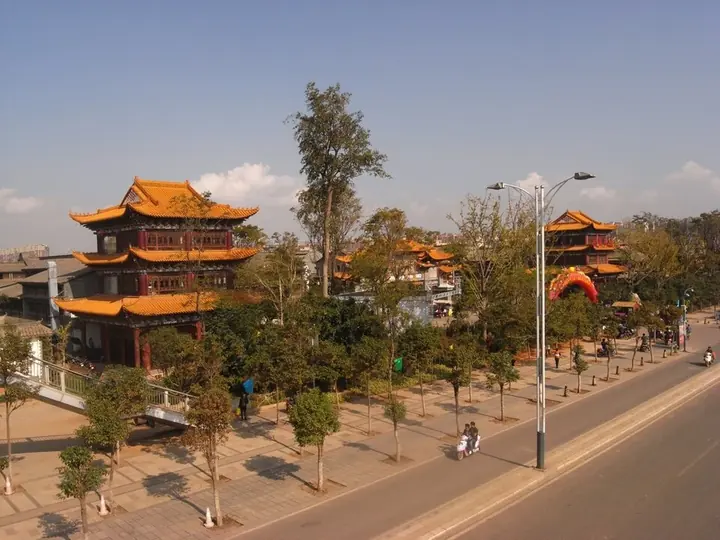
Guandu is more than the name of an old-town attraction. The district occupies Kunming’s southeast side, and its best-known historic settlement grew beside the lower Baoxiang River near the northeast side of Dianchi. The settlement was once reached by water; after Yuan-period waterworks changed the lake’s shoreline, its position on overland routes helped it become a trading centre. That shift—from ferry town to market town—is the clearest way to understand why old courtyards, temples, food and workshops sit inside a modern urban district.
The most rewarding visit connects two different settings. At the Yunnan Provincial Museum, the province’s history is told through galleries ranging from prehistoric Yunnan and Dian bronze culture to the modern period. The museum is at 6393 Guangfu Road (广福路6393号), in Guandu, rather than in the old-town core. Then continue to Guandu Ancient Town (官渡古镇), where the pedestrian streets gather the Miaozhan Temple Vajra Pagoda (妙湛寺金刚塔), Tuzhu Temple (土主庙), Wenming Pavilion (文明阁), surviving yikeyin courtyard houses (一颗印民居) and small workshops. The pagoda and the temples are cultural and religious places, not stage sets: keep voices low, follow signs, and do not interrupt worship or photograph people without permission.
Look for the district’s living skills as well as its buildings. At Yunzi Academy (云子棋院), displays and demonstrations explain Yunnan Go stones, made from locally associated mineral materials; the official district record also lists recognised bearers of the craft. At the Wutong Zouyin Transmission Hall (乌铜走银传习馆), silver or gold is set into engraved patterns in a dark copper body, creating the high-contrast surface that gives the craft its name. These are useful places to watch a process and ask whether a demonstration or hands-on activity is available that day, rather than assuming every workshop runs a fixed public class.
A small taste of Guandu
Guandu baba (官渡粑粑) is the snack most closely tied to the old town. A Xinhua profile describes a chewy dough with a sweet filling in which black sesame and sugar are prominent, cooked on a broad flat pan; the result is a warm, filling pastry rather than a delicate cake. Recipes and fillings vary between makers, so treat it as a local food tradition rather than a single protected formula. Ask about ingredients if you have allergies, and do not assume a sweet filling is vegetarian or free of animal fat.
Visiting and getting around
For the museum, the official visitor information gives opening hours of 09:00–17:00 from Tuesday to Sunday, with last entry at 16:30; it is closed on Mondays, apart from changes announced for holidays. Individual visitors are directed to the Yunnan Provincial Museum WeChat account for reservation instructions. The museum’s official address is 6393 Guangfu Road, and its listed bus stop is Guandu District Government (官渡区政府站), served by routes 169, 252 and A12. The same guide describes a Line 1 route via Xingyao Road (星耀路站), followed by the Z84 connection from Zijun Village (Caiyun North Road) to the Guangfu Road entrance area. Check the museum’s current notice and the day’s route before leaving; a reservation is a museum-entry matter, not a district-wide travel pass.
For Guandu Ancient Town, an English visitor source lists buses 31, 165, 169, 174, 185, 908, C74 and K15 as routes serving the town. Bus networks change, so enter 官渡古镇 Guāndù Gǔzhèn in Amap or another China-capable map on the day and verify the destination stop and the return direction. The old town and the museum are separate visitor stops: plan the transfer between them rather than treating the district name as an entrance.
A half day works for the museum or the old town alone; a fuller day can pair the museum’s chronological galleries with the old town’s pagoda, courtyards, crafts and food. Leave time to return before the last museum entry or the final useful bus connection, especially if you stay for evening street life.
Explore Guandu District
Core places to explore, with English and Chinese names.
Places to explore around Guandu District
 Historical exhibition photograph of the Western Han bronze cowrie container with four oxen and a gilt rider in the Yunnan Provincial Museum, Kunming. Photo: Daderot · Public domain
Yunnan Provincial Museum云南省博物馆
Yunnan’s provincial museum follows the region from prehistory and Dian bronze culture through Nanzhao and Dali Buddhism to modern Yunnan, in a purpose-built Guandu museum whose architecture echoes a local courtyard house and the Stone Forest.
Read the place guide →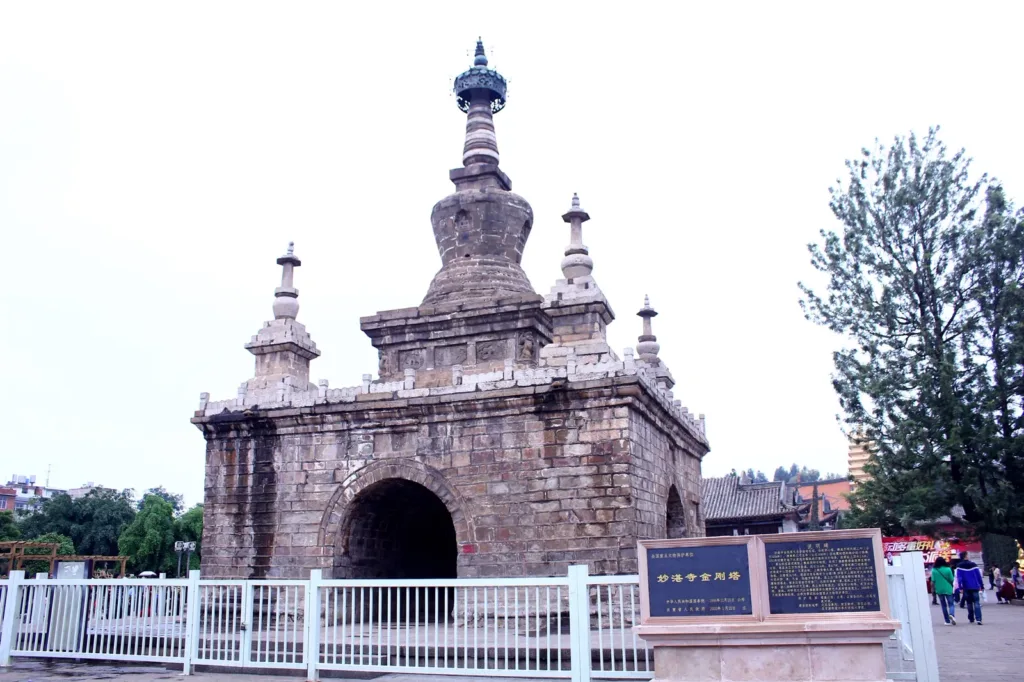 Miaozhan Temple Vajra Pagoda (妙湛寺金刚塔) in Guandu Ancient Town, Kunming, with its arched stone base and temple buildings behind it. Photo: Zhangmoon618 · CC BY-SA 3.0
Guandu Ancient Town官渡古镇
Guandu Ancient Town is a compact historic district in southeast Kunming where an ancient ferry and market town grew around a shell mound, a stone Vajra Pagoda, temple courtyards, local food and craft workshops.
Read the place guide →Plan your visit
Getting there
Guandu District is about 6 km (straight-line distance) from central Kunming. Search for 官渡区 in a map app to find stations and your accommodation.
Where to stay →Build your route
Yunnan Provincial Museum and Guandu Ancient Town are less than 1 km apart. The linked place guides have entrance and visit details.
Continue with Kunming →More in Kunming
Sources & geographic information
Administrative names and parent areas: Official geographic directory (dmfw.mca.gov.cn) · Reference date 2026-09-06.
Background text adapted from Guandu, Kunming — Wikipedia contributors, under CC BY-SA 4.0. Text has been shortened and reorganized; source revision 1352270053.
Map data © OpenStreetMap contributors. Pins mark approximate centres, not entrances or boundaries.
Image credits & notes (1)
- Guandu Old Town in Guandu District, Kunming. Photograph date recorded by the source: 2011-10-12 16:42.Photo: suwa320 · CC BY-SA 2.0Resized for the web; the photo itself has not been edited. Thumbnails may show a cropped view.
