

Explore the region
Tap any red Chinese text to hear it in Mandarin.
Why this place matters
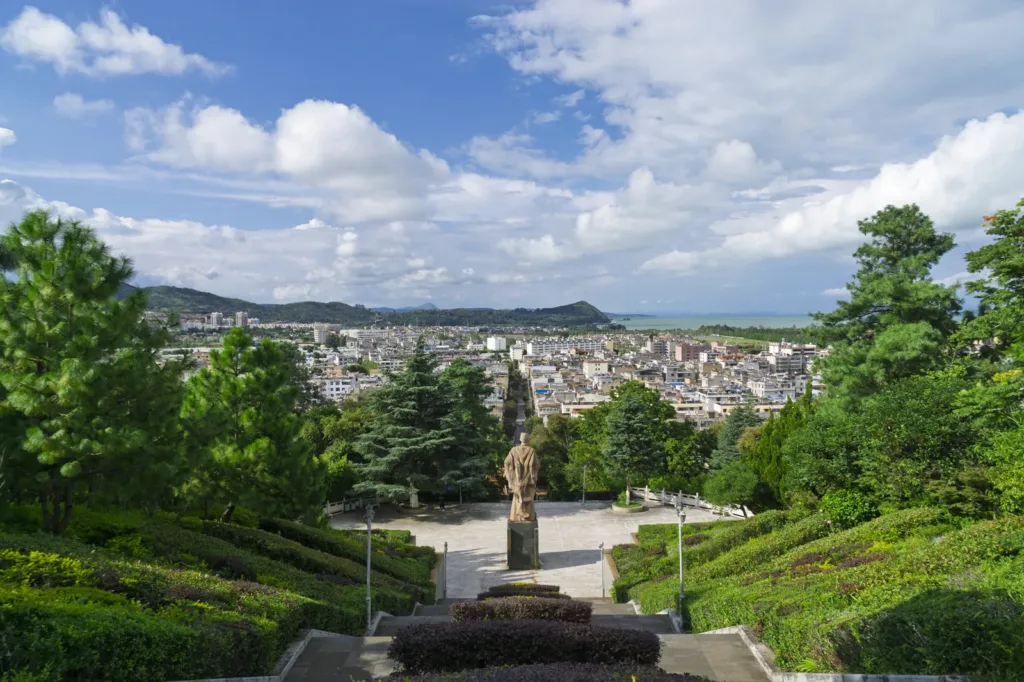
Kunyang is the hometown associated with Zheng He, the navigator whose seven voyages connected Ming China with ports across the Indian Ocean. Zheng He Park was established as a memorial landscape on Moon Hill and is listed by the Jinning district government as one of the “Kunming New Sixteen Scenes”, under the name Yueshan Fanying (“Sails on Moon Hill”). The park’s principal elements are the Zheng He Statue Square, Sanbao Tower, the Zheng He Stele Forest, Zheng He’s former residence and the Jinning District Museum.
The most important object is not a modern monument but the Maha Zhi Tomb Stele (Ma Ha Zhi Mu Bei, 马哈只墓碑). The Ming stone records Zheng He’s father as a man from Kunyang and names Zheng He as the younger son who was granted the surname Zheng. Its reverse carries a 1411 note about Zheng He returning to sweep and make offerings at the ancestral grave. The stele is 1.66 metres high and 0.94 metres wide, with a semicircular head, carved borders and a stone-tortoise base. The State Council included it in the sixth batch of National Key Cultural Relics Protection Units in 2006.
What to look for
- Maha Zhi Tomb Stele: Read the front inscription for the family record, then look for the protected stone and its tortoise base. The 1411 reverse inscription is the link between the object and Zheng He’s recorded return to Kunyang. Do not touch, climb on or photograph through barriers around the monument.
- Sanbao Tower: This three-storey building is shaped as a version of Zheng He’s treasure ship. Local and official descriptions associate its displays with nautical charts, fleet models and Sino-foreign exchange. From the upper level, views extend over the southern end of Dianchi and Kunyang when weather permits.
- Zheng He Stele Forest: The park’s outdoor collection brings together inscriptions attributed to 64 named figures from the Ming period onward. It rewards a slow walk rather than a quick photograph; allow time to read the layout and compare the different scripts.
- Jinning District Museum: Inside the park, the museum uses exhibitions on the remote past, Dian Kingdom civilisation and Zheng He culture, with a world maritime postage-stamp display. The museum adds regional archaeology and maritime history to the more personal story of the tomb stele.
- The statue and hillside paths: The granite Zheng He statue stands 5.55 metres high on a three-metre base shaped like a treasure-ship prow. Steps, pine and cypress, and several viewpoints make the park a walk on a slope rather than a flat city garden.
Location and getting there
The park is in Kunyang Subdistrict, Jinning District, Kunming, at the junction of Xingyang Road and Zhenghe Road. An English Kunming listing gives the address as 27 Xingyang Road, Kunyang Town, Jinning; keep the Chinese name 郑和公园 Zhèng Hé Gōngyuán and 晋宁区 Jìnníng Qū ready because map results can be inconsistent.
There is no directly verified metro stop for the park. The practical public-transport plan is to reach Kunyang first, then take a local taxi or bus to the park. A Kunming visitor guide lists CJ6 to 区中医院 Qū Zhōngyīyuàn and a walk of about 380 metres, and also describes taxi or local-bus connections from Kunyang Coach Station or Kunyang Railway Station. That guide was published in 2023, so check the live route and the return connection in Amap before leaving; do not rely on the route number or walking distance as a current guarantee.
By car or ride-hailing, set the Chinese destination to 郑和公园(晋宁区) rather than a similarly named park. The approach climbs onto Moon Hill, and the northern entrance includes steps. Leave enough time to return to Kunyang before the last useful local connection.
Before you go
Current official opening hours, admission arrangements and access to every interior have not been published in the sources checked for this guide. The district government’s route pages confirm the park and its component attractions, while a local visitor notice says that routine reservation is not normally required but that capacity controls may introduce “limited numbers, reservation and staggered entry”. Confirm the park and museum’s current status, any passport-based booking procedure and the entrance in use before travelling.
The tomb stele is a protected cultural relic, and Yuhuang Pavilion is described locally as a Taoist religious site. Follow signs and staff instructions, keep voices low in memorial or worship spaces, and treat inscriptions and buildings as heritage rather than props for climbing or staged photography.
Find Zheng He Park
郑和公园 · 晋宁区
The pin marks the area, not the entrance.
Sources & visit information
Sources checked on 23 October 2026. Hours, tickets, reservations and transport can change; confirm with the operator before you go.
- Jinning District Government: Recommended Jinning holiday route ↗
- China News Service Yunnan: Zheng He was from Yunnan ↗
- Wenlv News: Honouring the navigator Zheng He from Yunnan ↗
- Ministry of Culture and Tourism: Sixth batch of National Key Cultural Relics Protection Units ↗
- Jinning District Government: Six themed tourism routes ↗
- GoKunming: Zheng He Park listing ↗
- Kunming Local Treasure: Zheng He Park reservation and transport note ↗
Image credits & notes (1)
- View from Zheng He Park on Moon Hill over Kunyang, with the park hillside, a statue at the foot of the steps and distant Dianchi landscape. Photo: Kcx36Photo: CC BY-SA 4.0