

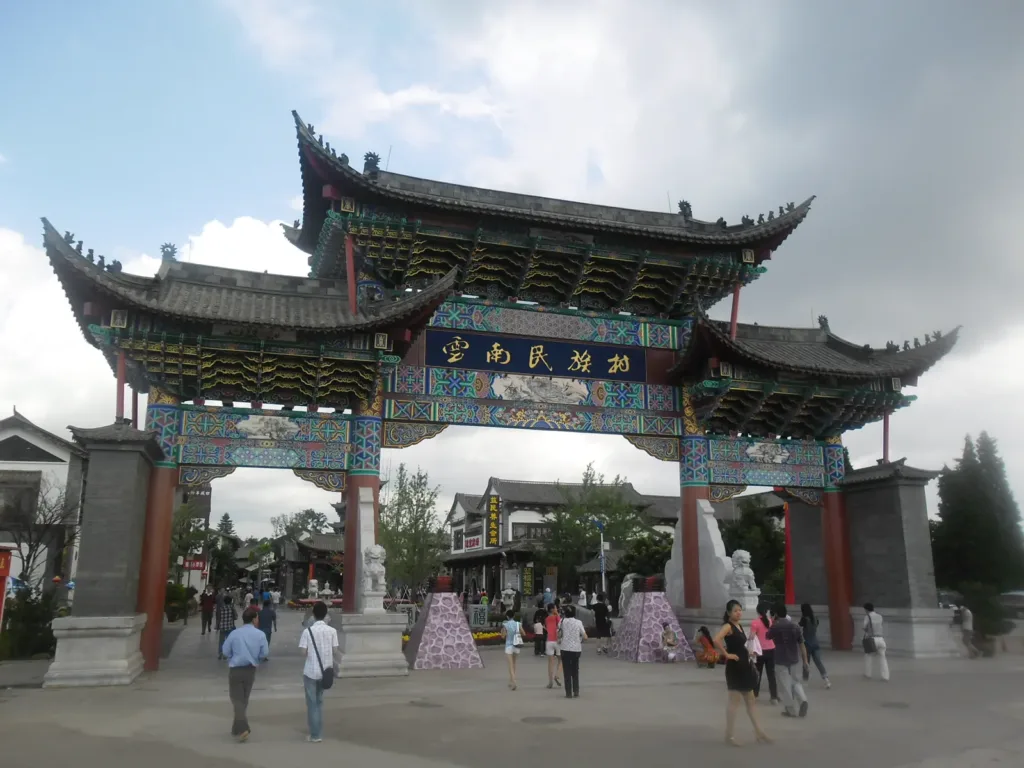
Explore the region
Why visit
Yunnan Ethnic Village is not a single preserved traditional village. It is an ethnographic theme park created to present many of Yunnan’s cultures together. Its setting matters: the park lies on the north shore of Dianchi, below the Western Hills, and combines water, paths, planted grounds and village-style buildings.
That format is useful for a first look at Yunnan’s cultural range, but it should be read as a curated presentation rather than a substitute for visiting living communities elsewhere in the province. The park’s own material describes performances, customs, clothing, architecture and traditional crafts; a 2025 Xinhua report likewise presents it as a window onto the culture of Yunnan’s 26 ethnic groups.
What to look for
Start with the Dai compound. The official description places it at the entrance and highlights stilted bamboo houses, a red-sandstone path, a white pagoda, a covered bridge and water on three sides. During the Water-Splashing Festival period, the programme may include elephant-foot drum and Gaguang dance, wedding scenes and other folk activities, but dates and programming must be checked for your visit.
The Tibetan compound gives a different architectural vocabulary. Look for sloping-roof homes associated with Zhongdian, flat-roofed Diaolou-style homes associated with Deqin, a Tibetan Buddhist temple, a white stupa and a white-yak sculpture. The same official description mentions Tibetan tea culture and Reba, Guozhuang and Xianzi dance traditions. Treat the religious references respectfully: do not enter restricted areas or photograph people, ritual objects or ceremonies without permission.
The official park map offers several village circuits rather than one mandatory route. They pass through combinations of Dai, Buyi, Wa, Bulang, Miao, Jinuo, Lahu, Bai, Zhuang, Naxi, Mosuo, Yi, Hani, De’ang, Tibetan, Jingpo and Achang areas, with a central performance/landscape stop marked as Jixiangyuan or “Elephant Garden.” Choose a circuit according to the day’s performances and your walking pace, instead of trying to collect every compound quickly.
Performances and festival presentations are part of the attraction. Examples named by Yunnan’s official tourism guide include the Dai Water-Splashing Festival (13–16 April), the Yi Torch Festival on the 24th day of the sixth lunar month, the Jinuo New Rice Festival around late July and early August, and the Bai Third Month Fair in late April. These are examples of the park’s seasonal programming, not a promise of dates in every year; check the current programme before buying a ticket.
The official site also lists an Ethnic Snack Street. It is a convenient place to sample changing Yunnan-style and minority-region snacks inside the park, but the readable page does not publish a fixed menu or ingredient list. Ask about meat, dairy, peanuts and spicy ingredients if you have an allergy or dietary restriction.
Timing, entry and practical checks
The venue homepage currently lists daytime hours of 09:00–18:00 and night hours of 17:30–21:10. It warns that government events, thunderstorms and other conditions can change the schedule. The ticket page says daytime tickets can be bought at the east, south or north gates; for night visits, use the east-side gate unless a Torch Festival arrangement says otherwise.
The official ticket page directs visitors to its WeChat service account or named authorised platforms. It says tickets and performance tickets are valid on the day of issue and normally cannot be refunded or replaced; if you leave and need to re-enter, arrange it at the inspection gate. The readable page does not state a current adult price or a passport-specific booking and ID policy. International visitors should confirm the accepted document and purchase process with the venue before travelling, rather than assuming that a domestic-ID concession or booking rule applies.
Allow at least half a day if you want to walk two or three compounds and see a performance. Add time for more circuits, the snack street and the Dianchi shore. Festival dates, show times, ticket bundles and any evening programme can change, so treat the official homepage and ticket notices as the final check.
Getting there
The address is No. 1310 Dianchi Road, Xishan District, Kunming (昆明市西山区滇池路1310号). The park is next to Dianchi and below the Western Hills.
The most useful verified option is the bus stop Yunnan Minzucun (云南民族村). Sources list buses 24, 44, 73, 94, 135, 165, 172, 184, 233, A1, A4 and A9, although the lists differ slightly by source and routes can change. The Yunnan tourism guide specifically notes buses 24 or 44 from Kunming Railway Station (昆明站), and the park’s location makes the stop more useful than navigating by an English translation alone. Confirm the day’s route in Amap or Apple Maps and keep the Chinese name ready.
If you take a taxi or ride-hailing car, show 云南民族村,昆明市西山区滇池路1310号 and confirm which visitor gate is open. The sources I could verify identify bus access rather than a direct metro station; do not treat a metro interchange as confirmed without checking the current map.
Find Yunnan Ethnic Village
云南民族村 · 西山区
The pin marks the area, not the entrance.
Sources & visit information
Sources checked on 23 October 2026. Hours, tickets, reservations and transport can change; confirm with the operator before you go.
- Yunnan Ethnic Village official homepage ↗
- Yunnan Ethnic Village official ticket service ↗
- Xishan Scenic Area: Yunnan Ethnic Village ↗
- Yunnan Nationalities Village, Visit Yunnan ↗
- China Southern Airlines: Kunming attractions ↗
- Xinhua: 到云南民族村,沉浸式感受民族团结之美 ↗
- Yunnan Ethnic Village official scenic map and routes ↗
- Yunnan Ethnic Village official Dai village guide ↗
- Yunnan Ethnic Village official Tibetan village guide ↗
- Yunnan Ethnic Village official Ethnic Snack Street page ↗
Image credits & notes (1)
- The ornate entrance paifang of Yunnan Ethnic Village in Kunming, photographed in 2011. Photo: 董辰兴Photo: CC BY-SA 4.0