

Explore the region
Tap any red Chinese text to hear it in Mandarin.
A surviving ordination hall
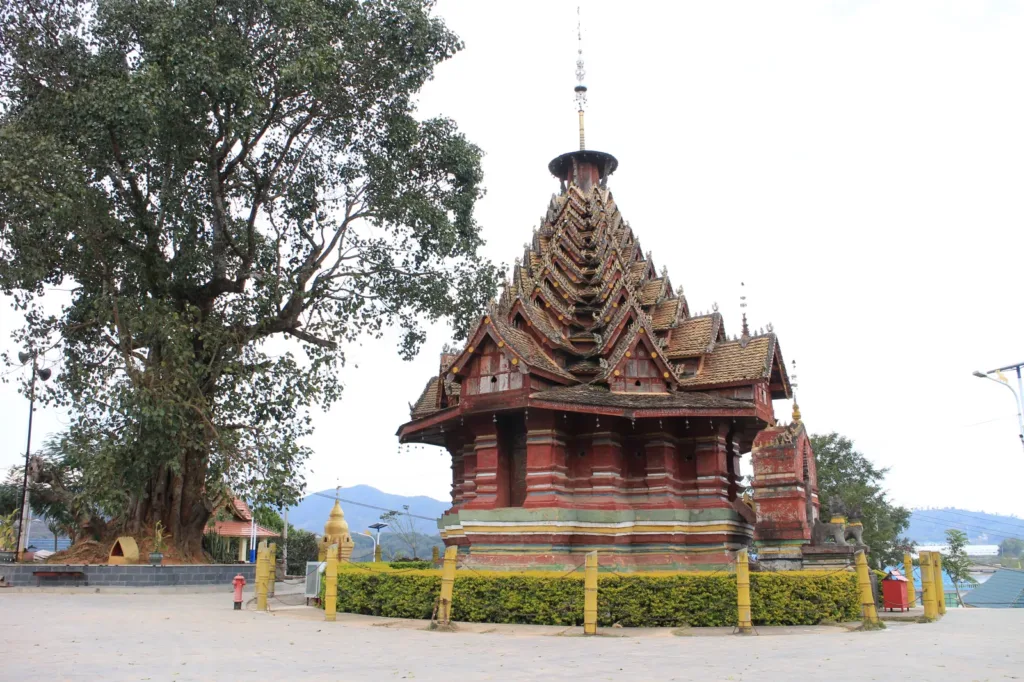
Jingzhen Octagonal Pavilion is not simply a decorative roadside gazebo. It is a bu sa tang (布萨堂), or ordination hall, associated with the Jingzhen Buddhist temple complex in Jingzhen Village. The pavilion is in Jingdai Buddhist Temple (景岱佛寺), in Mengzhe Town, Menghai County; the wider complex is also described in English sources as Jingzhen Temple or Walazhatan. The Menghai County government lists the pavilion among the county’s two national-level protected sites.
The hall was built in 1701, the 40th year of the Kangxi reign and Dai year 1063. The surrounding temple was destroyed in the nineteenth century, while the ordination hall survived and was repaired in the late twentieth century. It was listed in the third group of Major Historical and Cultural Sites Protected at the National Level in 1988. The pavilion is also known as “Bosu Jingzhen” (波苏景真), commonly explained as the “crown of the lotus”; a Yunnan planning institute’s account links its form and setting to Dai Theravada Buddhist culture and local epic traditions.
What to look for
Start with the silhouette. The pavilion’s brick base and body rise to a round timber eave, above which a conical roof is built from eight sloping groups in stacked tiers. Four doors open through the body, and a long iron finial with silver floral ornament crowns the roof. The recorded height is 15.42 metres and the width 8.6 metres.
Look closely rather than circling quickly for a single “best” view: the stepped, cross-like base; the layered roofline; the coloured details and carved Buddhist and animal motifs; and the relationship between the building, the raised terrace and the bodhi trees are the useful details. The pavilion’s meaning is inseparable from its religious setting, so treat the temple grounds as a place of worship as well as a heritage site.
Older planning material describes a separate Jinhu (金湖) cultural-tourism project to the east, including Buddhist-culture and palm-leaf-scripture facilities. That is a historical account of a planned and partly completed project, not proof that every adjacent museum or visitor facility is operating now. Keep the pavilion itself separate from any surrounding project when checking what is open.
Visiting respectfully
Wear clothing that is comfortable and reasonably modest, keep voices low, and ask before entering a hall, photographing an altar or taking close photographs of monks or worshippers. Do not touch the fabric, carvings or other protected features. Follow signs and instructions from temple or heritage staff, and do not step into closed areas simply to get a better view.
No official current operator notice confirming opening hours, admission or unrestricted access to the pavilion interior was located in the sources checked. A current Trip.com listing displays free admission and 08:00–18:00, while another travel page marks the hours as unknown and says any stated hours are subject to local arrangement. Treat those listings as provisional and confirm at the site before making a dedicated trip.
Getting there
The address to give a driver is 景真八角亭 / 景岱佛寺, 景真村, 勐遮镇, 勐海县. A current travel listing labels the approach as the 214 National Highway (G214) Huaihai section, but map pins and English names are inconsistent, so search the Chinese name together with 勐海县 Měnghǎi Xiàn and 勐遮镇 Měngzhē Zhèn.
For a public-transport approach from Jinghong, a 2023 Xishuangbanna travel report lists a Jinghong–Menghai–Mengzhe intercity route and names Jingzhen Octagonal Pavilion among the places reached from that corridor. The report does not provide a current timetable, boarding point, or a guaranteed stop at the pavilion. Check the current service at the coach station or local transport counter, then arrange the return before setting out.
From Menghai, a taxi, ride-hail car or private car is the simplest final leg. Ask the driver to wait or agree on a return arrangement: no current rural timetable or late return service was verified for the pavilion itself. Do not assume that a route to Menghai, a temple visit, or a nearby Jinhu project is the same thing as a confirmed entrance to the protected pavilion.
Find Jingzhen Octagonal Pavilion
景真八角亭 · 勐海县
The pin marks the area, not the entrance.
Sources & visit information
Sources checked on 24 October 2026. Hours, tickets, reservations and transport can change; confirm with the operator before you go.
Image credits & notes (1)
- Jingzhen Octagonal Pavilion (景真八角亭) beside a bodhi tree in Jingzhen Village, Menghai County, Yunnan, photographed on 3 February 2017. Photo: Xin (Wikimedia Commons user Halazhang)Photo: CC BY-SA 4.0