

Explore the region
Tap any red Chinese text to hear it in Mandarin.
Why visit
Mengjinglai is unusual because the attraction is the village setting itself. The Daluo River runs along the settlement and forms a natural boundary with Myanmar on the opposite bank. Rice fields, fish ponds, tropical planting and the village lanes make the border feel like part of an agricultural landscape, not an abstract line on a map. Local accounts explain Jinglai as Dai for “the blessed land found while chasing a golden deer.”
The visitor area follows a “village plus scenic area” model. Recent reporting describes three linked zones: a protected traditional Dai village, a pastoral landscape area and tropical agriculture. The project has repaired or replaced incongruous buildings while retaining the settlement’s traditional stilt-house character. Look for raised timber houses, shaded lanes, small household work spaces and the contrast between cultivated plots and the river edge.
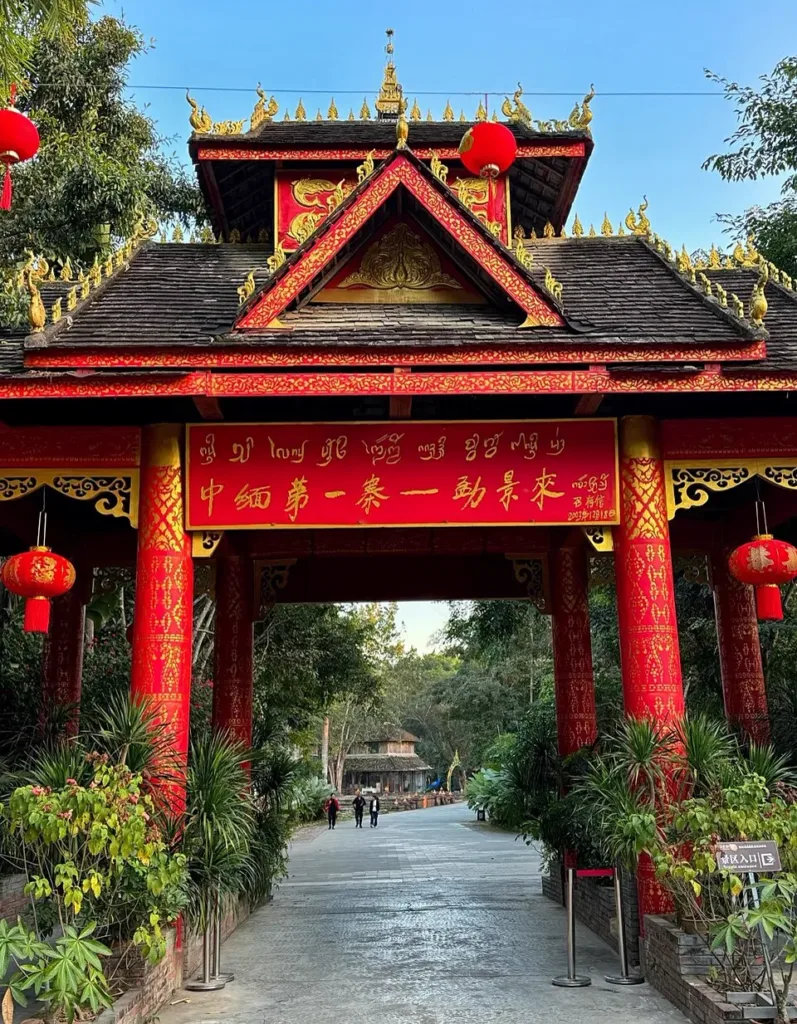
The cultural stops are more than decorative backdrops. The entrance pagoda group, the village Buddhist temple, the sacred tree and the spring are part of a living religious landscape; the site is associated with Theravada Buddhist practice. A slow visit can also include the Dai traditional culture displays and demonstrations of brocade weaving, papermaking, slow-wheel pottery, dyeing, sugar-making, bamboo work, brewing and blacksmithing. Peacock dance and elephant-foot-drum performances have been reported, but a performance or craft session should be treated as availability-dependent rather than a guaranteed daily show.
How to explore
Begin at the current scenic-area visitor entrance and walk rather than rushing between photo points. A practical sequence is the entrance and pagoda group, the sacred tree and spring, the temple area, then the village lanes and the agricultural edge. Older local guidance also lists the traditional culture exhibition, craft workshops and the 229 boundary marker among the possible stops; confirm which sections are open and whether a sightseeing vehicle is running when you buy or collect your ticket.
Pause to observe how the village is used. Residents’ houses and working spaces are not an open-air stage: ask before entering a residential compound, photographing people or filming a craftsperson. At the temple, follow staff or worshippers’ instructions, remove shoes where requested and do not touch ritual objects. Do not touch a monk’s head. The local visitor guidance specifically asks guests to use the respectful term “Theravada Buddhism” rather than an outdated label.
The river is a border feature, not an invitation to cross or approach restricted ground. Stay on marked visitor routes and do not enter riverbanks, fields or other areas that are not open to visitors. A border sightline can be enjoyed without turning a village walk into an attempt at unauthorised crossing.
Practical visit
Location: Mengjinglai Village, Daluo Town, Menghai County, Xishuangbanna Dai Autonomous Prefecture, Yunnan. A 2023 architectural-planning institute profile places the village east of Daluo Town and about 3 km from the town government; use the Chinese name 勐景来 Měngjǐnglái with 勐海县 Měnghǎi Xiàn in Amap or Apple Maps because map pins and road approaches can vary.
Opening and tickets: Mengjinglai is described by official and state-media sources as a national 4A scenic area. A current Trip.com listing read on 24 October 2026 displayed a next-day opening window of 08:00–18:00, while a 2023 local guide gave different hours. Treat the platform display as a live lead, not a guarantee: check the venue or current booking page on the day you travel. The scenic area is ticketed, and current booking pages show separate admission and sightseeing-vehicle products, but I did not locate a current official tariff notice; do not rely on an old quoted price.
Getting there: The most dependable plan is a private car, taxi or chartered vehicle to 勐景来景区/勐景来村 Měngjǐnglái Jǐngqū / Měngjǐnglái Cūn, with the Chinese destination saved before leaving Jinghong or Menghai. An English CGTN travel report recommended renting a car. A 2023 local transport guide reported a Jinghong–Daluo coach and a final connection from Daluo, but its departure times, fare and stop information are now too old to present as current. If you use public transport, confirm the current coach departure point, the last-mile drop-off and a return vehicle before entering the scenic area.
There is no verified metro or railway service to the village entrance. The railway stations and airport elsewhere in Xishuangbanna are gateways to the prefecture, not substitutes for the road transfer to Daluo. Do not confuse Daluo Port or a border park with Mengjinglai’s village entrance. Arrange the return leg in advance, especially if you are not travelling with a driver.
The sources checked for this guide do not confirm passport-specific ticketing, reservation or border-area access rules. International visitors should ask the venue or booking channel how a passport is handled before setting out, and should carry the passport used for the reservation. Conditions for performances, craft participation, temple access and any boundary-marker stop can change with local management, weather or village activity.
Find Mengjinglai Dai Village
勐景来 · 勐海县
The pin marks the area, not the entrance.
Sources & visit information
Sources checked on 24 October 2026. Hours, tickets, reservations and transport can change; confirm with the operator before you go.
- Xinhua: Mengjinglai’s village-plus-scenic-area model ↗
- Yunnan Institute of Urban and Rural Planning: 走进勐景莱 ↗
- CGTN: Explore the first village on China–Myanmar border ↗
- People’s Daily Yunnan: 党建引领擦亮傣寨旅游的金字招牌 ↗
- Yunnan Department of Commerce: Mengjinglai scenic-area upgrading project ↗
- Kunming Local Treasure: Mengjinglai transport guide ↗
- Trip.com: Mengjinglai current listing ↗
- Qunar ticket page: Mengjinglai products and address ↗
- Kunming Local Treasure: Mengjinglai ticket and visitor etiquette guidance ↗
Image credits & notes (1)
- The gateway and path into Mengjinglai Scenic Area, with the Dai village route visible beyond. Photo: 유신예Photo: CC BY-SA 4.0