

Explore the region
What to see and how to explore
“Hangzhou Grand Canal Scenic Area” is best understood as a visitor label for a long, open urban heritage corridor, not one enclosed attraction with a single gate. The Beijing–Hangzhou Grand Canal is part of a UNESCO-listed serial heritage property and remains an active waterway; its history joins engineering, grain transport, commerce, and the city life that grew along its banks. In Hangzhou, a rewarding walk centers on Gongchen Bridge (拱宸桥), the canal-side Qiaoxi Historic and Cultural Block (桥西历史文化街区), and the museum quarter around the bridge.
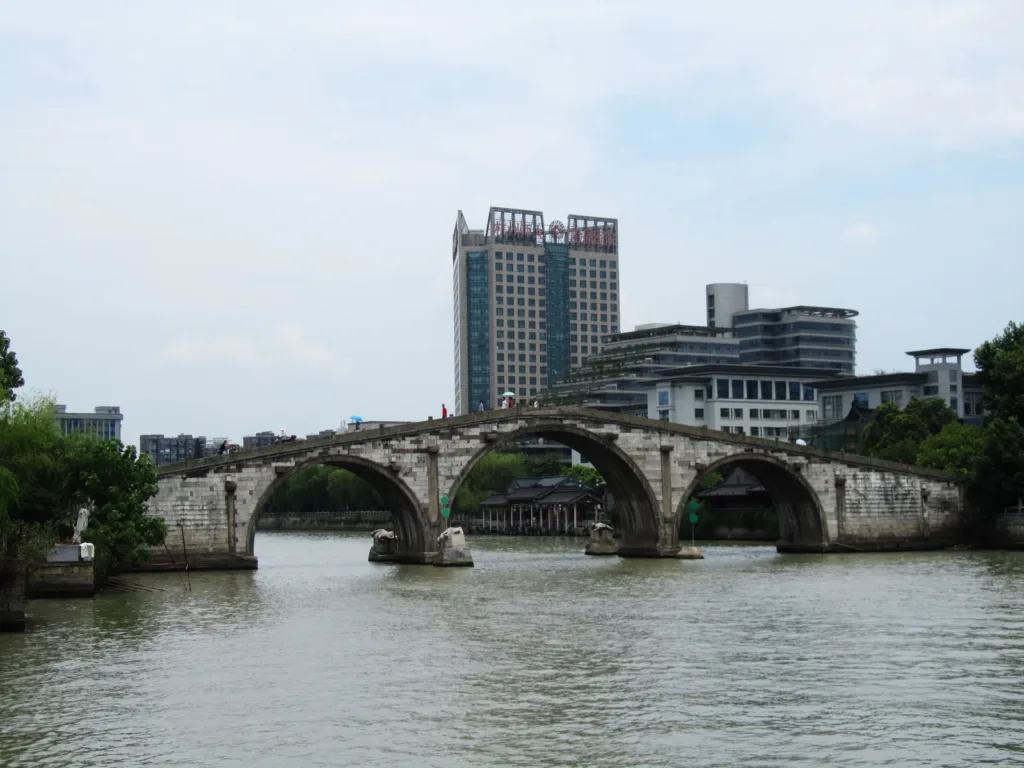
Begin at Gongchen Bridge, a substantial stone bridge beside the canal. Pause on its approaches to watch the river traffic and compare the older bridge-and-lane scale with the modern city behind it. Cross to the west bank and wander Qiaoxi’s narrow streets at an unhurried pace. Former mill, warehouse, and factory buildings have been reused for cultural venues, so the walk reads as both a historic working district and a contemporary neighborhood rather than a reconstructed set.
Allow time for the Hangzhou Arts and Crafts Museum complex. Its separate halls explore knives and scissors, umbrellas, fans, and other local crafts; the living-craft venue may offer demonstrations or hands-on activities, but activities are not guaranteed on every visit. These museums are independent venues within the historic block, not one bundled “canal attraction.” Across the river, the China Grand Canal Museum (中国京杭大运河博物馆) is a separate institution. Its galleries follow the canal’s long history through objects such as transport records, boat equipment, and maps, making a useful indoor companion to the outdoor walk. Check each museum’s own current opening, reservation, and exhibition information before setting out; this research did not confirm a current daily schedule.
The canal is also a lived public landscape. Look for boats moving through the waterway, neighbors using the riverside routes, and the way old industrial buildings now share space with workshops and cafés. Keep a respectful distance from residents, avoid photographing people or home interiors without permission, and treat demonstrations or neighborhood activity as occasional rather than scheduled performances.
Getting there
For the bridge and museum side, take Hangzhou Metro Line 5 to Gongchen Bridge East (拱宸桥东站), then walk west along Quzhou Street (衢州街) toward Yunhe Culture Square (运河文化广场) and the canal. For the Qiaoxi lanes and arts-and-crafts museums, Line 5’s Grand Canal station (大运河站) is close to the district; follow local signs toward the canal and Qiaoxi. Local sources confirm both stations and these nearby destinations, but the exact best exit letter for each walking route could not be reliably confirmed, so do not rely on an unverified exit number.
A local report documented the 好运悠悠 loop bus, which linked Yunhe Tiandi (运河天地), Gongchenqiaoxi (拱宸桥西), Dadou Road (大兜路), and other canal-side stops. That report dates from November 2024 and does not establish the route’s current operating days or timetable; confirm the route and service before relying on it.
Hangzhou’s water bus is an alternative way to experience the canal from the water. A recent October 2026 report confirms active service on Line 1 and departures serving Wulinmen (武林门) and Gongchen Bridge (拱宸桥), alongside separate tourism products. Check the Water Bus mini-program at the time of travel for current departure times, queues, and return boarding; a boat ride is a transport service, not a guaranteed sightseeing timetable.
For a taxi, enter 中国京杭大运河博物馆(杭州市拱墅区运河广场1号) as the destination; this is a specific visitor venue, not a gate for the entire canal corridor. The precise legal curb or ride-hailing bay could not be confirmed, so ask the driver to use the locally signed lawful visitor drop-off and do not stop on Gongchen Bridge or block the canal-side street.
Find Beijing–Hangzhou Grand Canal (Hangzhou Section)
京杭大运河拱宸桥片区 · 拱墅区
The pin marks the area, not the entrance.
Sources & visit information
Sources checked on 21 October 2026. Hours, tickets, reservations and transport can change; confirm with the operator before you go.
Image credits & notes (1)
- Gongchen Bridge over the Grand Canal, viewed from the south. Photo: 猫猫的日记本Photo: CC BY-SA 3.0