

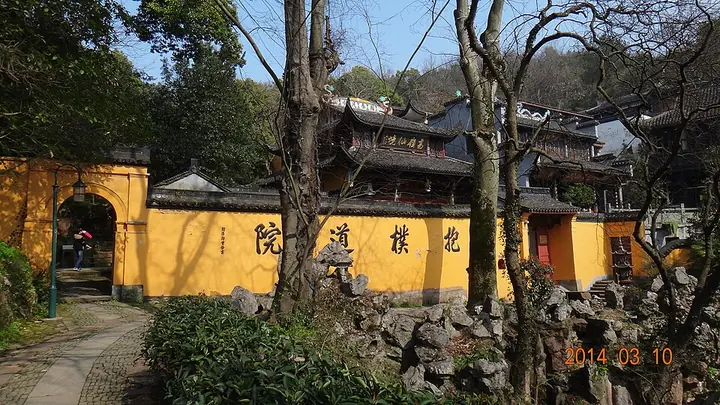
Photo adjustments
Full frame retained; proportionally resized and converted to WebP. No retouching or changes to the photographed subject. Card displays may crop the view.
Explore the region
About Baopu Taoist Temple
Yellow walls, tiled roofs and stepped approaches give the complex a recognisable hillside character. The main Gexian Hall honours Ge Hong, while Hongmei Pavilion contains carved narrative panels connected with the story of Li Huiniang. Stone inscriptions along the ascent add another layer of interest. This is an active religious setting, with access to individual halls governed by temple arrangements.
Baopu Taoist Temple, also called Gexian'an (葛仙庵) or Baopulu (抱朴庐), takes its name from the Eastern Jin Daoist Ge Hong (葛洪), said to have practised alchemy on Geling (葛岭). A shrine to Ge Hong, the Gexian Ci (葛仙祠), was built here in the Tang dynasty. In the Southern Song the site became part of the imperial Jifang Garden (集芳园) and later passed to Chancellor Jia Sidao (贾似道), who built Hongmei Pavilion (红梅阁) here as a private villa. It was destroyed by war in the Yuan dynasty, rebuilt in the Ming as Manao Shanju (玛瑙山居), and renamed Baopu Taoist Temple in the Qing dynasty, the name still in use today.
During the Cultural Revolution the temple was occupied by the parks department, and Daoist management resumed in 1982; in 1983 it was designated a National Key Daoist Temple (道教全国重点宫观). Its halls and statues were restored between 2001 and 2003, when a consecration ceremony marked its reopening, and it now serves as the seat of the Hangzhou Taoist Association. In 2011, when West Lake was inscribed on the World Heritage List, Baopu Taoist Temple and its Daoist culture were included in the West Lake Cultural Landscape listing. Historically, together with Huanglong Cave (黄龙洞) and Yuhuang Hill (玉皇山), it was known as one of West Lake's three great Taoist temples.
What to look for
- Gexian Hall, the principal hall dedicated to Ge Hong.
- Hongmei Pavilion’s woodcarved narrative panels.
Location & getting there
Getting to Baopu Taoist Temple
Use the Geling approach on the north side of West Lake. Pass through the yellow arched Geling gate and climb the steps by Liudan Pavilion and Dixin Pool toward the temple halfway up the slope.
Combine your visit
A suggested sequence linking the specific features of this visit.
-
Geling gate and ascent
Follow the inscribed hillside approach to the temple.
-
Gexian Hall
See the principal shrine to Ge Hong.
-
Hongmei Pavilion
Look for the carved narrative panels where visitor access permits.
This order is editorial. Confirm access and any transfers between stops; it does not establish a walking route, same-day connection or common admission ticket.
Find Baopu Taoist Temple
抱朴道院 · 西湖区
The pin marks the area, not the entrance.
More places nearby
Approximate straight-line distances between map pins, not travel distances.
Baochu Pagoda 保俶塔
Less than 1 km awayBaochu Pagoda makes a slender landmark above the north side of West Lake. The present brick-and-stone tower follows a 1933 rebuilding and has no internal staircase, so the visit centres on its exterior and the paths of Baoshi…
View guide →Bai Causeway 白堤
Less than 1 km awayBai Causeway provides a direct waterside route from Broken Bridge to Gushan and the Autumn Moon terrace. Jindai Bridge interrupts the planted strip, opening views across different sections of the lake. The causeway’s older name…
View guide →Lingering Snow on Broken Bridge 断桥残雪
Less than 1 km awayBroken Bridge joins Beishan Road to the eastern end of Bai Causeway. The bridge is intact; its name belongs to a group of stories and winter views rather than a missing span. The present bridge dates to a twentieth-century…
View guide →Sources & visit information
The sources below support the place-specific description and arrival information. Suggested combinations are editorial planning ideas; confirm current opening, entry arrangements and transport services for your date.
Visitor information adapted and edited from Wikipedia contributors, “抱朴道院” · CC BY-SA 4.0. Source revision 92441810.
Background paragraphs translated and condensed from Wikipedia contributors, "抱朴道院", Chinese Wikipedia · CC BY-SA 4.0. Source revision 92441810.