

Explore the region
Tap any red Chinese text to hear it in Mandarin.

Lingyin Temple is an active Chan Buddhist monastery in Hangzhou’s West Lake District. The temple stands between Feilai Peak and Beigao Peak; its formal entry hall bears the name Yunlin Chan Temple, a Qing-era name for this same monastery, not a separate attraction. Distinguish the temple from the wider Lingyin–Feilai Peak Scenic Area: the scenic-area entrance is reached first, and the booked area also covers the nearby Yongfu and Taoguang temples.
How to explore
Approach through the Lingyin–Feilai Peak Scenic Area entrance. Before reaching the monastery’s main gate, pause by the stream-side rock faces and caves: the scenic area’s carved Buddhist images span several historical periods and are an outdoor art stop, not part of the temple’s interior halls.
Enter through the double-eaved Hall of the Heavenly Kings (天王殿). Look first at the Maitreya figure facing the entrance, then the Four Heavenly Kings along the sides and the Skanda guardian, known in Chinese as Weituo (韦陀), at the rear facing uphill. The hall’s plaque reads “Yunlin Chan Temple.”
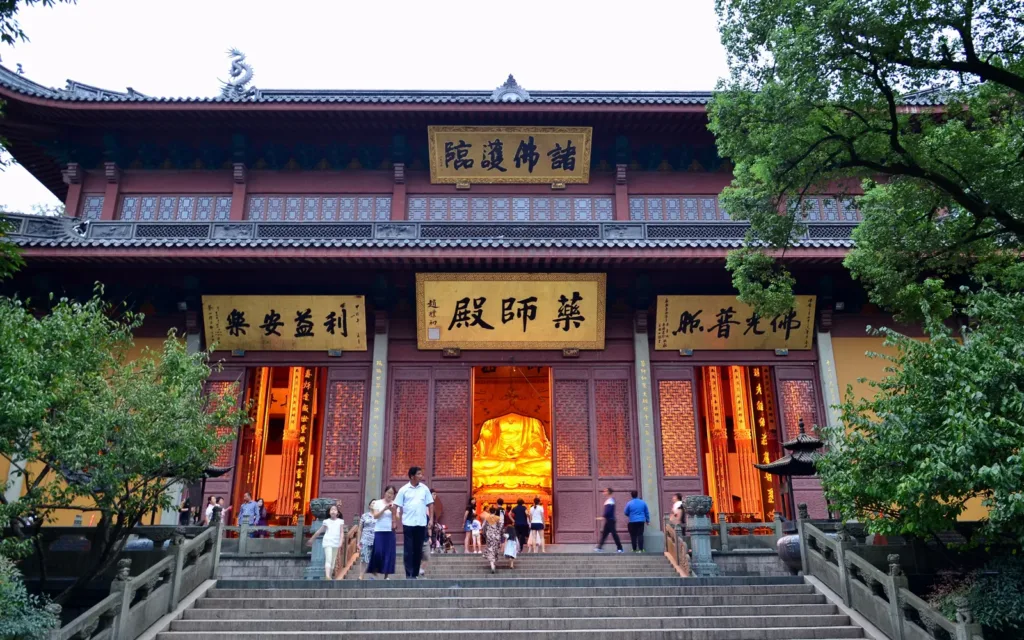
Continue along the central axis to the Mahavira Hall (大雄宝殿), where a large carved camphor-wood statue of Sakyamuni sits above the altar. Look behind the central image for the sculpted “Fifty-Three Pilgrimages” tableau from the Avatamsaka tradition. The route continues toward the Medicine Buddha Hall (药师殿) and the higher Huayan Hall (华严殿); the official temple introduction lists these among its principal halls.
This is a living place of worship, not only a monument. Keep voices low, leave worshippers room, follow signs around any active ceremonies, and do not photograph people at prayer without permission. A current temple notice lists a Water and Land Dharma Assembly from 21 to 28 October 2026; that is an event notice, not a promise that every hall or ordinary visitor route will be available during those dates. Confirm access before visiting then.
Admission and reservations
A Hangzhou visitor notice announced free admission to the Lingyin–Feilai Peak Scenic Area from 1 December 2025, including Lingyin Temple, Yongfu Temple and Taoguang Temple. The published 2025 notice describes the free-entry policy; check the official booking platform for the conditions that apply to your chosen date.
The temple’s official notice says that, from 1 February 2026, on-site registration for the scenic area was discontinued. Reserve through the “Hangzhou Lingyin Feilai Peak” mini-program in WeChat or Alipay, up to seven days ahead. If a slot is full, an online waitlist request must be submitted by 20:00 on the day before the visit. Admission requires a successful reservation or waitlist allocation and the original valid identity document used for it. The notice gives hotline 0571-87969691 for booking questions. It does not explain the document procedure for overseas passports, so international visitors should confirm that detail with the hotline before travelling.
The latest official booking notice opened for this guide does not state ordinary daily opening hours or the current session times. Do not rely on old hours; check the mini-program for the date you intend to go.
Getting there
There is no metro station at the temple entrance. A straightforward public-transport route is Metro Lines 1 or 5 to Chengzhan (城站) Station. Leave by Exit A, transfer to bus 7 at the Chengzhan stop, and ride to Lingyin Bus Terminal (灵隐公交总站). From there, follow the signs along the Lingyin Road approach toward the scenic entrance and Fayun Lane (法云弄).
An alternative is Metro Line 3 or 10 to Huanglong Sports Center (黄龙体育中心) Station, Exit C, then bus 278M to the Lingyin Road No. 32 bus terminal (灵隐路32号公交总站). This is a separate bus interchange from Lingyin Bus Terminal; on arrival, follow current stop and pedestrian signs for the scenic entrance rather than treating the terminal as the temple gate.
For a taxi or ride-hail destination, use 灵隐飞来峰景区游客入口,杭州市西湖区灵隐路法云弄1号. Traffic-control arrangements can prevent vehicles reaching the entrance. Hangzhou’s published traffic guidance directs taxis to set down at 西溪路608号停车场 or 小牙坞公交站 Xiǎoyáwù gōngjiāo zhàn, then transfer by the signed scenic-area shuttle. Do not ask a driver to stop at a barrier or where stopping is prohibited; follow the day’s police and road signs.
Combine your visit
A suggested sequence linking the specific features of this visit.
-
Hall of Heavenly Kings
Begin with the guardian figures at the front of the temple axis.
-
Mahavira Hall
Continue to the principal Buddha and narrative sculpture.
-
Hall of Medicine Buddha
Follow the rising axis to the Medicine Buddha and attendant figures.
This order is editorial. Confirm access and any transfers between stops; it does not establish a walking route, same-day connection or common admission ticket.
Find Lingyin Temple
灵隐寺 · 西湖区
The pin marks the area, not the entrance.
More places nearby
Approximate straight-line distances between map pins, not travel distances.
Feilai Feng 飞来峰
Less than 1 km awayFeilai Feng’s limestone crags stand across the stream from Lingyin Temple. Buddhist images occupy exposed rock faces and small grottoes, making this an outdoor sculpture visit rather than a summit climb. The broad relief of…
View guide →China National Tea Museum 中国茶叶博物馆
2 km awayChina National Tea Museum connects tea leaves with the objects, trade and customs surrounding them. The Shuangfeng branch sits within the tea-growing landscape west of West Lake, with displays on tea history, varieties and…
View guide →Longjing, Hangzhou 龙井村
2 km awayLongjing village gives its name to the tea grown on the hills southwest of West Lake. The village landscape brings together tea gardens, teahouses and the old Dragon Well, connecting a familiar drink with its place of…
View guide →Sources & visit information
Sources checked on 21 October 2026. Hours, tickets, reservations and transport can change; confirm with the operator before you go.
- Lingyin Temple official introduction ↗
- Lingyin Temple official description of the Hall of the Heavenly Kings ↗
- Lingyin Temple official description of the Grand Hall ↗
- Lingyin Temple: On-site registration for admission is cancelled ↗
- Hangzhou traffic guidance for the Lingyin-Feilai Peak Scenic Area ↗
- Lingyin Temple official notices ↗
- Lingyin Temple, Hangzhou — government-hosted attraction listing ↗
Image credits & notes (1)
- The Medicine Buddha Hall at Lingyin Temple, Hangzhou. Photo: Tyg728Photo: CC BY-SA 4.0