

Explore the region
Tap any red Chinese text to hear it in Mandarin.
Reading the tea landscape
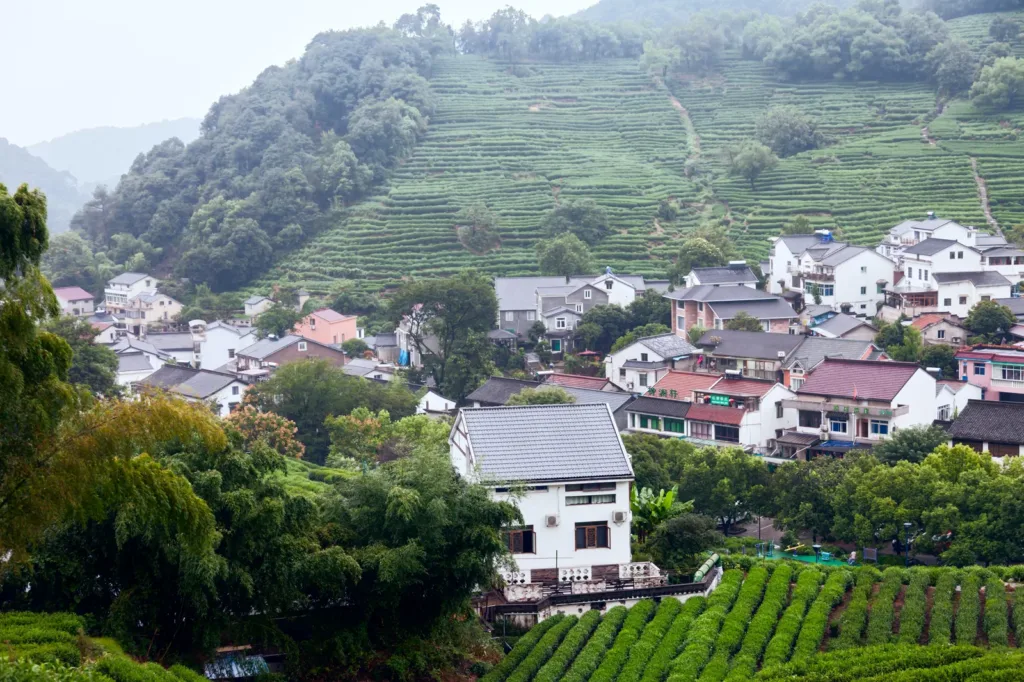
Longjing Tea Fields refers here to the cultivated hills around Longjing Village in Hangzhou’s Xihu District (西湖区), on the southwest side of West Lake—not to every tea plantation in the wider Dragon Well region, and not to the separate China National Tea Museum or its Longjing branch. Longjing Village is a living settlement within the West Lake scenic landscape. Its tea rows follow the contours of the hills, with houses and working tea gardens interwoven below the wooded ridges. The point of a visit is to read that relationship between cultivation, village life and landscape rather than to look for a single ticket gate. The wider West Lake landscape is recognized for how human-made and cultivated features merge with the surrounding hills.
Walk public village lanes and any signed, open paths that skirt the planted slopes. From the village, look for contour-following rows, changes in shade and elevation, and the way the tea gardens open toward wooded hill views. A simple visit can pair a lane walk with an authorized tea tasting. Do not enter planted rows, pick leaves, or cross farm boundaries unless a grower has explicitly invited you; these are working plots, not public lawns. Some farms arrange picking or hand-firing demonstrations, but these are private, seasonal experiences rather than guaranteed village services.
Tea in the cup
West Lake Longjing is a pan-fired green tea. Fresh leaves are heated in a wok to halt oxidation and lose moisture; skilled makers use coordinated hand movements to press and turn them into the familiar flat, narrow shape. The recognized craft includes ten named actions, among them shaking, pressing, grasping and polishing. Small differences in leaf maturity, picking date and firing practice affect the result, so no single flavor describes every batch.
A well-made cup may smell gently chestnut-like, fresh-green or softly floral, with a light, mellow body and a clean, sweet finish rather than the forceful bitterness of a heavily brewed tea. Harvest timing matters: the earliest spring leaves, often described as mingqian when picked before Qingming, are particularly prized, but the harvest window shifts with weather and is brief. Mid-to-late March into early April is a useful seasonal guide, not a promise that picking or demonstrations will be happening on a given day.
Getting there and visiting respectfully
There is no metro station at the village. Public buses are the practical last mile: current route listings show bus 27 and the 27 scheduled service at 龙井村 (Longjing Village), while bus 87 also serves the nearby 龙井茶室 (Longjing Tea House) stop. From 龙井村, start along public village lanes; from 龙井茶室, continue on foot toward the village and tea-growing slopes. Use the same route in reverse for the return journey, and check the live stop display or current transit app before setting out because route patterns and service can change.
For a taxi or ride-hail, enter 龙井村,杭州市西湖区龙井路沿线 Lóngjǐng Cūn, Hángzhōu Shì Xīhú Qū Lóngjǐng Lù yánxiàn as the destination. This is a village rather than a single attraction entrance; a designated lawful taxi drop-off point could not be confirmed, so ask the driver to use an allowed public roadside pull-off and never stop in a bus bay or block residents’ access. Do not assume a private tea garden, tasting room or hillside path is open just because the village road is accessible.
The best-known harvest activity is concentrated in spring, but the village remains a lived-in agricultural community through the year. Ask before photographing growers or residents, keep people and private homes out of close-up shots unless invited, and follow posted closures or farm instructions.
Combine your visit
A suggested sequence linking the specific features of this visit.
-
Longjing Village lanes
See how the tea-growing landscape connects with village life.
-
Lion Peak tea-field viewpoints
Observe the planted slopes from permitted paths.
-
Village teahouse
Compare the landscape with a prepared cup of the local tea, if a tasting is available.
This order is editorial. Confirm access and any transfers between stops; it does not establish a walking route, same-day connection or common admission ticket.
Find Longjing Tea Fields
龙井茶园 · 西湖区
The pin marks the area, not the entrance.
More places nearby
Approximate straight-line distances between map pins, not travel distances.
Longjing, Hangzhou 龙井村
Less than 1 km awayLongjing village gives its name to the tea grown on the hills southwest of West Lake. The village landscape brings together tea gardens, teahouses and the old Dragon Well, connecting a familiar drink with its place of…
View guide →China National Tea Museum 中国茶叶博物馆
2 km awayChina National Tea Museum connects tea leaves with the objects, trade and customs surrounding them. The Shuangfeng branch sits within the tea-growing landscape west of West Lake, with displays on tea history, varieties and…
View guide →Nine Creeks and Eighteen Gullies 九溪十八涧
2 km awayNine Creeks follows a valley between Longjing Village and Jiuxi Village, with streams crossing a landscape of tea fields and woodland. The attraction is the changing pattern of water, cultivated slopes and shaded paths rather…
View guide →Sources & visit information
Sources checked on 21 October 2026. Hours, tickets, reservations and transport can change; confirm with the operator before you go.
Image credits & notes (1)
- Tea rows rise behind the houses of Longjing Village in Hangzhou. Photo: Niklas DoughertyPhoto: CC BY-SA 4.0