

Explore the region
Tap any red Chinese text to hear it in Mandarin.
Why Wuzhen is worth a stop
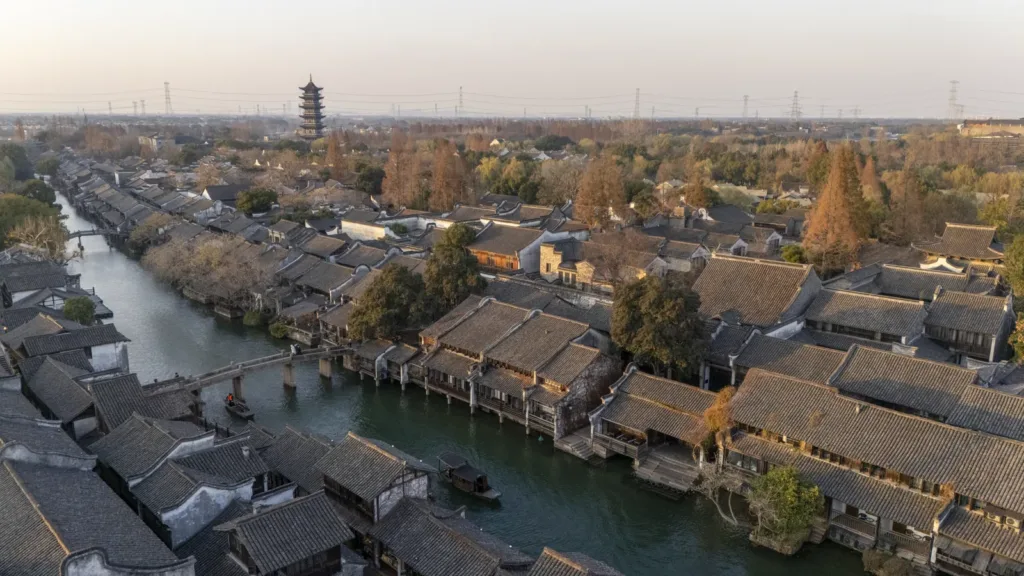
Wuzhen is a water town in northern Tongxiang, within Jiaxing. Its historic settlement grew around a cross-shaped network of waterways, traditionally described as four quarters—Dongzha, Xizha, Nanzha and Beizha. The two districts most visitors enter are not interchangeable gates to one small street: Dongzha is the compact, workshop-and-folk-life side, while Xizha is the larger, managed district built around long waterside streets, bridges, accommodation and evening lighting.
That contrast is the reason to visit rather than simply collect a canal photograph. In Dongzha, look closely at timber-fronted houses, waterside platforms, small museums and working-style craft displays. In Xizha, slow down beside the canals and bridges, then return after dusk if the district is open; the same white walls, dark roof edges and water-level passages read differently under the lighting. The operator describes Xizha’s old street as about 1.8 km long and its district as containing 72 historic stone bridges, but these are reasons to explore on foot, not a promise that every building or performance will be open on your date.
Mao Dun Former Residence (茅盾故居) gives the eastern district a literary anchor. The Wuzhen tourism site describes the Qing-period Jiangnan house as the former home of the writer Mao Dun, where he lived for 13 years, with rooms including a bedroom, study and reception room and a small planted garden. Read it as a domestic house within the old town, not as a separate town or a second Wuzhen entrance.
What to look for and taste
Start in Dongzha by comparing the street-facing shop fronts with the canal-side edges. Traditional craft and food displays, the blue-printing workshop, the Sanbai wine workshop, the wood-carving and bed museums, and Mao Dun’s former residence make this the better district for a compact, content-rich walk. Allow time to look inside courtyards and under eaves rather than rushing from one named stop to the next.
Use Xizha for a longer walk: follow the old street, cross several bridges, and keep changing your angle between the public bank, bridge openings and waterside houses. Xizha also has the more extensive visitor services and accommodation. A boat ride is an optional, separately charged way to see the same built edge from the water; the operator lists routes between the Andufang (游客服务中心) and Ruyi Bridge (如意桥) wharves, rather than a general free-form cruise.
For a local sweet, try Wuzhen sister-in-law cake (姑嫂饼). The town’s own account describes a small pressed cake made with fine wheat flour, sugar, sesame and pork fat, with both pepper-salt and white-sugar versions. That gives it a crisp, crumbly texture and a sweet-savoury range; ask about the batch’s ingredients if you avoid pork or have an allergy, rather than treating the name or appearance as a dietary guarantee.
Tickets and a practical visit
Choose Dongzha or Xizha before you leave for the town. The operator’s current ticket page lists Dongzha at CNY 110, Xizha at CNY 150 and a combined ticket at CNY 190. It states that tickets are normally valid for one use on the day of validity and that Dongzha uses separate checks for its smaller sights. A FAQ notes that guests staying in Xizha may be able to buy a two-day combined ticket under the accommodation arrangement; confirm the exact product when booking.
The operator’s travel guidance lists Dongzha as 07:00–18:00 in the May–September summer period and 07:00–17:30 from October to April; Xizha is listed as 09:00–22:00. Treat these as planning windows, not a guarantee of last entry or of every interior attraction. Check the date-specific notice before setting out, especially in October during festival or exhibition periods.
The two visitor centres are separate. Xizha’s centre handles the entrance, tickets, check-in, accommodation services and luggage transfer; Dongzha’s centre handles entrance, tickets and luggage storage. A taxi or ride-hailing driver should be given the Chinese destination 乌镇东栅景区游客服务中心 Wūzhèn Dōngzhà Jǐngqū Yóukè Fúwù Zhōngxīn or 乌镇西栅景区游客服务中心 Wūzhèn Xīzhà Jǐngqū Yóukè Fúwù Zhōngxīn, not just “Wuzhen”.
If you want both districts, the operator’s free shuttle links their visitor centres. The published town-transport page lists about one bus every 20 minutes, 09:00–17:00 in May–September and 09:00–16:30 from October to April; holidays follow the on-site situation. Do not rely on the shuttle for a late return.
Getting there and back
The most useful rail connection is Tongxiang Railway Station (桐乡高铁站), not a railway stop at the scenic area. From the station, the operator lists K281 and K282 to Wuzhen Bus Station (乌镇汽车站). Its published schedules give K282 as approximately 06:00–17:05 and K281 as approximately 06:15–17:40, with intervals varying by route; the same operator warns that actual departures prevail. From Wuzhen Bus Station, use K350 toward the scenic area and identify the district by its visitor-centre name.
For the daytime last mile, the operator lists K350 between Xizha and Wuzhen Bus Station, with Dongzha shown on the stop list as “Dongzha Scenic Area (Ziye Hotel)” and Xizha as “Xizha Scenic Area”. It also lists Night 010 on the same corridor from 18:00 to 22:00. For a return to Tongxiang Railway Station after the daytime K281/K282 window, the operator lists Night 009 from Xizha at 18:40 and 20:00, and Night 006 at 19:30 and 20:30. These are useful route names, not guaranteed same-day departures: recheck before leaving the district.
There is no need to invent an airport transfer or a fixed taxi fare here. If arriving by air, first confirm the current airport-to-Tongxiang or airport-to-Wuzhen service, then use the named visitor centre as the final destination. Within the old town, stay on managed public paths and docks; do not enter closed buildings, private residences or unmarked water edges.
Combine your visit
A suggested sequence linking the specific features of this visit.
-
Dongzha streets and workshops
Begin with the smaller eastern canal district.
-
Xizha old street
Continue separately to compare the longer western streetscape.
-
Xizha canal bridges
Look back at the waterside houses from the crossings and public banks.
This order is editorial. Confirm access and any transfers between stops; it does not establish a walking route, same-day connection or common admission ticket.
Find Wuzhen
乌镇 · 嘉兴市
The pin marks the area, not the entrance.
More places nearby
Approximate straight-line distances between map pins, not travel distances.
Nanxun 南浔
15 km awayNanxun’s canal-side homes, gardens and library reflect the wealth generated by the silk trade. Xiaolian Manor and Jiaye Library offer two different expressions of that prosperity, while the Baijian waterside houses show a…
View guide →Majiabang Culture Museum 马家浜文化博物馆
21 km awayThe Majiabang Culture Museum explains a Neolithic community through finds from the nearby site and its place within the Taihu region. Pottery, stone, jade and bone objects recovered during excavation accompany evidence of houses…
View guide →Citadel of Jiaxing 嘉兴子城遗址
25 km awayJiaxing’s Zicheng marks the fortified administrative core of the old city. Its surviving gate, drum tower and flanking wall preserve a fragment of a much larger compound; the present gate structure dates from rebuilding in 1908…
View guide →Sources & visit information
Sources checked on 24 October 2026. Hours, tickets, reservations and transport can change; confirm with the operator before you go.
- Wuzhen Overview ↗
- Wuzhen Scenic Area Traffic Information ↗
- Ticket Policy ↗
- Scenic Area Transportation ↗
- Township Transportation ↗
- Wuzhen Tourism FAQ ↗
- Classical and Fashionable Wuzhen ↗
- Wuzhen Sister-in-Law Cakes ↗
- Xizha Visitor Service Center ↗
- Dongzha Visitor Service Center ↗
- Course 3: Wuzhen's East, West, South and North Zha ↗
Image credits & notes (1)
- Aerial view of Wuzhen's canal-side historic town, Tongxiang, Jiaxing, Zhejiang (photographed 28 October 2023). Photo: ChensiyuanPhoto: CC BY-SA 4.0